Serving The Jacksonville Area


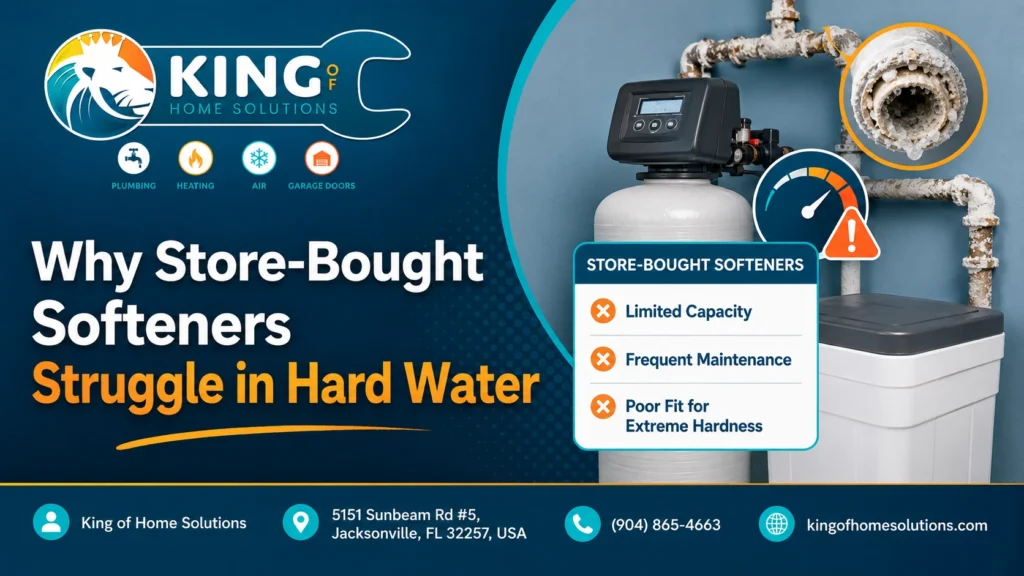
Problems With “Off-the-Shelf” Water Softeners in High-Hardness Areas
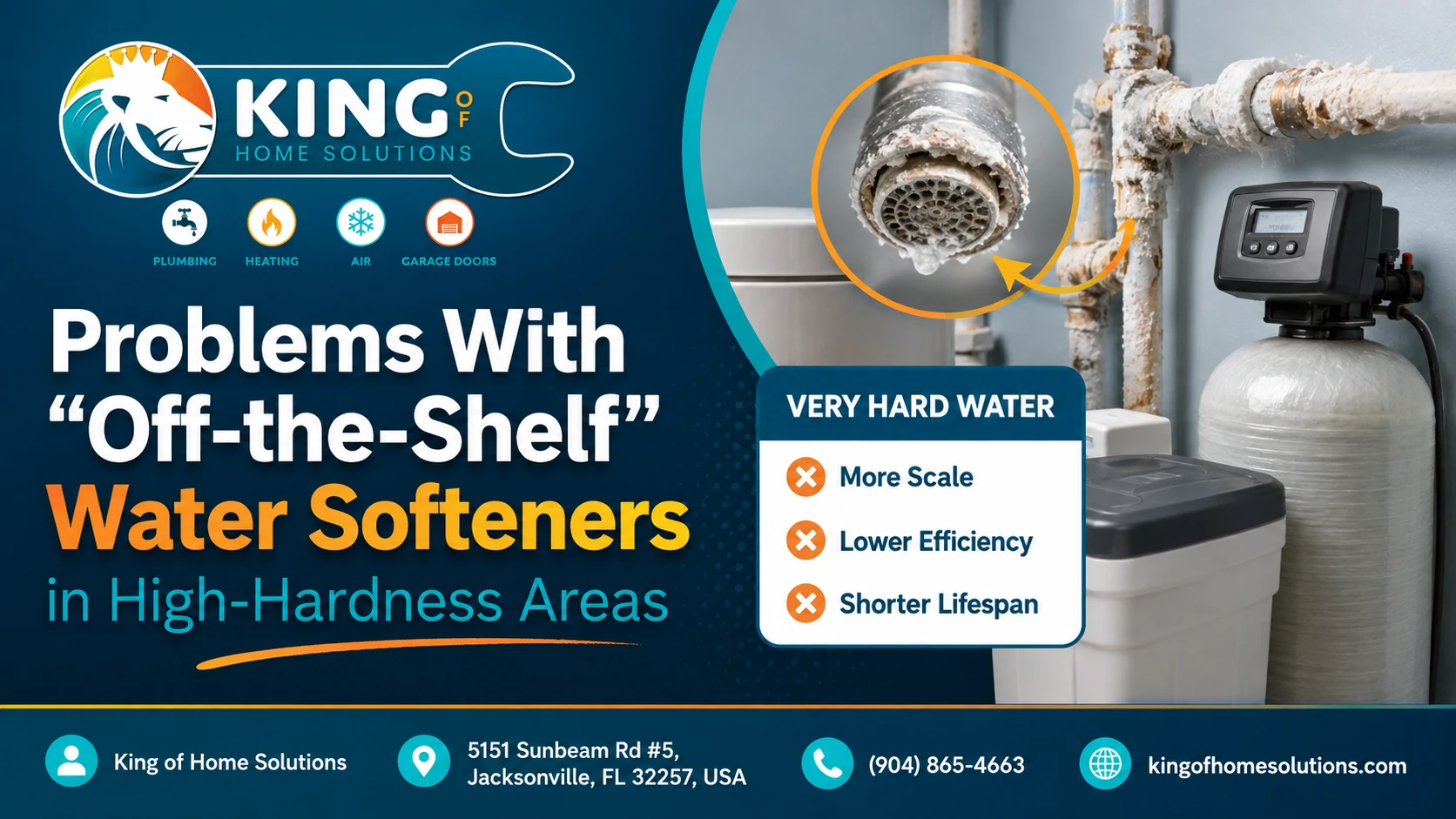
Problems With “Off-the-Shelf” Water Softeners in High-Hardness Areas
The water softener at a big-box store may look like an easy solution.
The box promises softer water, fewer spots, cleaner fixtures, and protection from scale. The unit fits within your budget, and the installation instructions make the project appear straightforward.
Then, a few months later, the problems begin.
The salt disappears faster than expected. The water feels hard again before the next regeneration. White scale returns to faucets and shower doors. Water pressure drops when several fixtures are running. The softener regenerates constantly or fails to keep up at all.
The problem is not necessarily that every off-the-shelf water softener is poorly made. It is that high-hardness water demands accurate testing, sizing, programming, and installation.
A softener selected mainly by price or a capacity number printed on the box may be too small, inefficient, incorrectly configured, or unsuitable for the home’s complete water chemistry.
Hard Water Causing Problems?
Get a professional water-softening solution built for high-hardness water. Call today for reliable service.
What Is Considered High-Hardness Water?
Water hardness is primarily caused by dissolved calcium and magnesium. These minerals are not usually considered a health concern, but they can create scale, soap residue, cloudy glassware, stiff laundry, and buildup inside plumbing fixtures and water-using appliances.
Water hardness is commonly measured in either:
- Milligrams per liter as calcium carbonate
- Parts per million
- Grains per gallon
One grain per gallon is approximately equal to 17.1 milligrams per liter.
The U.S. Geological Survey classifies water as:
- Soft: 0–60 mg/L
- Moderately hard: 61–120 mg/L
- Hard: 121–180 mg/L
- Very hard: More than 180 mg/L
Water above 180 mg/L is roughly equivalent to more than 10.5 grains per gallon.
In practice, homes with hardness readings well above that level place much greater demand on a residential softener. A household receiving water at 18, 25, or 30 grains per gallon will exhaust a resin bed much faster than a home with 6 or 8 grains per gallon.
How a Water Softener Works
Most conventional residential water softeners use cation-exchange resin.
As hard water passes through the resin tank, calcium and magnesium ions are exchanged for sodium or potassium ions. Once the resin has captured its usable amount of hardness minerals, the softener must regenerate with a salt solution. That process restores the resin so it can continue treating incoming water.
A properly selected system should provide enough softened water between regenerations without wasting excessive salt or rinse water.
That balance becomes difficult when a unit is undersized, programmed with an inaccurate hardness number, or forced to treat iron and other water-quality problems it was not designed to handle.
Problem 1: The Advertised Capacity Can Be Misleading
Off-the-shelf softeners are often marketed by a prominent capacity number, such as:
- 32,000 grains
- 40,000 grains
- 48,000 grains
- 64,000 grains
Homeowners may assume this is the amount of hardness the softener will efficiently remove between regenerations.
That is not always the case.
The highest advertised capacity may require a large salt dose during each regeneration. A unit marketed as a “40,000-grain” softener may provide considerably less usable capacity when programmed for more efficient salt consumption.
In other words, the biggest number on the box may describe a maximum laboratory setting, not the most economical everyday operating point.
This matters in very hard water because the household may consume the practical working capacity quickly. The system then regenerates more frequently, using more salt and water than the buyer expected.
When comparing equipment, homeowners should ask for:
- Capacity at each salt setting
- Salt efficiency in grains removed per pound of salt
- Regeneration-water consumption
- Recommended reserve capacity
- Maximum service flow rate
NSF/ANSI 44 establishes minimum requirements for residential cation-exchange softeners, including materials, structural integrity, and performance claims. NSF certification can also verify published hardness-reduction capacity when that claim is included in the listing.
Problem 2: The Unit May Be Too Small for the Household
Proper softener sizing depends on more than the number of bathrooms.
A useful estimate considers:
- Actual water hardness
- Number of occupants
- Average daily water consumption
- Iron and manganese levels
- Desired regeneration frequency
- Peak household flow rate
- Usable resin capacity
Consider a family of four using 60 gallons per person each day:
4 people × 60 gallons = 240 gallons per day
If the water measures 20 grains per gallon:
240 gallons × 20 grains = 4,800 grains of hardness per day
Over seven days, the softener would need approximately:
4,800 × 7 = 33,600 grains
That calculation does not yet include reserve capacity or compensation for dissolved iron.
A small cabinet-style softener marketed at 32,000 grains may therefore regenerate more often than expected or allow hard water through before the regeneration cycle begins.
Frequent regeneration is not simply inconvenient. It increases salt use, water use, valve wear, and the likelihood that the system will regenerate at an inconvenient time.
Problem 3: High Peak Flow Can Overwhelm the Softener
A softener must do more than provide enough total capacity. It must also handle the amount of water being used at one time.
Peak demand can be high when:
- Two showers are running
- A washing machine is filling
- A dishwasher is operating
- A bathtub is being filled
- An outdoor fixture is accidentally connected through the softener
Compact store-bought systems often contain smaller resin tanks and valves. They may treat ordinary low-flow use adequately but struggle during simultaneous demand.
When water moves through the resin bed too quickly, hardness removal can become less effective. Homeowners may notice:
- Hard water during morning showers
- Scale in heavily used bathrooms
- Inconsistent water feel
- Reduced pressure
- Hardness breakthrough during appliance use
The correct system needs a service flow rate appropriate for the home, not merely enough theoretical grain capacity.
Problem 4: Factory Settings Rarely Match the Home’s Water
An off-the-shelf softener cannot arrive correctly programmed for every house.
The installer must enter or verify settings such as:
- Water hardness
- Household size or reserve
- Regeneration time
- Salt dose
- Capacity
- Meter configuration
- Recharge frequency
If the hardness setting is too low, the system may run out of capacity and send hard water into the home.
If the setting is too high, it may regenerate more frequently than necessary and waste salt and water.
Guessing based on a regional average is not ideal. Water hardness can vary by utility source, neighborhood, seasonal conditions, private-well characteristics, and changes in treatment or blending.
A water test should be completed before the softener is selected and programmed. Water-treatment design guidance from the Water Quality Association emphasizes collecting and analyzing water-supply data before choosing and configuring treatment equipment.
Problem 5: Iron Can Consume Capacity and Foul the Resin
Well-water households often assume a softener will solve both hardness and iron problems.
A conventional softener may remove limited amounts of dissolved ferrous iron, but iron increases the treatment load and may foul the resin or internal components if the system is not maintained correctly.
A common sizing approach adds several grains of compensated hardness for each part per million of iron. The exact compensation depends on the equipment, resin, iron form, and water conditions.
That means water testing at 20 grains per gallon with measurable iron should not necessarily be programmed as only 20 grains.
Iron may also be present in a form that is poorly suited to removal by a standard softener, such as:
- Oxidized iron particles
- Iron bacteria
- Organic-bound iron
- Sediment containing iron
In those cases, pretreatment may be needed.
A softener should not be expected to replace a complete water-treatment system. WQA guidance notes that residential treatment design must account for the full water analysis and may require filtration, oxidation, chemical treatment, or other processes in addition to softening.
Problem 6: Sediment Can Damage the Control Valve
Water containing sand, rust particles, pipe scale, or suspended sediment can interfere with a softener’s valve, seals, injector, screens, and flow meter.
Possible symptoms include:
- Incomplete regeneration
- Water continuously flowing to the drain
- A brine tank that does not refill correctly
- A system that fails to draw brine
- Inaccurate water-use readings
- Pressure loss
- Hard water after regeneration
A sediment prefilter may be appropriate in some homes, particularly those on private wells or older plumbing systems.
However, the prefilter must also be sized correctly. A restrictive cartridge can create its own pressure problem when it becomes dirty.
Problem 7: Chlorine May Shorten Resin Life
Municipal water is commonly disinfected before reaching the home.
Depending on the disinfectant concentration, water temperature, resin quality, and operating conditions, long-term exposure to oxidants can contribute to resin degradation.
As resin deteriorates, it may lose capacity or create pressure-related problems.
Some homeowners choose pretreatment to reduce chlorine or chloramine before the softener, but that decision should be based on testing and equipment compatibility. A carbon system adds its own maintenance requirements and must be sized for the home’s flow rate.
Adding equipment without a coordinated design can create a collection of components that do not work well together.
Problem 8: The System May Regenerate Too Often
A softener that is too small for high-hardness water may recharge every few days or even more frequently in a large household.
Each regeneration consumes:
- Salt
- Water
- Electricity
- Drain capacity
- Valve operating cycles
The EPA notes that cation-exchange softeners use water during regeneration and that inefficient systems may regenerate more frequently than necessary. EPA guidance recommends selecting a correctly sized, demand-initiated system rather than relying on frequent fixed-schedule regeneration.
NSF/ANSI 44 includes a voluntary water-efficiency rating under which qualifying softeners use no more than 5 gallons of regeneration water per 1,000 grains of hardness removed.
A homeowner comparing systems should therefore look beyond purchase price and ask:
- How many gallons does one regeneration use?
- How often will the system regenerate in this home?
- How many pounds of salt will it consume per month?
- Is the unit demand-initiated or timer-based?
- Does it have verified efficiency data?
Problem 9: The Cabinet Design Can Limit Repairability
Many retail softeners place the resin tank, brine storage, and control components inside one compact cabinet.
This design can be convenient in a small space, but it may also make service more difficult.
Possible drawbacks include:
- Limited access to internal parts
- Smaller brine storage
- Difficult resin replacement
- Proprietary components
- Entire-unit replacement when one major component fails
- Restricted options for upgrading the valve or tank
A separate resin tank and brine tank generally occupy more space, but they may provide greater flexibility for sizing, maintenance, and future repairs.
That does not mean every cabinet softener is disposable. It means homeowners should investigate parts availability and service support before purchasing.
Problem 10: Warranty Coverage May Depend on DIY Installation Details
A homeowner-installed softener may work correctly, but installation errors can create leaks, drainage problems, code violations, or premature equipment failure.
Common mistakes include:
- Reversing the inlet and outlet
- Installing an undersized bypass
- Connecting the drain incorrectly
- Omitting an approved air gap
- Using a drain line that is too small or too long
- Connecting the outdoor irrigation system through the softener
- Failing to bond metallic plumbing when required
- Installing the system where freezing or flooding is possible
- Programming the wrong hardness or capacity
- Failing to sanitize the equipment at startup
Warranty terms may exclude damage linked to improper installation, poor water conditions, freezing, excessive pressure, sediment, or use outside the manufacturer’s specifications.
Before purchasing, read both the product warranty and installation manual, not only the marketing summary.
Problem 11: A Softener Does Not Remove Every Water Contaminant
Softening addresses calcium and magnesium hardness. Depending on the system and certification, it may also reduce limited amounts of certain positively charged substances.
It should not automatically be assumed to remove:
- Bacteria
- Viruses
- PFAS
- Pesticides
- Nitrates
- Sulfur odor
- Chlorine
- Sediment
- Most dissolved organic chemicals
- Total dissolved solids
The EPA describes cation exchange as a technology for removing hardness ions and certain other positively charged contaminants. Other contaminants require different treatment methods.
A homeowner may purchase a softener expecting “purified water” and later discover that hardness was only one part of the problem.
Treatment should be selected according to a laboratory or otherwise reliable water analysis and the specific contaminants the homeowner wants to address.
Problem 12: Softened Water May Add Sodium
Standard ion-exchange softeners replace calcium and magnesium with sodium ions when sodium chloride is used for regeneration. Potassium chloride may be an alternative with compatible equipment, although it usually costs more and may affect system efficiency or programming.
The amount of sodium added depends on the hardness removed.
This does not automatically make softened water unsafe, but people following medically prescribed sodium restrictions should discuss their drinking-water setup with a healthcare professional.
Some homes keep the kitchen cold-water tap or an outdoor drinking-water line unsoftened. Others install a properly selected reverse-osmosis drinking-water system at one sink.
The plumbing arrangement should be planned before installation rather than improvised afterward.
Warning Signs That a Store-Bought Softener Is Undersized
A softener may be struggling when:
- Hardness returns before regeneration
- The system recharges every few days
- Salt consumption is unexpectedly high
- The brine tank frequently empties
- Scale continues forming
- Soap performance changes throughout the week
- Water pressure falls during peak use
- The unit cannot keep up with guests
- Hardness is detected immediately after regeneration
- Appliances still show heavy mineral buildup
Some of these symptoms can also result from a clogged injector, salt bridge, failed seal, incorrect programming, resin damage, or bypass-valve problem.
Testing the water before and after the unit can help separate a capacity issue from a mechanical failure.

Top 5 Plumbing Fixtures for a Modern Coastal Bathroom
“Modern coastal” is one of those design styles that looks effortless when it is done well and themed when it…
Read The BlogHow a Water Softener Should Be Sized
A proper recommendation should begin with water testing.
At minimum, evaluate:
- Hardness
- Iron
- Manganese
- pH
- Total dissolved solids
- Chlorine or chloramine
- Sediment
- Sulfur-related conditions when relevant
- Bacterial safety for private wells
The technician or homeowner can then estimate daily hardness load:
Daily water use compensated hardness daily grain requirement
The system should provide enough practical capacity to operate efficiently between regenerations while maintaining adequate reserve.
It should also meet the home’s peak service flow rate.
The goal is not simply to buy the largest unit available. Oversizing can also be inefficient when the softener goes too long between regenerations or uses settings inappropriate for the actual demand.
What to Look for Instead
A high-hardness home may benefit from a softener with:
- Verified NSF/ANSI 44 certification
- Demand-initiated regeneration
- Published capacity at multiple salt doses
- Adequate resin volume
- A suitable continuous and peak flow rate
- Accessible, replaceable components
- Locally available service parts
- Settings based on tested water chemistry
- A properly sized brine tank
- Clear salt- and water-efficiency data
- Pretreatment when sediment, iron, or other conditions require it
EPA guidance recommends choosing a certified, correctly sized, water-efficient system and configuring it according to actual hardness and household water use.
Certification does not guarantee that a particular model is correctly sized for your home. It verifies specified product requirements or performance claims. Selection and setup still matter.
Are Off-the-Shelf Water Softeners Always a Bad Purchase?
No.
A retail softener may work adequately when:
- Water hardness is moderate
- Iron and sediment are minimal
- The household is small
- Peak water demand is low
- The unit is properly sized
- Installation follows the manufacturer’s requirements
- Replacement parts and service are available
- The homeowner monitors salt and performance
The risk increases when the home has very hard water, a large family, high simultaneous demand, private-well complications, or multiple water-quality issues.
In those situations, buying the least expensive unit first can result in higher long-term costs through salt use, water waste, repairs, scale damage, and early replacement.
Questions to Ask Before Buying
Before choosing any water softener, ask:
- What is the tested hardness in grains per gallon?
- Is iron or manganese present?
- What is the household’s estimated daily water consumption?
- What is the system’s usable capacity at an efficient salt setting?
- How often should it regenerate in this home?
- How much salt will each regeneration use?
- How much water will each regeneration discharge?
- What is the continuous service flow rate?
- Is hardness-reduction capacity independently certified?
- Are repair parts available locally?
- Does the water require sediment or iron pretreatment?
- Who will program and verify the unit after installation?
A seller who cannot answer those questions may be selling a box rather than designing a solution.
The Bottom Line
The main problem with an off-the-shelf water softener is not where it is sold.
The problem is selecting equipment without fully understanding the water it must treat.
In a high-hardness area, an undersized or incorrectly programmed softener may:
- Regenerate too frequently
- Consume excessive salt
- Waste water
- Reduce household flow
- Allow hardness breakthrough
- Wear out prematurely
- Fail to treat iron or sediment
- Provide inconsistent results
Start with a water test. Calculate the household’s hardness load. Confirm the required flow rate. Compare practical capacity not just the largest number printed on the carton.
A correctly sized retail unit may perform well. An incorrectly sized one can become an expensive salt-consuming appliance that never delivers consistently soft water.
Upgrade Your Water Softener Today
Skip off-the-shelf systems that fall short. Call now for a solution designed for your home’s water.