Serving The Jacksonville Area


Why North Florida Homes Are Switching to Heat Pumps in 2026
Why North Florida Homes Are Switching to Heat Pumps in 2026
Your Jacksonville air conditioner is 14 years old.
The technician gives you the bad news: the compressor is failing, the system uses older technology, and putting several thousand dollars into another major repair probably doesn’t make sense.
Then comes the replacement question:
“Do you want another straight-cool AC or should we install a heat pump?”
For more North Florida homeowners in 2026, the answer was increasingly heat pump.
But there is an important misconception to clear up first.
Heat pumps were not suddenly introduced to Florida in 2026.
They have been common throughout the Southeast for decades. Historical EIA data show that electricity overwhelmingly dominates Florida residential heating, with electric furnaces and heat pumps accounting for most heating equipment in homes that use heat.
What changed was the equipment.
Modern variable-speed compressors became better.
Federal and utility incentives made high-efficiency replacements more attractive.
And homeowners increasingly realized that in a climate like Jacksonville’s, buying a separate air conditioner and relying on inefficient resistance heat doesn’t always make much sense.
Here’s why.
Reason #1: North Florida Is Almost the Ideal Heat-Pump Climate
A heat pump is basically an air conditioner that can run in reverse.
During summer, it removes heat from your house and sends it outside.
During winter, a reversing valve changes the refrigerant flow and the system extracts heat from outdoor air and moves it indoors.
That sounds strange when the air outside feels cold.
But outdoor air still contains usable heat energy well below typical Jacksonville winter temperatures.
ENERGY STAR notes that air-source heat pumps can deliver up to three times as much heat energy as the electrical energy they consume because they move heat rather than creating it directly with electric resistance elements.
And North Florida doesn’t normally spend months at subzero temperatures.
Jacksonville sits in a hot-humid climate region, where cooling dominates HVAC operation for much of the year.
That means a heat pump spends most of its life doing what a normal central AC already does.
Then when December or January arrives, the same outdoor unit handles heating.
For North Florida, that’s a very natural match.
Reason #2: You’re Already Buying an Air Conditioner Anyway
This is the part many homeowners overlook.
If you lived in a climate where air conditioning was optional, adding a heat pump would represent an entirely different system.
Not in Jacksonville.
You already need central cooling.
So when your AC reaches the end of its life, the real comparison may be:
Straight-cool AC + electric resistance heat
versus
Heat-pump AC + heat-pump heating + auxiliary backup heat
The heat pump simply adds the ability to reverse the refrigeration cycle.
That can make the additional cost over a comparable straight-cool system much easier to justify than installing a completely separate heating technology.
This is one reason heat-pump adoption has historically been strongest in the South. Census-based 2026 housing data show the South Atlantic was by far the nation’s largest heat-pump region, accounting for nearly 60% of heat pumps installed in new single-family construction that year.
Florida isn’t joining a Northern heat-pump experiment.
The Southeast has been heat-pump territory for a long time.
Reason #3: Modern Inverter Heat Pumps Changed the Comfort Equation
Older single-stage heat pumps were pretty simple.
On.
Off.
Full capacity.
Off again.
Modern inverter-driven and variable-capacity heat pumps can operate very differently.
Instead of constantly jumping between zero and 100%, the compressor can reduce its output when the house needs only a little cooling or heating.
That is particularly valuable in Jacksonville.
Why?
Humidity.
During a humid Florida afternoon, comfort is not just about getting the thermostat from 77°F to 74°F.
The AC also has to remove moisture.
An oversized fixed-capacity unit may cool the house quickly, shut off and leave the indoor humidity higher than you would like.
DOE research in hot-humid Climate Zone 2A specifically points to oversizing and moisture-control challenges in modern low-load homes and has studied variable-capacity heat pumps as a way to improve operation in those conditions.
A properly sized variable-capacity heat pump can run longer at lower output.
That can mean:
More consistent temperatures.
Longer dehumidification cycles.
Less dramatic on/off noise.
Fewer hot and cold spots.
For many Jacksonville homeowners, that comfort improvement is a stronger reason to upgrade than the heating efficiency alone.
Reason #4: The 2026 Incentives Helped
Money mattered too.
During 2026, qualifying high-efficiency heat pumps could potentially qualify for a federal Energy Efficient Home Improvement Credit worth 30% of eligible project costs, up to $2,000 for qualifying heat-pump equipment, subject to the applicable rules and equipment requirements. ENERGY STAR documented those qualification standards for systems installed during that period.
JEA customers had another incentive.
JEA’s residential efficiency program in 2026 included rebates of up to $200 for qualifying heating and cooling systems, including heat pumps. The program required eligible efficiency levels and appropriate equipment certification.
A $200 utility rebate isn’t going to transform the economics of a $10,000 HVAC replacement by itself.
But combined with federal incentives then available, increasing electricity costs and the fact that homeowners already needed a new AC, high-efficiency heat pumps became easier to consider.
The important word is qualifying.
Not every heat pump met every incentive requirement.
Homeowners needed the exact model numbers and AHRI efficiency certification—not merely a proposal that said “high efficiency.”
Reason #5: Electric Resistance Heat Is Expensive to Run
Many Florida air handlers contain electric resistance heat strips.
Think of them as very large versions of the heating element inside an electric toaster.
Electricity passes through resistance elements.
They get hot.
Air passes across them.
They work.
But they create heat directly from electricity instead of moving existing heat from outdoors.
A heat pump can therefore provide substantially more heating for each unit of electricity consumed under favorable conditions. ENERGY STAR notes that efficient heat pumps can provide as much as roughly three units of heat for each unit of electricity used.
That doesn’t mean the heat strips disappear.
Many North Florida heat-pump systems still include auxiliary electric heat for very cold conditions, defrost operation or unusually large heating demands.
The goal is simply not to run those expensive strips every time the thermostat asks for heat.
But What Happens During a Jacksonville Freeze?
This is where old heat-pump advice can be misleading.
You may have heard:
“Heat pumps don’t work when it gets cold.”
Modern equipment is considerably better than that.
ENERGY STAR’s current cold-climate certification criteria evaluate heat-pump performance all the way down to 5°F, and qualifying cold-climate units must retain meaningful heating capacity at those temperatures.
Jacksonville homeowners don’t necessarily need an expensive cold-climate model designed for Minnesota.
But modern compressor technology means a properly selected heat pump can handle typical North Florida winters very effectively.
During an unusually cold morning, the system may use auxiliary heat.
That’s normal.
What you don’t want is improperly configured auxiliary heat strips running unnecessarily every time the outdoor temperature falls below 50°F.
That can destroy much of the efficiency advantage.
A Heat Pump Is Not Automatically Cheaper to Operate
Here’s where the sales pitch needs some restraint.
Simply installing something labeled “heat pump” does not guarantee low electric bills.
A badly sized heat pump can still perform poorly.
So can:
Leaky ducts.
Low airflow.
Dirty coils.
Incorrect refrigerant charge.
Poor attic insulation.
An improperly configured thermostat.
Oversized electric heat strips.
ENERGY STAR specifically recommends that contractors perform a proper Manual J load calculation when sizing heat-pump equipment.
In Jacksonville, I would put this near the top of the buying checklist.
If the salesperson says:
“Your old unit was four tons, so we’re installing another four-ton unit,”
that isn’t a load calculation.
Homes change.
Windows get replaced.
Insulation gets added.
Duct systems change.
A replacement is an opportunity to verify what capacity the house actually needs.
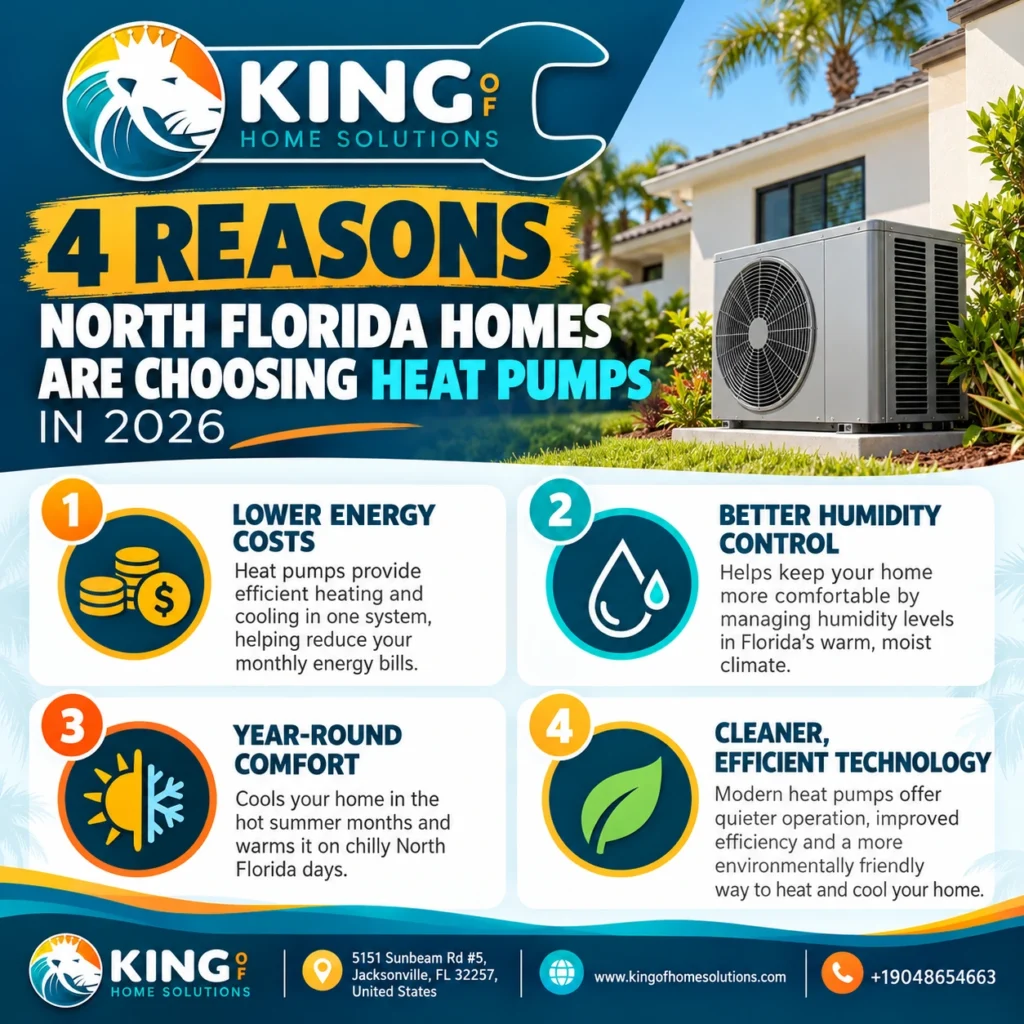
Heat Pump vs. Gas Furnace Is a Different Conversation
If your Jacksonville home already has natural gas and a relatively efficient furnace, switching entirely to an electric heat pump is not automatically the obvious financial winner.
Fuel costs matter.
The condition of the furnace matters.
Electrical infrastructure matters.
Some homeowners may prefer a dual-fuel system: a heat pump handles cooling and mild-weather heating, while the gas furnace takes over when conditions make it preferable.
ENERGY STAR specifically recognizes dual-fuel heat-pump systems as an option for homes with existing furnaces.
But for the many North Florida houses already relying primarily on electricity, the heat-pump decision is much simpler.
What I Would Buy for a Jacksonville Home
If I were replacing an aging all-electric HVAC system, I would usually compare three levels:
A single-stage heat pump for lowest upfront cost.
A two-stage heat pump for better comfort without going fully premium.
And a variable-capacity inverter heat pump for the best temperature stability, humidity control and quiet operation.
For a Jacksonville homeowner who expects to remain in the house for years, I would look particularly hard at the second and third options.
Not because the highest SEER2 number automatically pays for itself.
But because Florida homeowners spend thousands of hours each year in cooling mode.
Better low-load performance and moisture control affect comfort almost every day.
The Bottom Line
North Florida’s 2026 heat-pump trend wasn’t really about discovering a new heating technology.
It was about better versions of a technology already perfectly suited to the region.
Jacksonville has long cooling seasons.
Relatively mild winters.
Predominantly electric homes.
High humidity.
And occasional cold snaps rather than months of extreme cold.
That is almost exactly the operating environment where a good air-source heat pump makes sense.
The biggest improvements came from variable-speed compressors, better low-temperature performance, higher efficiency requirements and in 2026 financial incentives that lowered the effective upgrade cost.
So if your old Jacksonville AC was already due for replacement, the question in 2026 increasingly became:
Why buy a machine that can only cool when nearly the same refrigeration system can efficiently heat the house too?
Just don’t stop at the words “heat pump.”
Get the system properly sized.
Pay attention to humidity performance.
Understand how the auxiliary heat is configured.
Check the exact efficiency ratings.
And remember that in North Florida, the best heat pump isn’t necessarily the one with the biggest capacity or highest price.
It’s the one that can run gently through a humid August, efficiently through a cool January morning, and keep the house comfortable during everything Jacksonville throws at it in between.
Recent News
Why North Florida Homes Are Switching to Heat Pumps in 2026
Top 5 Garage Door “Curb Appeal” Trends in Jacksonville: 2024 Edition

Braided Stainless Steel vs. Rubber Supply Lines: Is the “Flood Guard” Worth It?

5 Plumbing Upgrades That Can Increase a Jacksonville Home’s Resale Value