Serving The Jacksonville Area


The “Ghost Flush”: Why Your Toilet Is Running and Wasting Jacksonville Water
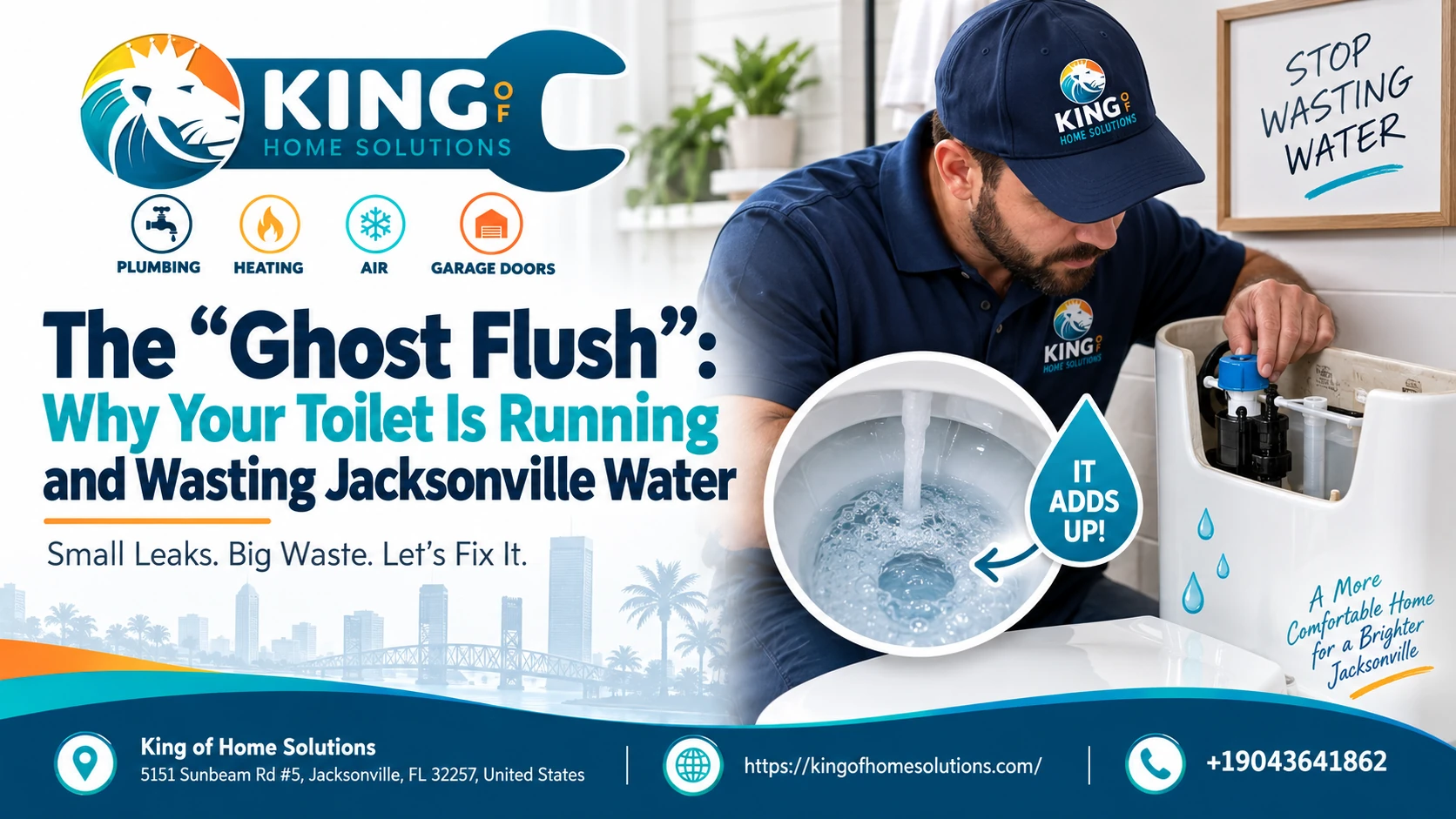
The “Ghost Flush”: Why Your Toilet Is Running and Wasting Jacksonville Water
You are sitting in a quiet house when the toilet suddenly refills.
Nobody touched the handle. Nobody used the bathroom. Yet the tank makes the same familiar sound it makes after a flush.
That is commonly called a ghost flush.
There is nothing mysterious happening. Water is slowly leaking from the toilet tank into the bowl. Once the tank level drops far enough, the fill valve turns on automatically and replaces the lost water.
The cycle may happen every few minutes or only a few times per day. Either way, water is moving through the meter and JEA is billing you for it.
A toilet that appears to be only mildly annoying can waste thousands of gallons per year.
What Causes a Toilet to Flush by Itself?
A standard tank-style toilet stores water until the handle is pressed. The flapper or flush-valve seal keeps that water inside the tank.
When the seal no longer closes properly, water slips into the bowl. The tank’s water level gradually falls, causing the fill valve to activate.
You hear the toilet refill even though it was never flushed.
The most common causes include:
- A worn or warped flapper
- Mineral buildup around the flush-valve opening
- A flapper chain that is too tight
- A chain caught beneath the flapper
- A damaged flush-valve seal
- A cracked overflow tube
- An incorrectly adjusted fill valve
- Water set too high inside the tank
The EPA identifies old or worn toilet flappers and malfunctioning fill valves as common sources of household water leaks. It also notes that a deteriorated flapper can make a toilet flush on its own or leak silently.
Why the Flapper Is Usually the First Suspect
The flapper is the rubber or silicone component covering the opening at the bottom of the tank.
When you press the handle, the chain lifts the flapper and releases water into the bowl. The flapper then drops back into place and creates a watertight seal.
Over time, the flapper can:
- Harden
- Warp
- Crack
- Become coated with mineral deposits
- Lose its ability to sit flat
- Separate from its mounting tabs
Jacksonville-area water conditions, toilet-cleaning chemicals, age, and ordinary wear can all shorten the life of the seal.
The EPA recommends checking flappers periodically and says replacing an old one is often a quick, inexpensive way to stop a toilet leak.
How Much Water Can a Ghost Flush Waste?
The amount depends on how quickly water is leaking from the tank.
A toilet that refills once every several hours may waste a relatively modest amount. A badly deteriorated flapper or stuck fill valve can waste far more.
Here are three illustrative examples:
| Estimated toilet leak | Water wasted annually |
| 50 gallons per day | 18,250 gallons |
| 100 gallons per day | 36,500 gallons |
| 200 gallons per day | 73,000 gallons |
A severe fill-valve failure can waste substantially more. EPA guidance published in 2026 notes that a stuck toilet fill valve may waste thousands of gallons in a single day.
Even a smaller leak should not be ignored. Because it continues 24 hours a day, the total can build quickly.
What Could That Add to a JEA Bill?
As of July 2026, JEA’s residential water rates range from $1.34 to $6.45 per 1,000 gallons, depending on monthly usage. Residential sewer usage is billed at $5.17 per 1,000 gallons.
Duval County customers also pay a 3% franchise fee on water and sewer service and a 10% public service tax on water. These published rates remain effective through September 30, 2026; JEA has approved additional rate adjustments beginning October 1, 2026.
For a home connected to both JEA water and sewer, each additional 1,000 gallons currently costs approximately:
- $6.84 in the lowest water tier
- $8.70 in the second tier
- $11.12 in the third tier
- $12.61 in the highest tier
Those figures include usage-related Duval County taxes and fees but exclude fixed monthly charges, which a toilet repair will not eliminate.
Estimated annual cost of a ghost flush
| Leak rate | Lowest-tier cost | Third-tier cost |
| 50 gallons per day | About $125 per year | About $203 per year |
| 100 gallons per day | About $250 per year | About $406 per year |
| 200 gallons per day | About $499 per year | About $812 per year |
These examples assume the leaked water is billed for both JEA water and sewer service. A property using a septic system would avoid the sewer portion, so its financial loss would be lower.
The exact cost also depends on where the additional usage falls within JEA’s tiered rate structure. A leak may push part of the household’s consumption into a more expensive tier.
Why the Leak May Not Be Obvious
Some leaking toilets never make a dramatic sound.
You may hear the tank refill for only a few seconds. In other cases, water moves continuously but silently from the tank into the bowl.
Possible warning signs include:
- The toilet refills when nobody has used it
- You hear a faint hissing sound
- Water ripples inside the bowl
- The handle needs to be jiggled
- The tank takes a long time to fill
- The water level inside the tank changes
- The toilet runs intermittently at night
- JEA usage increases without an obvious reason
A toilet leak can be easy to miss in a busy household, especially when the bathroom is located far from the main living area.
How to Perform a Toilet Dye Test
A dye test is one of the easiest ways to confirm a tank-to-bowl leak.
- Remove the toilet-tank lid.
- Add several drops of food coloring to the tank water.
- Do not flush.
- Wait approximately 10 minutes.
- Look inside the bowl.
If colored water appears in the bowl, water is leaking past the flapper or flush-valve seal.
Flush the toilet after completing the test so the coloring does not remain in the fixture.
The EPA recommends this type of dye test for identifying silent toilet leaks.
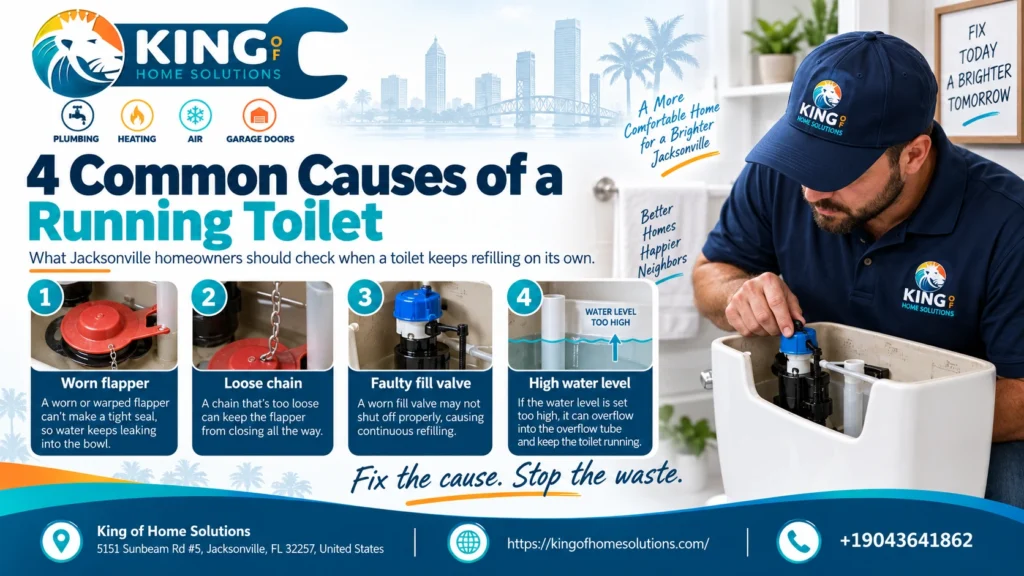
Check the Flapper Chain
The chain connecting the handle lever to the flapper needs a small amount of slack.
If the chain is too short, it may hold the flapper slightly open. If it is too long, it may become trapped underneath the flapper after flushing.
The flapper should:
- Lift fully when the handle is pressed
- Drop freely when the tank empties
- Sit flat over the flush-valve opening
- Remain closed without pressure from the chain
A chain adjustment may solve the problem without requiring replacement parts.
Check the Tank’s Water Level
The tank water should normally stop below the top of the overflow tube.
When the fill valve is adjusted too high, water may continuously spill into the overflow tube. This produces a running sound even when the flapper is sealing correctly.
Look inside the tank while the toilet is idle.
If water is flowing into the overflow tube, the fill valve may need to be adjusted, cleaned, or replaced.
Some tanks have a marked waterline showing the correct level. Otherwise, the proper setting is commonly about an inch below the top of the overflow tube, although the toilet manufacturer’s instructions should take priority.
Should You Replace the Flapper or the Whole Toilet?
A ghost flush does not automatically mean you need a new toilet.
A flapper replacement may be enough when:
- The toilet is otherwise reliable
- The porcelain is not cracked
- The flush valve is in good condition
- The toilet does not clog frequently
- Replacement parts are readily available
A more extensive repair may be needed when the flush-valve seat is damaged, the overflow tube is cracked, or the toilet uses a proprietary seal.
Full toilet replacement may make sense when:
- The fixture is very old
- It uses 3.5 gallons per flush or more
- It frequently clogs
- Multiple tank components are failing
- The porcelain is cracked
- Repairs are approaching the cost of a new fixture
WaterSense-certified toilets use no more than 1.28 gallons per flush and must meet independent performance requirements. Replacing an old, inefficient toilet can eliminate the leak while also reducing water used during normal flushing.
Can You Replace a Toilet Flapper Yourself?
Many homeowners can replace a standard flapper with basic tools.
The general process involves:
- Turning off the toilet’s water supply
- Flushing to empty the tank
- Removing the old flapper
- Matching it to the correct replacement
- Attaching the new flapper
- Adjusting the chain
- Restoring the water supply
- Performing another dye test
Not every flapper is universal. Size, mounting design, toilet brand, and flush-valve style matter.
The EPA recommends bringing the old flapper to the store or checking the toilet manufacturer’s model information to find the correct part.
Call a plumber when:
- The shutoff valve will not close
- The valve leaks when turned
- The flush-valve assembly is damaged
- The overflow tube is cracked
- The tank bolts are heavily corroded
- The toilet continues leaking after the repair
- You are unsure which component has failed
What About an Unusually High JEA Bill?
If a toilet leak caused abnormal water consumption, repair it promptly and keep documentation.
JEA allows customers to request an adjustment for certain leaks or accidental excessive water use. Requests must generally be submitted within 90 days of the affected billing period. Approval is not automatic, and JEA limits how frequently adjustments may be granted.
Useful documentation may include:
- The date the leak was discovered
- The date it was repaired
- A plumber’s invoice
- Receipts for replacement parts
- Photographs
- A description of the failed component
- Water-meter readings before and after repair
JEA’s adjustment form specifically includes toilets as a type of leak that can be reported.
How to Confirm the Repair Worked
After replacing or adjusting the faulty component:
- Allow the tank to refill.
- Confirm that water stops entering the tank.
- Mark the tank’s water level with a pencil.
- Avoid using the toilet for 30 to 60 minutes.
- Check whether the level has dropped.
- Repeat the dye test.
- Listen for unexpected refilling.
You can also review the water meter when no water is being used elsewhere in the home. Continued meter movement may indicate another plumbing or irrigation leak.
The Bottom Line
A ghost flush happens because water is leaking from the toilet tank into the bowl. When the tank level falls, the fill valve switches on and replaces the missing water.
The most likely causes are:
- A worn flapper
- An incorrectly adjusted chain
- Mineral buildup
- A leaking flush-valve seal
- A faulty fill valve
- A cracked overflow tube
- An excessively high tank-water level
For a JEA water-and-sewer customer, a toilet leaking 100 gallons per day could waste 36,500 gallons and add roughly $250 to $406 per year at current usage rates.
That is a meaningful expense for a problem that may be solved with a relatively inexpensive replacement part.
When your toilet flushes itself, do not treat it as background noise. It is the sound of water and money continuously slipping down the drain.