Serving The Jacksonville Area


Best Air Filters for Jacksonville’s Heavy Pollen Seasons
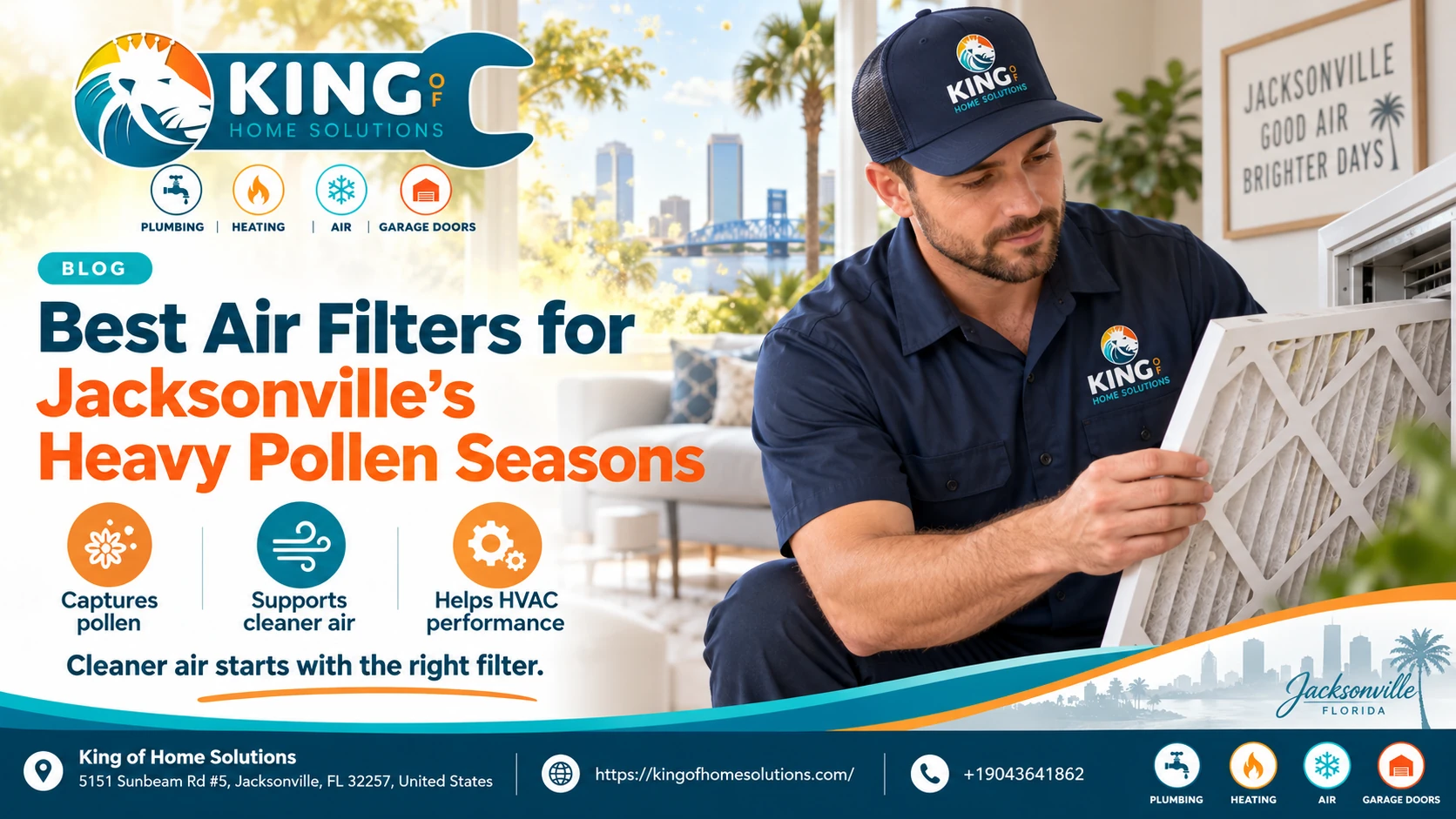
Best Air Filters for Jacksonville’s Heavy Pollen Seasons
You walk outside in Jacksonville during spring and your car has turned yellow.
Oak pollen coats the windshield.
It collects on the driveway.
It gets tracked inside on shoes, clothes, pets, and bags.
Then you start noticing the indoor symptoms:
Sneezing.
Itchy eyes.
A dusty return grille.
More frequent cleaning.
And suddenly that $8 HVAC filter at the hardware store starts looking like it may not be doing enough.
For Jacksonville homeowners, choosing the right air filter matters because North Florida can experience a long and heavy pollen season. UF/IFAS notes that Florida tree pollen can begin as early as winter, with oak pollen particularly important from roughly February through May. Grass and weed pollen can extend the allergy season much farther into the year.
So should you install the highest-MERV filter you can find?
Not necessarily.
For most homes, the better rule is:
Use the highest-efficiency filter your HVAC system can handle without restricting airflow.
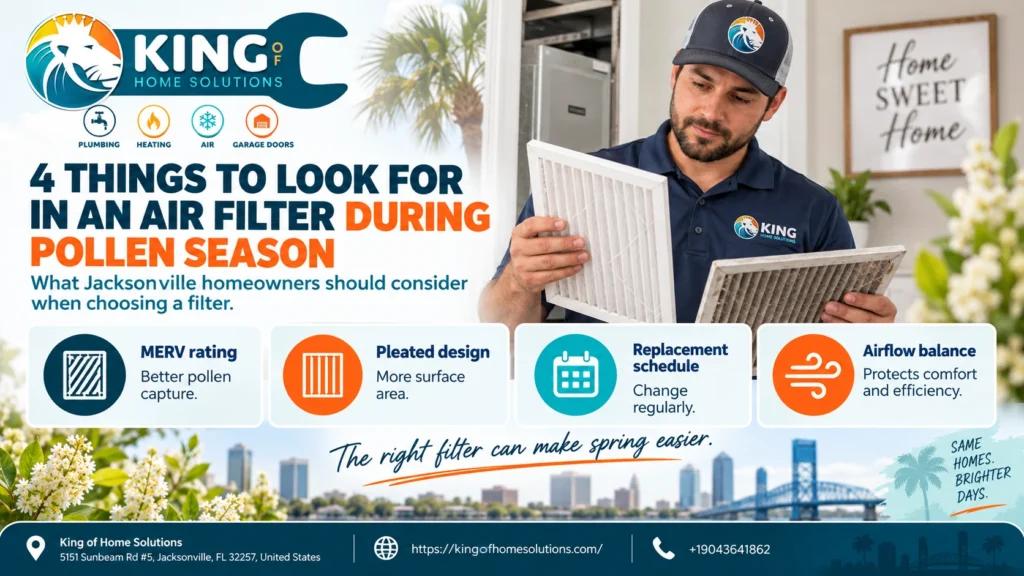
For many systems, that means aiming for MERV 11 to MERV 13, with MERV 13 being an excellent target when the equipment and filter cabinet are designed to accommodate it. EPA currently recommends MERV 13 or the highest rating the system can safely support for improved particle filtration.
Why Jacksonville Pollen Is Such a Persistent Problem
Jacksonville does not have one neat three-week allergy season.
Florida’s climate allows different plants to release pollen throughout much of the year.
UF/IFAS identifies oak as one of Florida’s major allergenic tree pollen and notes that trees account for a large share of airborne pollen in the state. Grasses such as Bahia and Bermuda grass and weeds such as ragweed add another layer later in the year.
That means your HVAC filter may face a much heavier particle load during certain months.
Every time the air conditioner runs, indoor air is pulled toward the return.
That air can contain:
- Pollen
- Dust
- Pet dander
- Hair
- Mold particles
- Fine outdoor particles
- Fibers and household debris
The filter’s job is to capture those particles before they recirculate through the home.
But different filters capture dramatically different amounts.
What Does MERV Actually Mean?
MERV stands for Minimum Efficiency Reporting Value.
It rates how effectively a filter captures particles in several size ranges.
The scale generally runs from 1 through 16 for common HVAC filtration.
The higher the number, the more efficiently the filter captures increasingly small particles.
EPA’s current MERV guidance shows a major performance jump as the rating increases.
For particles between 3 and 10 microns, for example:
MERV 8: at least 70% average capture efficiency.
MERV 11: at least 85%.
MERV 12: at least 90%.
Higher-rated filters also become much better at capturing particles below 3 microns.
For Jacksonville pollen, that improved filtration can be useful.
But there is a catch.
Higher MERV Can Mean More Airflow Resistance
A better filter generally contains more filtering media or a more efficient structure.
That can create greater resistance to airflow.
Your air conditioner still has to pull air through it.
If your HVAC system was designed around a thin, low-resistance filter and you suddenly install an extremely restrictive filter, airflow through the system may fall.
That can contribute to:
- Reduced cooling performance
- Longer run times
- Higher energy use
- Increased blower strain
- Poor airflow from vents
- Evaporator-coil problems in severe cases
This is especially important in Jacksonville, where the AC may operate heavily during hot, humid weather.
You do not want to improve pollen filtration by accidentally suffocating the HVAC system.
EPA therefore recommends MERV 13 or the highest rating the system fan and filter slot can accommodate, rather than telling every homeowner to install the highest rating available.
MERV 8: The Basic Choice
A MERV 8 filter is common in residential systems.
It is reasonably effective at catching larger household particles and much of the larger pollen and dust entering the return air.
It may be appropriate when:
- Your HVAC system has airflow limitations
- You use a basic one-inch filter slot
- Nobody in the home has significant allergies
- The system was designed around lower-resistance filtration
For equipment that cannot tolerate higher-efficiency filters, a clean MERV 8 is considerably better than an overloaded MERV 13 that has not been changed in months.
But if Jacksonville pollen bothers you significantly, moving higher may provide noticeably better filtration.
MERV 11: A Strong Middle Ground
For many homeowners, MERV 11 is the practical sweet spot.
It provides better particle capture than MERV 8 without necessarily creating as much resistance as some higher-rated products.
It can be a good choice when you are trying to reduce:
- Pollen
- Pet dander
- Fine dust
- Mold particles
- Other common household allergens
If you’re currently using MERV 8 and want better allergy-season performance without making an aggressive jump, MERV 11 is worth considering.
However, actual airflow resistance varies by filter design.
Two filters carrying the same MERV rating can have different pressure drops.
That is why the physical filter construction matters too.
MERV 13: Usually the Best Target for Allergy Filtration
When the HVAC system can handle it, MERV 13 is generally the strongest residential target for serious particle filtration.
EPA recommends filters rated at least MERV 13 when higher-efficiency HVAC filtration is desired, provided the system can accommodate them.
MERV 13 improves capture of much smaller particles compared with basic residential filters.
That makes it useful not only for pollen but also for fine airborne particulate matter.
For a Jacksonville home where someone struggles with seasonal allergies, this is usually the rating I would discuss with an HVAC technician first.
But instead of asking:
“Can I buy a MERV 13?”
Ask:
“Can my system maintain proper airflow with a MERV 13 installed?”
That is the better question.
A 4-Inch Filter Can Be Better Than a 1-Inch Filter
This is one of the most useful upgrades homeowners overlook.
A thick media filter is not automatically “more restrictive” simply because it is thicker.
In fact, a deeper pleated filter can provide more surface area, which can reduce resistance compared with trying to force the same filtration performance through a very thin filter.
Imagine unfolding a pleated filter.
A deeper filter can contain substantially more media area.
More surface area gives the air more places to pass through.
That is why upgrading from a one-inch filter slot to a properly sized four- or five-inch media cabinet can sometimes allow better filtration without creating excessive static pressure.
For a homeowner who wants MERV 13 filtration during Jacksonville’s heavy pollen months, a larger media cabinet may be more effective than constantly buying ultra-dense one-inch filters.
How Often Should You Change the Filter During Pollen Season?
Do not blindly follow the phrase:
“Change it every three months.”
That is a starting point—not a universal rule.
Jacksonville pollen, pets, construction dust, household occupancy, filter size, HVAC runtime, and return-air leakage can all change how quickly a filter loads.
ASHRAE guidance emphasizes regular filter replacement because filter performance and system resistance change as filters become loaded.
During peak pollen periods, inspect the filter more frequently.
For a one-inch filter, that could mean checking it roughly every month.
A deeper four- or five-inch filter may last substantially longer because it contains more media area, but it still needs inspection.
Do not judge only by color.
Some discoloration is normal.
What matters is whether the media is heavily loaded and whether airflow is being affected.
Your Filter Must Fit Correctly
A premium MERV 13 filter does little good if air simply passes around it.
EPA specifically recommends installing filters snugly so air cannot bypass the filter around gaps in the cabinet.
Check:
- Width
- Height
- Thickness
- Direction-of-airflow arrow
- Whether the filter seals properly in its rack
If the filter is crushed, bent, or substantially smaller than the opening, some return air may bypass the media entirely.
That means Jacksonville pollen is taking the easy route around your expensive filter.
Should You Run the Fan Continuously for More Filtration?
Technically, more airflow through the filter means more filtration.
EPA notes that central HVAC filters only clean air while the blower is operating.
So why not put the thermostat fan on ON 24 hours a day?
In Florida, there is a humidity concern.
After the compressor turns off, moisture may remain on the evaporator coil.
Continuous blower operation can sometimes reintroduce some of that moisture into the home rather than allowing it to drain normally.
EPA itself notes that longer HVAC fan operation during the cooling season may affect humidity control.
If your thermostat has a circulation mode that runs the fan intermittently rather than continuously, that may offer a compromise.
But humidity performance should come first in a Jacksonville house.
What If MERV 13 Is Too Restrictive?
Do not force it.
You have several alternatives.
You may be able to:
- Install a larger media cabinet
- Improve return-air capacity
- Use a less restrictive MERV 11 filter
- Add a portable HEPA purifier in important rooms
A portable HEPA air purifier in a bedroom can be especially useful for someone with significant seasonal allergies.
EPA recommends selecting portable air cleaners according to room size and Clean Air Delivery Rate rather than simply purchasing the smallest HEPA unit available.
That way, you can keep the HVAC filter within the system’s airflow limits while adding more aggressive filtration in the room where you sleep.
Don’t Forget the Rest of the House
The best filter cannot capture pollen that never reaches it.
During heavy Jacksonville pollen periods:
Keep windows closed when practical.
Remove shoes near the entrance.
Change clothes after extensive outdoor exposure.
Wash bedding regularly.
Vacuum with effective filtration.
Wipe surfaces with damp cloths instead of simply redistributing dust.
Avoid drying clothing outside when pollen counts are high.
UF/IFAS specifically recommends avoiding outdoor clothes drying during heavy pollen periods because pollen can collect on fabrics and then be carried indoors.
The HVAC filter should be one layer of the strategy not the entire strategy.
So What Is the Best Filter for a Jacksonville Home?
For a typical homeowner, the decision looks like this:
MERV 8: Fine for basic filtration or systems with limited airflow capacity.
MERV 11: Excellent middle ground for better pollen and allergen capture.
MERV 13: Best general target for stronger residential particle filtration when the HVAC system can support it.
4- to 5-inch MERV 11 or 13 media filter: Often an excellent long-term upgrade when the filter cabinet and HVAC design allow it.
If you suffer significantly during Jacksonville’s oak and grass seasons, my first choice would generally be a properly sized MERV 13 media filter, assuming an HVAC technician confirms the system can maintain correct airflow.
If it cannot, use MERV 11 and consider adding a HEPA purifier in the bedroom.
The Bottom Line
During Jacksonville’s heavy pollen seasons, the answer is not:
“Buy the highest MERV number you can find.”
The answer is:
Use the highest-efficiency filter your HVAC system can properly breathe through.
For many homes, that means MERV 11 or MERV 13.
A deeper media filter can make higher-efficiency filtration easier on the HVAC system.
And if allergies are severe, adding a portable HEPA purifier to the bedroom can provide an additional layer of protection without restricting your central AC.
Because the best Jacksonville air filter isn’t the one with the biggest number printed on the package.
It’s the one that captures more pollen while still allowing your air conditioner to move the amount of air it was designed to move.