Serving The Jacksonville Area



Whole-Home Filtration vs. Reverse Osmosis: Price and Performance
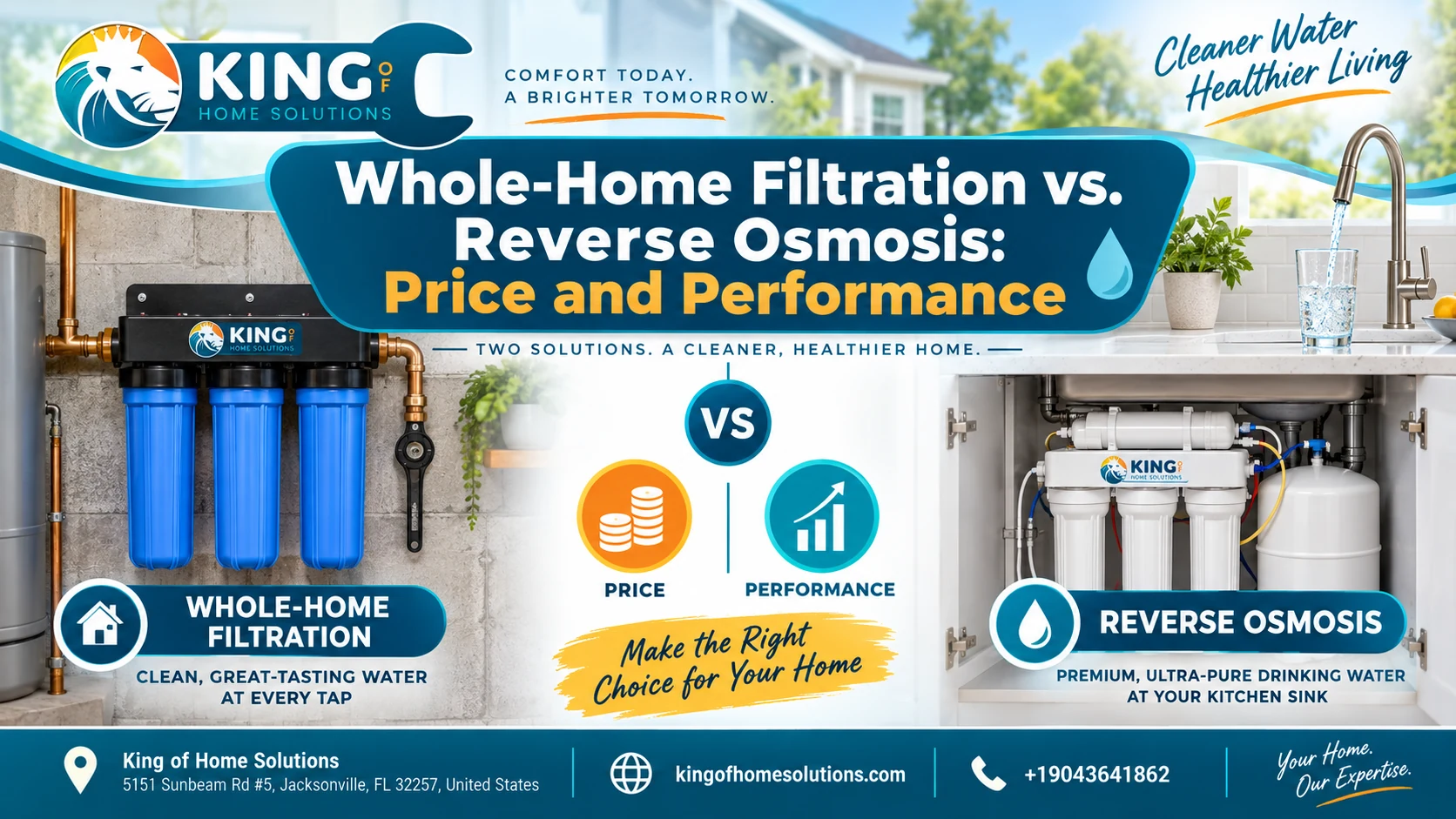
Whole-Home Filtration vs. Reverse Osmosis: Price and Performance
You turn on the kitchen faucet and notice the chlorine smell again. Maybe your shower leaves your skin feeling dry. Perhaps you’re tired of buying bottled water, or you’re concerned about lead, PFAS, nitrates, sediment, or other contaminants that may be present in your water.
At that point, two solutions usually come up: whole-home water filtration and reverse osmosis.
They sound like competing systems, but they actually solve different problems.
A whole-home filtration system treats the water throughout your house. Reverse osmosis, commonly installed under the kitchen sink, provides more intensive treatment for the water you drink and cook with.
So which one gives you better performance—and what should you expect to pay?
Whole-Home Filtration vs. Reverse Osmosis at a Glance
For most homeowners, the biggest difference is where the water is treated and how aggressively contaminants are removed.
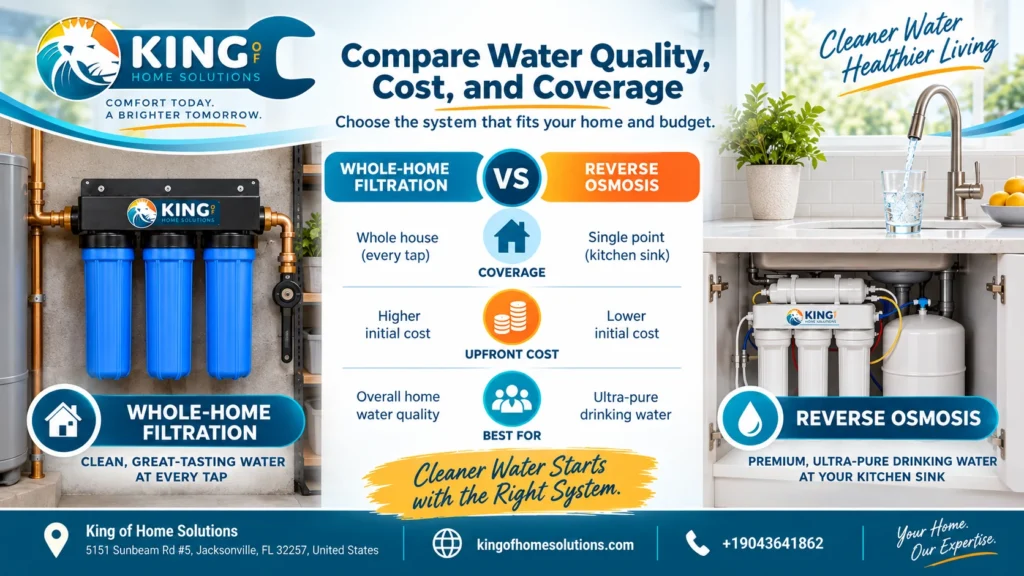
A whole-home system, also called a point-of-entry system, connects to the main water line entering your house. Every faucet, shower, washing machine, dishwasher, and other fixture then receives treated water.
The EPA notes that point-of-entry systems are designed to treat large volumes of water because they supply the entire home.
Reverse osmosis systems are often point-of-use systems. They are usually installed beneath a kitchen sink and provide purified water through a dedicated faucet.
RO uses pressure to force water through a semipermeable membrane. That membrane can remove contaminants that many conventional filters cannot effectively address.
The simplest way to think about it is:
Whole-home filtration improves water everywhere. Reverse osmosis provides deeper purification where you need drinking water.
How Much Does Whole-Home Water Filtration Cost?
In 2026, professionally installed whole-house filtration commonly falls somewhere around $1,100 to $3,500, although sophisticated systems can cost considerably more.
HomeAdvisor currently places the average whole-house filtration range at approximately $1,129 to $3,540, while higher-end treatment equipment can reach several thousand dollars beyond that depending on the technology involved.
Angi reports that whole-home systems can range from approximately $1,500 to $10,000 when the category includes more advanced treatment configurations and complex installations.
Why such a large price difference?
Because “whole-home filtration” can describe everything from a relatively straightforward sediment and carbon system to a multi-stage setup containing specialized media, UV disinfection, water conditioning, or other treatment technologies.
Your final price can depend on:
- The contaminants in your water
- Number and type of filtration stages
- Household water demand
- Plumbing modifications
- Filter capacity
- Installation complexity
- Whether you’re treating municipal or private well water
This is why testing the water before buying equipment matters. Paying for filtration technology that doesn’t target your actual water problem can turn an expensive system into an expensive disappointment.
How Much Does Reverse Osmosis Cost?
Reverse osmosis has a much wider price range because there is a major difference between under-sink RO and whole-house RO.
For most households, an under-sink system is the practical choice.
Current 2026 pricing from Angi puts point-of-use RO systems at approximately $200 to $900, depending on whether you choose countertop, traditional under-sink, or tankless equipment. Professional installation adds to the cost depending on plumbing requirements.
Whole-house reverse osmosis is a different category entirely.
These systems must produce enough RO-treated water for showers, appliances, toilets, faucets, and other household uses. They may require pumps, storage tanks, pretreatment, drainage, and substantial plumbing changes.
As a result, whole-home RO can run into several thousand dollars. HomeGuide estimates approximately $4,800 to $8,000 installed for many whole-house RO systems.
For an average homeowner on municipal water, installing RO beneath the kitchen sink is normally much more economical than sending every gallon used in the house through reverse osmosis.
Which System Filters More Contaminants?
This is where reverse osmosis has an important advantage.
A typical whole-home carbon filtration system can be excellent for reducing chlorine, unpleasant odors, tastes, sediment, and certain organic compounds.
But carbon filtration is not the same as RO purification.
Reverse osmosis can address many dissolved contaminants because water is forced through a membrane rather than simply passing through conventional filter media.
The EPA says RO can potentially remove contaminants including lead, PFAS, arsenic, certain volatile organic compounds, bacteria, and viruses, depending on the system.
NSF/ANSI 58 is the primary standard associated with residential reverse osmosis drinking-water systems. Certified systems may carry verified reduction claims for contaminants such as lead, arsenic, nitrate/nitrite, chromium, fluoride, copper, radium, and others.
That doesn’t mean every RO unit removes every contaminant.
Look at the specific certification and contaminant-reduction claims for the exact model you’re buying.
Where Whole-Home Filtration Wins
Imagine taking a shower in water with a strong chlorine odor.
An under-sink RO system doesn’t help.
Neither does it help the water going to your washing machine, bathroom sinks, dishwasher, or other fixtures.
That’s where whole-home filtration earns its place.
Because the system treats water as it enters the property, you can improve water quality throughout the house rather than at only one faucet.
Whole-home filtration may be especially appealing when your concerns involve:
- Chlorine taste or odor throughout the property
- Sediment
- Rust particles
- Certain chemicals
- Well-water issues
- Shower and bathing water
- Protecting downstream fixtures and equipment
Its greatest strength is coverage.
Where Reverse Osmosis Wins
RO wins when your priority is producing highly treated water for drinking, cooking, coffee, ice, or baby formula.
You aren’t paying to provide RO water to toilets or wash the driveway. You’re concentrating more advanced treatment where it provides the most practical benefit.
There is one drawback, however: reverse osmosis produces a reject-water stream.
Older and less efficient systems can waste significant amounts of water during purification. EPA’s WaterSense program now addresses RO efficiency, and WaterSense-labeled point-of-use systems must meet specific performance and efficiency requirements.
RO filters and membranes also require periodic replacement.
Current estimates suggest filters may need replacement approximately every six to twelve months, while membranes often last roughly two to five years depending on the equipment and water conditions.
Maintenance shouldn’t be ignored when comparing long-term costs.
Do You Actually Need to Choose One?
For many homes, the best answer is both.
Think of it as a two-layer approach.
A whole-home system handles the water entering your property. It can address sediment, chlorine, odor, and other problems before the water travels through your plumbing.
Then an under-sink RO system provides an additional level of purification for the water your family actually drinks.
This approach avoids the high price and complexity of whole-house RO while still giving you improved water throughout the home.
It can also protect the RO system itself by reducing some contaminants before water reaches it.
Which System Offers Better Value?
If you’re mainly concerned about drinking-water contaminants, spending several thousand dollars filtering every gallon in the house may not make sense.
An under-sink RO system can provide excellent drinking-water treatment for hundreds rather than thousands of dollars.
If your problem affects showers, laundry, fixtures, taste, odor, or water throughout the property, whole-home filtration offers much greater coverage.
And if you’re dealing with several concerns at once, pairing whole-home filtration with kitchen RO may provide the best overall performance.
The most important step comes before buying either system: find out what’s actually in your water.
Once you know what needs to be removed, you can choose equipment based on verified performance rather than marketing claims.
Because when it comes to water treatment, the best system isn’t necessarily the one that removes the most contaminants or costs the most money.
It’s the one designed to solve the specific water problems coming into your home.