Serving The Jacksonville Area


5 Plumbing Upgrades That Can Increase a Jacksonville Home’s Resale Value

5 Plumbing Upgrades That Can Increase a Jacksonville Home’s Resale Value
You can spend $8,000 remodeling a bathroom and buyers will notice the tile.
But during the inspection, they may care even more about the 40-year-old plumbing hidden behind it.
That is the strange thing about plumbing upgrades.
Some of the improvements that add the most confidence to a Jacksonville home are almost invisible.
A new whole-house repipe doesn’t photograph particularly well.
Neither does a replaced sewer line.
But tell a buyer that the 1980s plumbing has already been replaced, the water heater is efficient, the house has automatic leak protection, and the bathrooms have modern fixtures?
Suddenly you’ve removed several reasons for them to negotiate the price downward.
National remodeling research reinforces the importance of kitchens and bathrooms in resale, although homeowners should not assume every plumbing upgrade returns 100% of its cost. The National Association of REALTORS® estimated around 60% cost recovery for complete and minor kitchen renovations in its 2025 Remodeling Impact Report.
For Jacksonville specifically, I would prioritize plumbing projects a little differently than I would in a brand-new subdivision in another part of the country.
Our older slab homes, very hard JEA water, humid climate and long plumbing-service lives all matter.
Here are five upgrades worth considering.
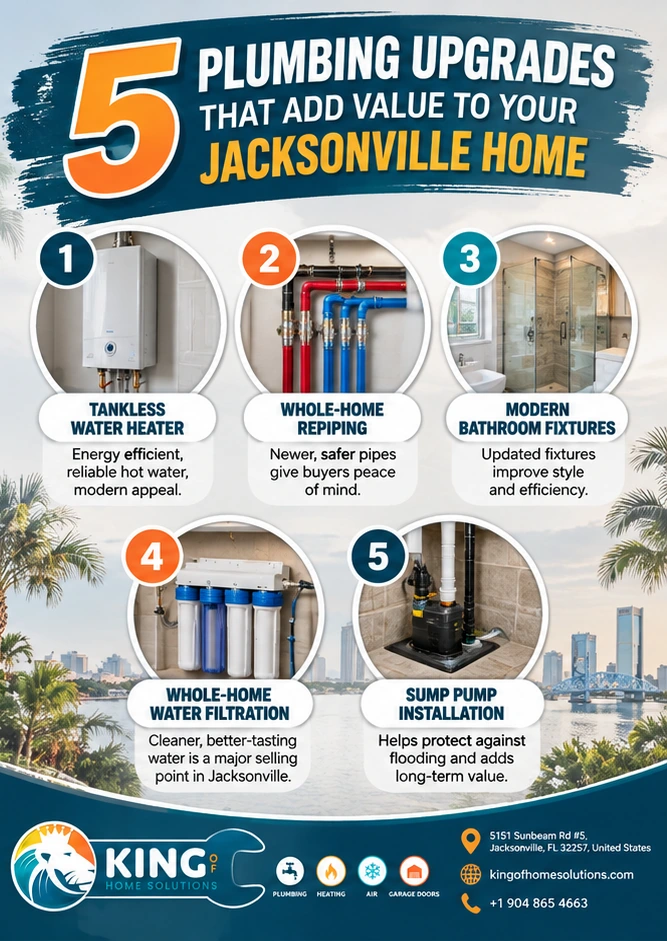
#1: Replace Aging or Problematic Supply Plumbing
This may be the least glamorous upgrade on the list.
It may also remove the biggest objection.
If you’re selling a Jacksonville home from the 1970s, 1980s or 1990s and it still contains aging supply plumbing, buyers and inspectors are going to want to know what is inside the walls and slab.
Depending on the home’s age, that might include old galvanized piping, aging copper or, in some houses, polybutylene.
One isolated repair isn’t necessarily a reason to repipe the entire house.
But repeated leaks change the conversation.
Imagine two otherwise similar Mandarin homes.
House A has beautiful new floors but has experienced three under-slab leaks.
House B has already been repiped through accessible walls and attic spaces, with invoices and permits available.
Which one feels safer to buy?
Exactly.
A professionally completed repipe can remove uncertainty about hidden leaks and future slab demolition.
And documentation matters almost as much as the work.
Jacksonville requires permits for regulated plumbing alterations and repairs, while simple fixture replacements after the shutoff are among the work that may be exempt.
Keep the permit, inspection records and contractor invoice.
You’re not just selling new pipes.
You’re selling evidence that the problem has already been handled correctly.
#2: Upgrade the Water Heater Before It Becomes an Inspection Problem
Nobody tours a house and says:
“Wow, look at that beautiful water heater.”
But inspectors absolutely notice one that is rusty, leaking or approaching the end of its useful service life.
If your water heater is already old and you’re planning to sell within several years, replacing it can make the mechanical systems of the house feel much better maintained.
For an all-electric Jacksonville home, a heat-pump water heater deserves serious consideration.
Florida’s climate works particularly well for them. ENERGY STAR specifically identifies garages in warm climates as good heat-pump-water-heater locations because they provide plenty of surrounding warm air; the unit can also produce some cooling and drying of the garage while operating.
That creates a useful selling point:
high-efficiency hot water without converting the house to gas.
If the property already has natural gas or propane and high hot-water demand, a quality condensing tankless system can also appeal to buyers who value space savings and continuous hot water.
But don’t install tankless merely because the words sound luxurious.
Gas-line capacity, venting, hard-water maintenance and installation costs matter.
The resale advantage comes from having the right modern system for the house, not simply the most expensive water heater you could buy.
#3: Install a Whole-House Water Softener
In some cities, I would classify a water softener as a luxury.
Jacksonville is different.
JEA’s current water-hardness data show much of the service territory in the very hard category.
Examples include approximately:
32223: 15 grains per gallon
32225: 18 grains
32256: 20 grains
32257: 17 grains
32258: 17 grains
JEA specifically identifies ion-exchange softening as a way homeowners can treat hard water.
Buyers may not understand grains per gallon.
They understand:
Clean shower glass.
Fixtures without white crust.
Less scale around faucets.
A nicer-feeling shower.
Reduced mineral accumulation on plumbing equipment.
That makes a properly installed softener one of those upgrades that can be demonstrated during a showing.
Turn on the faucet.
Show the equipment.
Explain the maintenance.
Provide the installation record.
For drinking water, some homeowners pair the softener with an under-sink reverse-osmosis system.
That can create a strong whole-home package:
softened water throughout the house + filtered drinking water at the kitchen.
Just don’t oversell it.
A softener primarily addresses hardness.
Carbon and RO treatment solve different water-quality problems.
#4: Replace Old Toilets, Faucets and Shower Fixtures
Now we get to the plumbing upgrades buyers actually see.
If the bathrooms still contain stained toilets, dripping builder-grade faucets and crust-covered showerheads from 1997, new plumbing fixtures can provide a surprisingly large visual improvement without requiring a full bathroom gut renovation.
The key is to choose fixtures that look modern and perform well.
WaterSense toilets are independently certified for both water efficiency and flushing performance and use no more than 1.28 gallons per flush. EPA says replacing older inefficient toilets can reduce toilet water use by 20%–60%.
WaterSense bathroom faucets use no more than 1.5 gallons per minute and can reduce flow by 30% or more compared with the old federal standard while maintaining performance.
For resale, I would lean toward durable, widely appealing finishes:
Brushed nickel.
Polished chrome.
Quality matte black when it fits the design.
Avoid choosing the cheapest decorative faucet simply because it photographs well.
Buyers may forgive an older faucet.
They won’t appreciate a brand-new one that already feels loose.
And while the plumber is replacing fixtures, have the shut-off valves and supply lines inspected.
A fresh bathroom faucet connected to a green-crusted 30-year-old stop valve is only half an upgrade.
#5: Add Whole-House Leak Detection and Automatic Shutoff
This is the least visible upgrade here.
It may be the most modern.
Whole-house leak-monitoring systems can watch water flow and identify patterns suggesting an unusual leak. More advanced systems can automatically close the home’s main water supply when they detect a serious problem.
EPA specifically recognizes flow-monitoring and leak-detection devices as tools for identifying abnormal water use and reducing water waste and property damage. Some systems provide mobile alerts, remote shutoff or automatic shutoff capability.
That is particularly attractive in Jacksonville because so many homes are built on slabs.
A small hidden plumbing leak can remain invisible much longer than a pipe leaking into an open crawlspace.
It also makes sense for:
Second homes.
Frequent travelers.
Rental properties.
Homes with expensive wood flooring.
Older plumbing systems.
You may never recover the entire purchase price directly in the appraisal.
But it is the kind of feature that helps a house feel updated, protected and thoughtfully maintained.
And in a competitive sale, that perception matters.
What I Would NOT Do Just for Resale
Don’t install a $12,000 whole-house reverse-osmosis system simply because you think buyers will pay $12,000 more.
Don’t convert a perfectly functional water heater to tankless without doing the math.
Don’t repipe a healthy five-year-old plumbing system.
And don’t spend luxury-fixture money in a house where buyers are likely to immediately remodel the bathroom anyway.
The smartest resale projects usually either:
remove a future problem
or
make an important room feel noticeably better.
Ideally, they do both.
The Jacksonville Priority List
If I were preparing an older Jacksonville home for sale, I would prioritize based on condition.
If the house has questionable old supply piping, deal with that first.
If the water heater is near failure, replace it.
If hard water is destroying fixtures throughout the home, consider softening.
Then update the visibly tired toilets and faucets.
Finally, add leak monitoring if the budget allows.
This order matters.
A buyer is much more likely to forgive a dated bathroom faucet than a history of unexplained slab leaks.
The Bottom Line
The plumbing upgrades that add the most value aren’t necessarily the ones with the fanciest showroom displays.
In Jacksonville, value often comes from reducing uncertainty.
A documented repipe says:
“You probably won’t be cutting into the slab next year.”
A newer efficient water heater says:
“This isn’t an immediate replacement expense.”
A softener says:
“You won’t be fighting JEA’s hard water every weekend.”
Modern toilets and faucets make bathrooms feel updated.
And automatic leak protection tells buyers that someone thought about protecting the house, not merely decorating it.
That’s the resale lesson.
Don’t just upgrade the plumbing buyers can see. Upgrade the plumbing problems they’re afraid they can’t see.
Recent News

Why North Florida Homes Are Switching to Heat Pumps in 2026

Top 5 Garage Door “Curb Appeal” Trends in Jacksonville: 2024 Edition
Braided Stainless Steel vs. Rubber Supply Lines: Is the “Flood Guard” Worth It?
5 Plumbing Upgrades That Can Increase a Jacksonville Home’s Resale Value