Serving The Jacksonville Area


Braided Stainless Steel vs. Rubber Supply Lines: Is the “Flood Guard” Worth It?
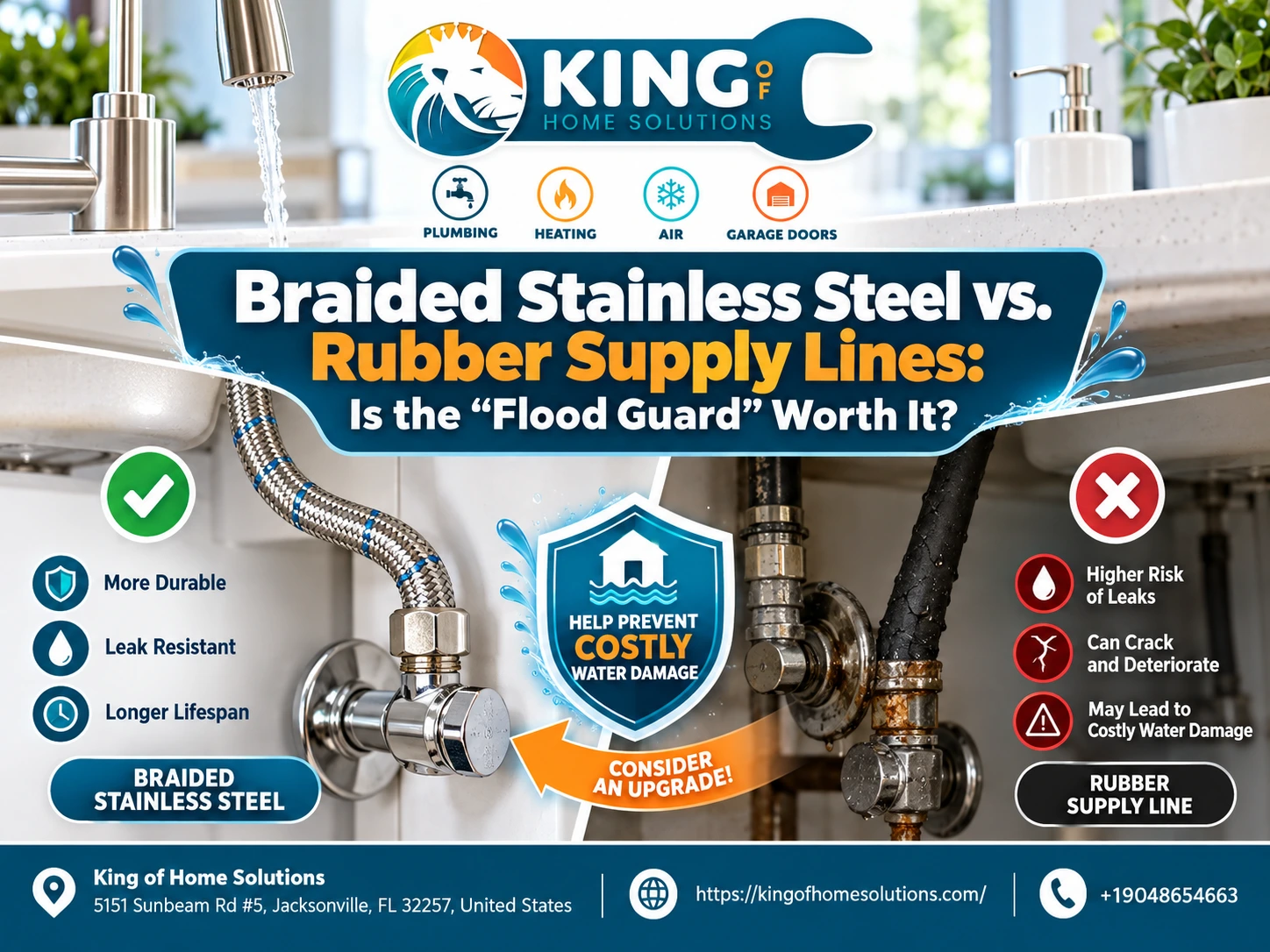
Braided Stainless Steel vs. Rubber Supply Lines: Is the “Flood Guard” Worth It?
Behind your washing machine are two small hoses most homeowners rarely think about.
One carries hot water.
One carries cold water.
Both may sit under household water pressure every hour of every day.
And if one fails while you’re at work, asleep, or out of town, that inexpensive hose can suddenly become one of the most expensive plumbing components in the house.
That is why plumbers frequently recommend replacing traditional rubber washing-machine supply hoses with braided stainless-steel lines.
Then there is a third option:
Flood-protection or “Flood Guard” hoses, which are designed to restrict or stop water flow when they detect an unusually high flow condition.
Are they worth the extra money?
For many homeowners, braided stainless is already a worthwhile upgrade over plain rubber.
But if the laundry room is upstairs, located near hardwood flooring, or regularly left unattended, an automatic shutoff system can provide another layer of protection that even a high-quality braided hose cannot.
Why Washing-Machine Supply Lines Are Such a Flood Risk
A washing-machine hose is different from a drain hose.
The drain hose only carries wastewater when the washer is pumping out.
The supply hoses connect directly to your home’s pressurized plumbing.
If the wall valves remain open, which they usually do, the hoses can remain pressurized even when the washing machine is turned off.
That means a rupture is not limited to the amount of water inside the washing machine.
Water can continue flowing until someone closes the valve.
Current homeowner guidance recommends routinely inspecting washer hoses because loose fittings, worn seals, damaged hose material, and vibration can all contribute to leaks.
If the laundry room is upstairs, even a relatively short leak can affect flooring, drywall, insulation, ceilings, and rooms below.
That makes this a very inexpensive component with a surprisingly large damage potential.
How Traditional Rubber Hoses Fail
Basic washing-machine supply hoses are often made from reinforced rubber.
They are inexpensive, flexible, and easy to install.
The problem is aging.
Years of pressure, heat, movement, and water hammer can gradually weaken the hose.
Warning signs may include:
- Bulges
- Blisters
- Surface cracking
- Hard or brittle rubber
- Dampness around fittings
- Rust or mineral buildup near connections
But a hose does not always provide an obvious warning before failure.
The internal material can deteriorate while the outside still looks relatively normal.
Current plumbing guidance commonly recommends replacing older rubber washer hoses on a preventive schedule rather than waiting until visible damage becomes severe. Around five years is frequently used as a planning interval, although actual service life varies with hose quality and operating conditions.
That is the strongest argument against keeping an inexpensive rubber hose indefinitely:
You’re waiting for a pressurized rubber component to tell you when it has reached the end of its life.
It may not.
How Braided Stainless-Steel Hoses Are Different
A braided stainless hose still has a flexible inner tube.
The major difference is the woven metal reinforcement around it.
That stainless-steel braid helps restrain the inner hose from expanding outward under pressure.
So if the inner material starts weakening, the outer braid provides additional mechanical support.
It also helps protect the hose from:
- Abrasion
- Kinking
- External damage
- Bulging
- Pressure-related expansion
This does not make a braided hose indestructible.
The inner liner still ages.
Connections can still leak.
The braid itself can become damaged or corroded.
But the construction generally provides greater resistance to sudden bursting than an unprotected rubber hose. Current homeowner and plumbing guidance consistently favors braided stainless over basic rubber for this reason.
For most homeowners replacing old rubber washer hoses, braided stainless is the easy upgrade.
Does “Stainless Steel” Mean the Hose Cannot Leak?
No.
This is one of the most important misconceptions.
The visible stainless braid is not usually carrying the water.
There is still an inner hose.
And the hose still connects to fittings at both ends.
Potential failure points include:
- Internal liner deterioration
- Crimped connections
- Rubber washers
- Corroded fittings
- Improper installation
- Excessive bending
- Hose abrasion
- Loose connections
The outer braid reduces certain failure risks.
It does not eliminate every possible leak.
That is why calling any flexible hose “burst proof” can be misleading.
A better description is burst resistant.
What Is a “Flood Guard” Supply Hose?
Flood-protection hoses add another mechanism.
Instead of relying entirely on stronger hose construction, certain designs include a valve intended to respond when water flow suddenly becomes much higher than normal.
The idea is simple.
During normal operation, the washing machine fills at an expected flow rate.
If the hose ruptures completely, flow suddenly increases.
The protection mechanism senses that unusual condition and restricts or stops water flow.
That can potentially turn a catastrophic open-hose flood into a much smaller incident.
But homeowners should understand the limitation:
A flow-activated hose may not detect every type of leak.
A tiny pinhole leak may not create enough abnormal flow to trigger the valve.
A slow leak around a fitting may also continue.
And some protection devices can occasionally trip because of legitimate high-flow conditions or unusual pressure changes.
So “Flood Guard” should not be interpreted as:
“This hose guarantees my laundry room can never flood.”
It means the hose contains another protective feature designed for certain failure scenarios.
Is an Automatic Shutoff Valve Better?
If flood prevention is the real priority, a dedicated automatic shutoff system can provide more comprehensive protection than relying only on the hose.
Some systems use a floor-mounted moisture sensor.
If water reaches the sensor, the controller closes valves on the hot and cold supply lines.
Others open the supply valves only when the washing machine is actually operating, reducing how long the hoses remain pressurized.
This Old House currently describes automatic washing-machine shutoff valves that can close the water supply when the machine is off and may also incorporate floor leak sensors.
That solves one weakness of flow-sensitive hoses:
A moisture sensor does not necessarily need a catastrophic hose rupture.
It can respond to water reaching the floor from several sources.
That could include:
- A leaking supply hose
- A loose fitting
- Washer overflow
- Certain appliance leaks
For an upstairs laundry room, that additional protection can be especially valuable.

When Plain Rubber Might Still Make Sense
Rubber hoses are not automatically unsafe the moment they are installed.
A quality hose that is correctly installed and regularly inspected can function properly.
The biggest advantage is price.
For a temporary installation, inexpensive appliance, accessible utility room with a floor drain, or a situation where hoses will be replaced frequently, rubber may be adequate.
The problem is forgetting them.
A $10 hose installed today easily becomes a 12-year-old hose because no one remembers when it was installed.
That is where preventive replacement becomes important.
When Braided Stainless Is the Better Choice
For most permanent residential washing-machine installations, braided stainless is the more sensible baseline.
The cost difference is relatively small compared with:
- Flooring replacement
- Drywall repair
- Mold remediation
- Cabinet damage
- Ceiling repair below an upstairs laundry
- Insurance deductibles
Braided hoses also make particular sense when the washer is installed in a tight space where the hoses may rub or flex.
Just remember that braided lines still need room.
Do not push the washing machine so tightly against the wall that the hoses are crushed or sharply bent.
When a Flood-Protection System Is Worth It
Consider going beyond braided hoses when the consequences of a leak would be severe.
That includes:
Second-floor laundry rooms.
A failure upstairs can damage multiple levels.
Condos and townhomes.
Water may affect neighboring property.
Vacation homes.
Leaks can run unnoticed for long periods.
Homes are frequently left vacant.
A burst at 10 a.m. could continue for hours.
Laundry rooms next to expensive flooring.
Hardwood and certain engineered floors can suffer quickly from standing water.
In those situations, braided stainless plus an automatic water shutoff system offers stronger protection than either one alone.
Don’t Forget the Shutoff Valves
The world’s best hose cannot help much if the valve behind the washing machine is already corroded and barely operable.
When replacing supply lines, inspect the hot and cold shutoff valves.
Watch for:
- Corrosion
- Mineral buildup
- Dripping
- Stiff handles
- Valves that do not fully close
If the valves are old and questionable, replacing them may be just as important as replacing the hoses.
A reliable quarter-turn shutoff also makes it easier to close the water when leaving the house for an extended period.
Check the Connections After Installation
Another common source of leaks is not hose failure at all.
It is the connection.
A washer inside the hose fitting creates the seal.
If that washer is damaged, misaligned, or missing, the connection can drip.
Likewise, vibration can contribute to loosened connections over time.
After installing or replacing hoses, inspect both ends while the system is pressurized.
Then inspect them again after the washing machine has operated several cycles.
A dry paper towel wiped around each connection can reveal a slow leak that is difficult to see.
The Bottom Line
If you still have old plain rubber washing-machine supply hoses, braided stainless steel is generally the stronger replacement choice.
The outer braid provides additional resistance to bulging, abrasion, and sudden bursting.
But braided stainless is not a guarantee against leaks.
The inner hose, fittings, washers, and shutoff valves can still fail.
That is where “Flood Guard” hoses and automatic shutoff systems enter the conversation.
A flow-activated hose can potentially stop certain major ruptures.
A sensor-controlled automatic shutoff can provide an even broader layer of protection by responding when water is actually detected.
For a ground-floor utility room with a nearby drain, braided stainless may provide all the protection you reasonably want.
For an upstairs laundry room sitting above your kitchen?
The question changes.
At that point, spending extra on automatic shutoff protection isn’t really about protecting a $900 washing machine.
It’s about preventing a $20 hose failure from becoming a whole-house water-damage project.
Recent News

Why North Florida Homes Are Switching to Heat Pumps in 2026

Top 5 Garage Door “Curb Appeal” Trends in Jacksonville: 2024 Edition
Braided Stainless Steel vs. Rubber Supply Lines: Is the “Flood Guard” Worth It?

5 Plumbing Upgrades That Can Increase a Jacksonville Home’s Resale Value