Serving The Jacksonville Area


Hydro-Jetting vs. Rooter: The Best Way to Clear Jacksonville’s Sandy Drains
Hydro-Jetting vs. Rooter: The Best Way to Clear Jacksonville’s Sandy Drains
When a Jacksonville drain slows down repeatedly, homeowners often hear two recommendations:
- Run a rooter or drain snake through the line.
- Hydro-jet the pipe with high-pressure water.
Both methods can restore flow. They do not, however, solve every blockage in the same way.
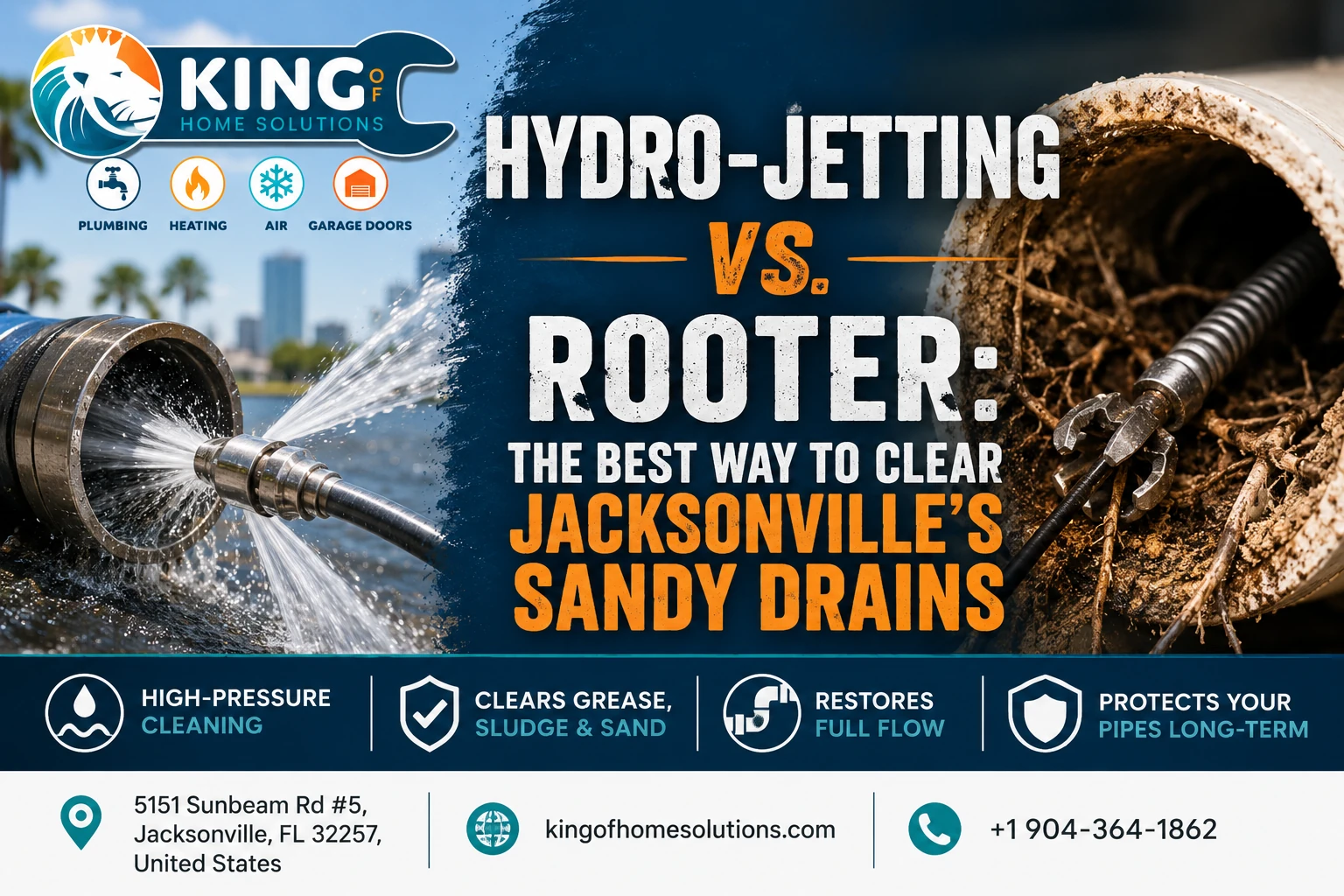
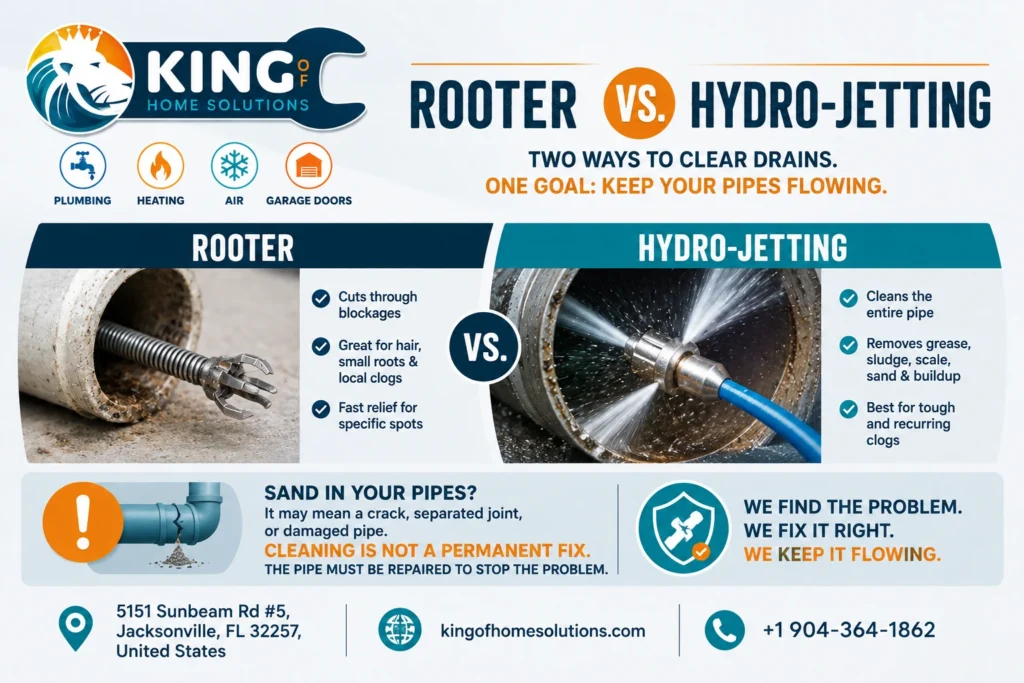
A rooter machine is generally best for opening a concentrated obstruction, such as hair, paper, or a small root mass. Hydro-jetting is better at washing grease, sludge, scale, loose sediment, and buildup from a larger portion of the pipe.
But there is an important warning for homes with sand inside the drain or sewer line:
Sand may be entering through a crack, separated joint, deteriorated pipe, or failed connection.
In that situation, neither a rooter nor hydro-jetting provides a permanent repair. Cleaning may reopen the line, but the sand can return until the damaged pipe is corrected.
Jacksonville Drain Clogged With Sand?
Clear stubborn buildup fast with professional drain cleaning. Call now to restore proper flow.
What Does “Rooter” Mean?
“Rooter” is often used as a general term for mechanical drain cleaning.
A plumber feeds a flexible cable into the drain. A cutting or retrieving head rotates at the end of the cable, breaking through or pulling apart the obstruction.
Depending on the attachment, a cable machine may remove:
- Hair
- Paper
- Soft debris
- Small roots
- Localized grease clogs
- Objects caught near a fixture
- A blockage at a specific point in the line
The main objective is usually to create an opening so wastewater can move again.
This makes mechanical snaking a practical first response for many ordinary household clogs.
What Is Hydro-Jetting?
Hydro-jetting uses a specialized hose and nozzle to send high-pressure water through a drain or sewer line.
Rear-facing water jets propel the nozzle through the pipe while cleaning the interior surface. Different nozzles may be used for grease, sludge, roots, sediment, or other deposits.
Instead of merely cutting a path through the middle of a blockage, hydro-jetting can wash material from more of the pipe wall and carry loosened debris downstream.
Jacksonville drain-cleaning providers commonly recommend hydro-jetting for recurring backups, grease, scale, roots, and heavy buildup that remains after conventional cabling.
The Basic Difference
Think of a rooter as a corkscrew and hydro-jetting as pressure washing.
A rooter cable is designed to penetrate, break apart, or retrieve an obstruction. Hydro-jetting is designed to scour and flush the line.
| Drain problem | Usually better starting method |
| Hair clog near a shower or tub | Rooter |
| Paper blockage in a toilet branch | Rooter |
| Small, isolated obstruction | Rooter |
| Heavy kitchen grease | Hydro-jetting |
| Sludge coating the pipe | Hydro-jetting |
| Recurring main-line backup | Camera inspection, then hydro-jetting if safe |
| Root intrusion | Mechanical root cutting and/or hydro-jetting, followed by pipe evaluation |
| Sand repeatedly entering the pipe | Camera inspection and likely pipe repair |
The correct choice depends on what is inside the pipe and whether the pipe is structurally sound.
Why Sand Is Different From a Normal Clog
Sand does not normally appear inside a closed sanitary drain in large quantities.
A small amount may enter through floor drains, outdoor fixtures, showers, laundry, or construction activity. Repeated or heavy sand accumulation in a buried sewer line is more concerning.
Possible entry points include:
- A cracked pipe
- A separated joint
- A deteriorated section of cast iron
- Broken clay pipe
- A failed connection
- An improperly abandoned opening
- A damaged cleanout
- Ground movement around the sewer lateral
- A low section that collects sediment
- A repair coupling that has shifted
Water moving through the line can carry surrounding soil or sand through the opening. Once inside, the material settles in low-flow areas and gradually reduces the pipe’s capacity.
A drain-cleaning machine can remove that sand. It cannot close the opening through which the sand entered.
Why Jacksonville Homes May Encounter Sandy Sewer Problems
Jacksonville is built across areas with sandy and highly variable soils. Buried sewer laterals can also be affected by age, roots, settlement, corrosion, previous repairs, and changing ground conditions.
The risk is not the sand alone. The larger concern is what the sand may reveal about the pipe.
Older Jacksonville neighborhoods may contain combinations of:
- Cast-iron drain piping
- Clay sewer laterals
- PVC repairs connected to older materials
- Offset joints
- Root intrusion
- Corroded or scaled interiors
- Low spots that retain wastewater and sediment
Local sewer-service providers report encountering older clay and cast-iron laterals, root intrusion, corrosion, and shifting-soil damage in Jacksonville properties.
That does not mean every sandy drain needs excavation. It means repeated sand should trigger an inspection rather than another blind cleaning.
When a Rooter Is the Better Choice
Mechanical cabling is often the most efficient option when the clog is simple, localized, and accessible.
Hair and soap buildup
Bathroom sinks, showers, and tubs commonly clog near the trap or within the first portion of the branch line.
A small cable can often remove the blockage without bringing in larger hydro-jetting equipment.
A single fixture is affected
When one sink or tub is slow but the rest of the home drains normally, the obstruction is probably located in that fixture’s branch line.
A rooter may be faster and less expensive than jetting the line.
A solid obstruction must be penetrated
A dense root mass or compacted blockage may need to be opened mechanically before water can flow well enough for hydro-jetting.
In some cases, plumbers use a root-cutting head first and hydro-jet afterward to remove remaining fragments and buildup.
The pipe may be fragile
A structurally questionable pipe may not be a good candidate for aggressive jetting.
Mechanical cleaning can sometimes be performed more conservatively, although a cable can also damage weak piping when the wrong head or technique is used.
A camera inspection is still the safer approach when the pipe’s condition is uncertain.
When Hydro-Jetting Is the Better Choice
Hydro-jetting becomes more valuable when the problem coats the pipe rather than blocking only one small point.
Grease buildup
A snake may punch through grease and temporarily restore flow. Significant grease may remain attached to the pipe wall, allowing the clog to rebuild.
Hydro-jetting can wash a greater portion of that material away.
This is especially relevant for kitchen drains and sewer lines receiving repeated cooking grease, oil, food residue, and detergent sludge.
Recurring clogs
When the same line needs cabling every few months, simply opening another small path may not be enough.
Recurring backups can indicate:
- Heavy buildup
- Root intrusion
- A sagging line
- Structural damage
- A foreign object
- Poor slope
- Sand or soil infiltration
Hydro-jetting may provide a more thorough cleaning when buildup is the cause. If the problem is structural, the pipe will still need repair.
Sludge and sediment
Hydro-jetting is generally more effective than a cable at moving loose material through the pipe.
The water flow can suspend and flush sediment instead of merely cutting a narrow channel through it.
Scale inside older pipe
Older cast-iron piping can develop a rough, scaled interior that catches waste.
The correct jetting nozzle may remove some internal deposits and improve the opening. Severely corroded pipe, however, may be too weak or too damaged to clean aggressively.
Preparing for a camera inspection or liner
A heavily coated pipe may need to be cleaned before a camera can clearly reveal cracks, joints, corrosion, or other defects.
Thorough cleaning is also commonly required before certain trenchless rehabilitation methods.
Can Hydro-Jetting Remove Sand?
Yes, hydro-jetting can remove loose sand and sediment when the pipe has adequate flow, access, slope, and structural integrity.
The nozzle helps loosen settled material while the water carries it toward a suitable exit or collection point.
But sand can create complications.
Large quantities of heavy sediment may not simply wash away in one pass. The technician may need to:
- Use a sediment-specific nozzle
- Work from more than one access point
- Pull material toward a cleanout
- Vacuum debris from the line
- Repeat passes
- Control water volume carefully
- Prevent sand from being pushed into a worse location
Jetting sand in the wrong direction may move the blockage farther down the line instead of removing it.
That is why access, pipe slope, downstream conditions, and nozzle selection matter.
Can a Rooter Remove Sand?
A standard rooter cable is not designed to wash loose sand out of a pipe.
It may bore a temporary channel through compacted sediment, allowing water to drain. Much of the sand may remain inside the line.
The drain can then slow down again as the channel collapses or more sand accumulates.
Mechanical equipment can still be useful when:
- Roots are mixed with the sand
- A hard obstruction is trapping sediment
- The line must be opened before flushing
- A cutting head is needed to reach the damaged section
For sand alone, hydro-jetting or controlled flushing is generally more effective than simply running a cable.

Top 5 Plumbing Fixtures for a Modern Coastal Bathroom
“Modern coastal” is one of those design styles that looks effortless when it is done well and themed when it…
Read The BlogThe Most Important Step: A Sewer-Camera Inspection
For recurring main-line trouble, the best starting point is often neither a router nor a hydro-jetter.
It is a camera.
A sewer camera can help identify:
- The location of the blockage
- Sand or sediment deposits
- Root entry points
- Cracked pipe
- Separated joints
- Corrosion
- Offset connections
- Standing water
- A belly or low spot
- Collapsed sections
- Previous repairs
A camera inspection should ideally be recorded and paired with distance measurements from the access point.
Ask the plumber to show you the suspected defect rather than relying only on a verbal description.
A pre-cleaning inspection may be limited when dirty water or heavy buildup blocks the view. In that case, the plumber may perform an initial clearing and inspect the line again after flow is restored.
Why the Pipe Should Be Inspected Before Hydro-Jetting
High-pressure water is not appropriate for every pipe in every condition.
Hydro-jetting may be unsuitable or require reduced pressure when the line has:
- Severe corrosion
- Missing pipe walls
- Broken clay sections
- Loose joints
- Deteriorated Orangeburg pipe
- A partial collapse
- Poorly connected repairs
- Unknown structural condition
Professional jetting equipment can be adjusted for pipe size, material, buildup, and condition. There is no single pressure setting that is safe for every sewer line.
Industry guidance consistently recommends evaluating older or fragile piping with a camera before selecting the nozzle and operating pressure.
Jetting does not normally “break” a healthy pipe. It can, however, expose or worsen a failure that was already developing in severely deteriorated material.
What If Tree Roots Are Mixed With the Sand?
Roots enter sewer lines through openings.
They do not normally penetrate an intact, properly joined pipe simply because a tree is nearby. They exploit cracks, loose joints, failed seals, and other defects where moisture is available.
A rooter with a cutting head may remove the central root mass. Hydro-jetting with the correct nozzle may then clear smaller roots, loosened pieces, and surrounding buildup.
Neither process repairs the entry point.
If roots return repeatedly, the long-term solution may involve:
- Localized excavation
- Joint repair
- Pipe lining
- Pipe bursting
- Replacement of the affected section
- Replacement of the entire lateral
Jacksonville drain and sewer companies describe root cutting and jetting as clearing methods while also distinguishing them from structural repair or replacement.
What If the Pipe Has a Belly?
A sewer belly is a low section where water and solids remain instead of flowing continuously downhill.
Hydro-jetting can remove accumulated waste and sediment from the area. It cannot correct the slope.
The standing water will return, and sand or solids may settle there again.
A camera may show standing water, but locating and confirming a belly may also require:
- Line locating
- Depth measurements
- Multiple camera passes
- Inspection from both directions
- Evaluation of the pipe grade
Correcting a significant belly generally requires structural repair or replacement.
Will Hydro-Jetting Solve a Broken Pipe?
No.
Hydro-jetting cleans the inside of a pipe. It does not seal cracks, reconnect separated joints, restore missing pipe walls, or correct improper slope.
If sand is entering through a damaged lateral, the proper sequence is usually:
- Restore enough flow to inspect the line.
- Locate the damaged area.
- Determine the pipe material and condition.
- Decide whether cleaning is safe and useful.
- Repair, line, or replace the defective section.
- Reinspect the completed work.
Repeatedly cleaning a structurally failed pipe may cost less per visit, but it can become more expensive over time than correcting the source.
Signs You Need More Than Basic Snaking
Consider requesting a camera inspection and a more complete diagnosis when:
- The same drain keeps clogging
- Several fixtures back up together
- Sand appears in a cleanout or sewer line
- The blockage returns within weeks or months
- Roots are removed repeatedly
- The yard stays unusually wet
- Wastewater odors appear outside
- The pipe does not drain completely after cleaning
- The technician retrieves pieces of pipe or heavy corrosion
- The camera shows standing water
- The home has an older clay or cast-iron lateral
- Previous owners made multiple spot repairs
A one-time clog is often just a clog. A pattern is evidence that something else may be happening.
Signs the Problem May Be in the Main Sewer
A main sewer blockage often affects more than one fixture.
Common warning signs include:
- A toilet bubbles when another fixture drains
- Water rises in a shower when the washing machine empties
- Multiple toilets drain slowly
- Wastewater appears at the lowest drain
- The exterior cleanout overflows
- The entire home loses drainage at once
Stop using water when sewage is backing up. Continuing to run fixtures can force more wastewater into tubs, showers, floors, or lower-level rooms.
Who Is Responsible for the Sewer Line?
JEA operates Jacksonville’s public wastewater system, but a home’s private sewer lateral is generally treated separately from the public main.
The exact point of responsibility can depend on the property, connection, easement, and utility requirements. Jacksonville sewer-service guidance commonly describes the property owner as responsible for the lateral connecting the home to the public sewer main, while JEA maintains the public main.
Before authorizing an expensive repair, confirm:
- Where the defect is located
- Whether it is in the private lateral or public system
- Where the property’s responsibility ends
- Whether permits are required
- Whether work will extend into a right-of-way
- Whether JEA must be notified
When multiple nearby homes experience a sudden backup, or the problem appears beyond the private lateral, contact JEA before assuming the homeowner must pay for the repair.
Hydro-Jetting vs. Rooter: Which Costs More?
Hydro-jetting usually costs more than basic mechanical drain cleaning because it requires specialized equipment, more setup, greater water management, and often a camera inspection.
The least expensive service is not always the least expensive solution.
A basic rooter visit may be the right value for an isolated hair or paper clog. It may be poor value when the same grease-coated or sand-filled sewer line needs to be opened repeatedly.
Compare proposals based on what is actually included:
- Initial drain clearing
- Camera inspection
- Video recording
- Line locating
- Cleanout access
- Root cutting
- Hydro-jetting
- Debris removal
- Post-cleaning inspection
- Written findings
- Repair recommendations
- Warranty or return policy
An advertised low drain-cleaning price may cover only a limited cable run and exclude camera work, difficult access, main-line cleaning, or root removal.
Questions to Ask the Plumber
Before choosing a method, ask:
- What do you believe is causing the blockage?
- Is the problem in a fixture drain or the main sewer lateral?
- Is sand actually inside the pipe?
- How could the sand be entering?
- Will you inspect the line with a camera?
- Can I receive the video?
- What material is the pipe?
- Is the pipe safe to hydro-jet?
- Will a rooter only open a temporary path?
- How will removed sand be collected or flushed out?
- Are roots, grease, corrosion, or a belly also present?
- What happens if the blockage returns?
- Does the line need cleaning, structural repair, or both?
A plumber should be able to explain why a specific tool fits the condition found inside the pipe.
Avoid Chemical Drain Cleaners
Chemical drain cleaners are unlikely to solve a sewer line filled with sand, roots, or structural debris.
They may also:
- Remain trapped behind the blockage
- Create a chemical exposure risk for the plumber
- Damage some piping or seals
- Produce heat or fumes
- Provide only temporary improvement
- Make diagnosis more difficult
Do not pour additional chemicals into a drain that is already fully blocked.
Tell the plumber what was used, how much was used, and when it was added.
The Best Approach for Jacksonville’s Sandy Drains
For a simple fixture clog, start with mechanical drain cleaning.
For grease, sludge, scale, or loose sediment in a structurally sound line, hydro-jetting generally provides the more complete cleaning.
For recurring sand, roots, or whole-house backups, the best approach is:
- Open the line if necessary.
- Perform a sewer-camera inspection.
- Identify where the sand is entering.
- Confirm the pipe material and structural condition.
- Hydro-jet only when the line can safely handle it.
- Repair the defect if sand is entering through damaged pipe.
- Inspect the line again after cleaning or repair.
The Bottom Line
A rooter is usually the better first tool for a localized hair, paper, or solid obstruction.
Hydro-jetting is usually better for cleaning grease, sludge, scale, and loose sediment from a larger section of pipe.
But when a Jacksonville sewer line repeatedly fills with sand, the most important service is not simply stronger drain cleaning. It is a camera inspection that explains where the sand is coming from.
Hydro-jetting may clear the line more thoroughly than a rooter. It cannot repair a crack, separated joint, pipe belly, or collapse.
Treat recurring sand as evidence. Clearing the blockage restores drainage today. Finding and correcting the opening keeps the problem from returning.
Stop Recurring Drain Clogs
Get the right solution for sandy, slow-moving Jacksonville drains. Call today for professional service.