Serving The Jacksonville Area



Why “Electrolysis” Is the Silent Killer of JAX Copper Lines

Why “Electrolysis” Is the Silent Killer of JAX Copper Lines
It usually starts with a dot.
Maybe you notice a tiny green spot on an exposed copper pipe.
Then there’s a little white crust around it.
A few months later, that spot is damp.
Eventually, you have a pinhole leak.
For Jacksonville homeowners with copper plumbing, these small failures can become incredibly frustrating because fixing one leak doesn’t always mean you’ve fixed the reason the pipe failed.
You patch one pinhole.
Then another appears six feet away.
Then one develops behind a wall.
Then another shows up near the water heater.
At some point, the homeowner starts asking the right question:
“Why is my copper pipe getting holes in it?”
One explanation plumbers sometimes give is “electrolysis.”
There’s just one problem.
Technically, that word is often being used incorrectly.
Protect Your Copper Lines Before They Fail
Stop hidden electrolysis damage before it turns into leaks and costly repairs. Call today for professional plumbing service.
First: What Plumbers Mean When They Say “Electrolysis”
In the plumbing world, “electrolysis” has become a catch-all term for several kinds of corrosion that can attack metal piping.
True electrolytic corrosion involves an external stray direct electrical current passing through a metallic system.
According to the Copper Development Association, true electrolysis in residential copper plumbing is relatively uncommon. What people frequently call electrolysis is actually galvanic corrosion or another form of electrochemical corrosion.
That’s an important distinction.
But if you’re standing in your Jacksonville garage staring at water dripping from a copper pipe, the terminology probably isn’t your biggest concern.
Your concern is:
Why is my pipe disappearing from the inside out?
Copper Pipes Don’t Have to “Rust” to Corrode
When most people think about corrosion, they picture rusty steel.
Copper behaves differently.
Copper can gradually lose metal through chemical and electrochemical reactions involving the pipe surface, the water inside it, and sometimes other metals connected to the plumbing system.
EPA describes corrosion in drinking-water systems as an electrochemical interaction between metal and water. That corrosion can occur uniformly across a surface or become highly localized, producing concentrated pits.
Localized corrosion is particularly important for homeowners.
You don’t need the entire copper pipe to become paper-thin.
You only need one tiny area to corrode deeply enough to penetrate the wall of the tube.
That’s your pinhole leak.
Why Pinhole Leaks Feel Like They Come Out of Nowhere
Imagine a copper pipe that looks perfectly normal from across the room.
Then you look closer.
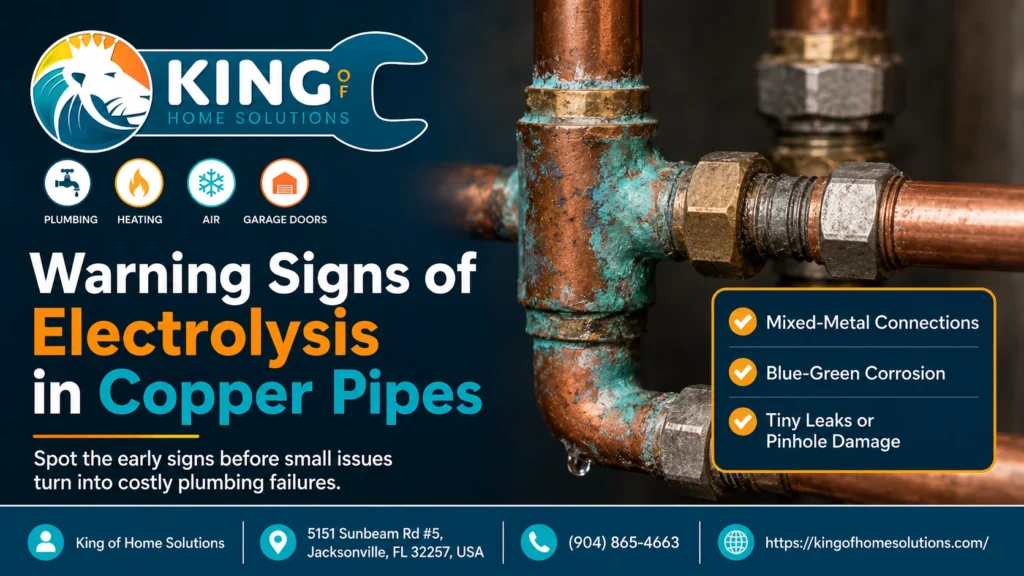
There’s a tiny blue-green spot.
Underneath that spot, corrosion may have been developing for months or years.
Eventually, a microscopic pit reaches completely through the copper.
Now pressurized water has an exit.
At first, you may only get a bead of moisture.
Then a fine spray.
Then enough water to damage drywall, cabinets, flooring, or insulation.
That’s why copper corrosion can feel like a silent plumbing problem.
The pipe may give you very little warning before it leaks.
The Green Spot You Shouldn’t Ignore
If you have exposed copper plumbing, particularly around your:
- Water heater
- Garage
- Utility room
- Repipe manifolds
- Plumbing connections
- Attic
- Outdoor hose connections
look at it closely.
Blue-green deposits on copper can be evidence of corrosion products.
A little oxidation on exposed copper doesn’t automatically mean the pipe is about to fail.
But a concentrated green or bluish crust surrounding a joint, fitting, or tiny dark spot deserves a closer look — especially if it feels damp.
The combination you care about is:
Discoloration + crust + moisture.
That’s different from harmless surface discoloration on an otherwise dry pipe.
Dissimilar Metals Can Create Their Own Corrosion Problem
Here’s where the “electrolysis” conversation usually begins.
Different metals have different electrochemical potentials.
When two dissimilar metals are electrically connected and an electrolyte is present, a small galvanic cell can form.
Water can act as the electrolyte.
That process is known as galvanic corrosion.
For example, a plumbing system may contain combinations of:
Copper.
Galvanized steel.
Brass.
Steel.
Various fittings and valves.
Connecting incompatible materials incorrectly can accelerate corrosion of the more vulnerable metal in that particular pairing.
This is why proper transitions between different plumbing materials matter.
But Here’s the Important Part: Copper Isn’t Always the Metal That Loses
This is where the common explanation of “electrolysis ate your copper pipe” gets oversimplified.
The Copper Development Association specifically notes that in ordinary dissimilar-metal plumbing situations, copper itself is not necessarily the metal that suffers the galvanic attack.
In certain copper-to-steel relationships, for example, the steel or zinc-coated material may be the more vulnerable component.
So when a copper pipe develops pinholes, a plumber shouldn’t simply point at a nearby metal fitting and say:
“Electrolysis.”
There are several other possible causes that need to be considered.
The Real Enemy Is Often Pitting Corrosion
Pitting corrosion is exactly what it sounds like.
Instead of the entire pipe thinning evenly, corrosion concentrates in tiny areas.
Think of somebody drilling microscopic holes into the pipe from the inside.
The outside can still look healthy.
Most of the pipe wall can still be healthy.
But one pit keeps getting deeper.
And deeper.
And deeper.
Until:
Pinhole.
EPA identifies localized pitting as one of the major forms of corrosion affecting metallic drinking-water plumbing.
This is one reason repeated pinholes deserve more attention than a simple patch.
The hole you can see may only be the first location that finally broke through.
What Does Jacksonville Water Have to Do With It?
This part needs some perspective.
JEA’s drinking water comes primarily from the Floridan aquifer and contains naturally occurring dissolved minerals. JEA describes much of its service area’s water as hard because of minerals including calcium and magnesium.
That does not mean JEA water automatically destroys copper piping.
And it would be misleading to say that every Jacksonville copper leak is caused by local water quality.
JEA regularly monitors its drinking water and publishes annual water-quality reports. Its published reports also specifically monitor copper at customer taps as part of regulatory requirements.
The bigger point is this:
Water chemistry matters whenever water and metal spend decades together.
EPA notes that copper release and corrosion can be influenced by several water characteristics and by conditions at the metal surface.
That’s why two homes on the same street can sometimes experience very different plumbing lifespans.
The water isn’t the only variable.
The piping system matters too.
Seven Things That Can Contribute to Copper Pipe Failure
When a Jacksonville home starts developing repeated copper leaks, a proper diagnosis should look beyond one magic explanation.
1. Water Chemistry
Factors including pH, alkalinity, disinfectant chemistry, dissolved constituents, temperature, and the protective scale that forms inside a pipe can influence corrosion behavior.
EPA’s corrosion-control guidance emphasizes that metals release is affected by both water chemistry and the characteristics of the plumbing surface.
2. Excessive Water Velocity
Water moving too quickly through undersized piping, restrictive fittings, or poorly designed sections can contribute to erosion-corrosion.
In simple terms:
The protective surface of the copper can be repeatedly disturbed.
Over time, that can contribute to localized wear.
3. Poor Installation
Copper tubing needs to be installed correctly.
Problems can result from things such as excessive flux, improper soldering practices, damaged tubing, poorly prepared joints, and contamination introduced during installation.
A pipe can therefore begin its life with conditions that make future corrosion more likely.
4. Dissimilar Metals
Improperly connected metals can create galvanic corrosion conditions.
Again, this doesn’t mean copper will always be the metal that fails.
But mixed-metal systems should be evaluated when corrosion appears around connections.
5. Stray Electrical Current
This is the situation closest to true electrolysis.
External stray DC current can produce electrolytic corrosion.
However, the Copper Development Association cautions that true electrolytic corrosion is far less common in plumbing than the term’s widespread use would suggest.
6. Physical Stress
Pipes expand and contract.
Buildings move.
Pipes rubbing against framing, concrete, or other materials can create localized wear or stress.
Eventually, an already vulnerable section can become a leak.
7. Time
Copper plumbing can last a long time.
But no plumbing material is immortal.
If a piping system begins producing repeated pinhole leaks after years of service, the problem may no longer be isolated to one fitting.
You may be seeing the beginning of a system-wide aging or corrosion pattern.
The Jacksonville Water Heater Connection
One place homeowners frequently notice copper problems is near the water heater.
That’s not surprising.
That area brings together several conditions:
Heat.
Metal transitions.
High water usage.
Valves and fittings.
Electrical equipment nearby.
Constant expansion and contraction.
If you see concentrated corrosion near the top of your water heater, don’t automatically assume the water heater itself is leaking.
Look at the copper connections.
Look at threaded transitions.
Look for white or green crust.
Check whether moisture seems to originate at a fitting rather than the tank.
Sometimes the “water heater leak” is actually a plumbing connection immediately above it.
What About Your Electrical Ground?
This is another area where homeowners receive confusing explanations.
You may see grounding or bonding connections attached to metal plumbing.
Then a leak appears.
Someone says:
“Electricity is running through your pipes and eating the copper.”
Maybe.
But don’t jump to that conclusion.
The Copper Development Association says there isn’t good statistical evidence supporting the common claim that normal electrical grounding to copper plumbing is itself responsible for widespread electrolytic copper-tube failure.
Electrical bonding is also a code and safety matter.
Do not start removing clamps or disconnecting wires from your plumbing because you think you’re stopping electrolysis.
If stray voltage or improper bonding is genuinely suspected, the plumbing system and electrical system should be evaluated by qualified professionals.
The Paper-Towel Test
Here’s an easy homeowner inspection.
Find an exposed copper pipe that you’re concerned about.
Dry it completely.
Wrap a clean, dry paper towel around the suspicious area.
Leave it for a short period while the plumbing remains pressurized.
Then check the towel.
A tiny pinhole leak may be difficult to see but easy to detect on dry paper.
Look especially carefully around areas with:
Green crust.
White deposits.
Black pinpoints.
Solder joints.
Unusual discoloration.
A recurring damp spot is worth investigating.
Problems With “Off-the-Shelf” Water Softeners in High-Hardness Areas
The water softener at a big-box store may look like an easy solution. The box promises softer water, fewer spots,…
Read The BlogWhat a Copper Pinhole Leak Can Look Like
Not every failure produces a dramatic spray.
You may see:
A Tiny Green Dot
This can be the first visible clue.
White or Blue-Green Crust
Minerals and copper corrosion products can accumulate around a slowly leaking area.
A Fine Mist
Some pinholes produce an extremely thin stream that’s almost invisible until light hits it.
A Damp Pipe
The pipe may simply feel wet.
Make sure you’re not confusing the problem with condensation.
A Green Streak
Water running down the exterior of copper can carry corrosion products with it.
Water Damage Below the Pipe
Sometimes the first thing you notice isn’t the pipe at all.
It’s the ceiling underneath it.
One Pinhole Leak Is a Repair. Five May Be a Pattern.
This is the conversation Jacksonville homeowners really need to have.
If you have one damaged fitting because of a specific installation issue, repairing that location may be all you need.
But suppose you’ve had:
Leak #1 in the garage.
Leak #2 behind the kitchen wall.
Leak #3 six months later.
Leak #4 in the attic.
At that point, continually patching individual holes becomes a different financial decision.
The question becomes:
Are these isolated failures, or is the plumbing system deteriorating?
That’s when discussing a repipe may make more sense than continuing to chase leaks one at a time.
Why You Shouldn’t Automatically Repipe After One Leak
The opposite mistake happens too.
A pinhole leak does not automatically mean your entire house needs new plumbing.
A good diagnosis should consider:
- The age of the plumbing
- Where the failure occurred
- Whether previous leaks have occurred
- The condition of exposed piping
- Water pressure
- Pipe sizing
- Installation quality
- Whether failures are concentrated around fittings
- Whether multiple areas show corrosion
- The home’s repair history
One failure may be exactly that:
One failure.
Repeated failures tell a different story.
Can a Water Softener Stop Copper Corrosion?
Not necessarily.
Jacksonville homeowners sometimes assume:
Hard water caused the leak, so a softener will fix the pipes.
It’s not that simple.
Water softening changes certain aspects of water chemistry, but copper corrosion is influenced by multiple variables.
You should not install water-treatment equipment solely to stop copper pinholes without understanding what’s actually causing the corrosion.
Water treatment should be selected based on testing and the specific problem you’re trying to solve.
Otherwise, you’re changing the chemistry of your plumbing system without knowing whether that change addresses the failure mechanism.
Why Repairing the Hole Doesn’t Diagnose the Problem
Soldering or replacing the damaged section stops today’s leak.
That’s important.
But after the emergency is over, ask:
Why did this exact section fail?
Was it:
- A bad joint?
- Physical rubbing?
- Localized pitting?
- Excessive velocity?
- A dissimilar-metal connection?
- Stray current?
- Broader pipe deterioration?
Sometimes the answer is obvious.
Sometimes it isn’t.
But when leaks begin repeating, answering that question matters.
The JAX Homeowner Takeaway
“Electrolysis” is a useful plumbing shorthand.
It just isn’t always scientifically accurate.
True electrolytic corrosion requires an outside electrical current. Many situations described as electrolysis are actually galvanic corrosion, localized pitting, erosion-corrosion, or another form of electrochemical attack.
For Jacksonville homeowners, the warning signs are more important than the terminology.
Look for:
Green or blue crust on copper.
Tiny wet spots.
Repeated pinhole leaks.
Corrosion concentrated around fittings.
Unexplained water stains below copper lines.
And pay attention to the pattern.
One pinhole can be an isolated repair.
A string of pinholes throughout the house is your plumbing system telling you something.
So if you’re repairing your third or fourth copper leak, don’t just ask the plumber:
“Can you patch this one?”
Ask:
“Why does this keep happening?”
Because the expensive part of copper corrosion isn’t usually the first tiny hole.
It’s spending years repairing one leak at a time while the rest of the piping quietly heads in the same direction.
Copper Pipes Showing Signs of Trouble?
Don’t wait for corrosion to cause a major leak. Get your JAX copper lines professionally inspected today.