Serving The Jacksonville Area


Heat Pump Not Turning On? Common Causes and When to Call for Repair
Heat Pump Not Turning On? Common Causes and When to Call for Repair
A heat pump not turning on may be caused by incorrect thermostat settings, a tripped circuit breaker, a clogged air filter, a triggered condensate safety switch, or a failed electrical component. Homeowners can safely check basic settings and visible conditions, but problems involving wiring, capacitors, refrigerant, or internal controls require professional diagnosis.
In Jacksonville, FL, a heat pump provides cooling during long, humid summers and heating when temperatures drop. At King of Home Solutions, we help homeowners identify why their systems fail to start and determine the repairs needed to restore reliable operation without unnecessary guesswork.
Heat Pump Won’t Turn On? Get Help Fast!
Restore comfort with professional heat pump repair. Call now for reliable troubleshooting and service!
Quick Answer: Why Is My Heat Pump Not Turning On?
When a heat pump does not start, the cause may involve its thermostat, power supply, airflow, drainage system, or internal equipment.
Some problems are relatively simple. A thermostat may be set incorrectly, or a circuit breaker may have tripped.
Other failures require specialized testing and replacement parts.
The most common possibilities include:
- Incorrect thermostat settings: The system may be turned off, set to the wrong mode, or operating under an unexpected schedule.
- Power interruptions: A tripped breaker or disconnected power supply may prevent startup.
- Dirty air filters: Severely restricted airflow can contribute to overheating, freezing, or protective shutdowns.
- Condensate safety switches: A clogged drain or high water level may trigger a switch that interrupts system operation.
- Failed electrical components: A faulty contactor, capacitor, transformer, or control board can interfere with startup.
- Outdoor unit problems: Fan motor, compressor, electrical, or control failures can prevent normal operation.
- System safety controls: Certain faults can trigger protective shutdowns to prevent equipment damage.
The symptoms matter.
A completely blank thermostat suggests a different problem from an indoor fan that runs while the outdoor unit remains silent.
Before calling for repair, homeowners can check the thermostat, air filter, and accessible electrical panel. They should avoid opening equipment panels or attempting electrical repairs.
If the heat pump still does not respond, a professional examination is the safest next step.
Check the Thermostat Settings First
A thermostat problem is one of the first things worth checking when a heat pump refuses to start.
The thermostat tells the system when heating or cooling is needed. If its settings are incorrect or it cannot communicate with the equipment, the heat pump may not receive a startup command.
Confirm the System Mode
Check whether the thermostat is set to Cool, Heat, or Off.
During Jacksonville’s warm months, the cooling mode should be selected when indoor cooling is needed.
For heating, the thermostat should be set to the appropriate heating mode.
Compare the Set Temperature
A heat pump will not necessarily start if the indoor temperature already meets the thermostat setting.
For example, if the indoor temperature is 76°F and the cooling setpoint is 78°F, the system has no reason to begin cooling.
For a basic test, adjust the setpoint a few degrees beyond the current room temperature.
Allow several minutes for the equipment to respond.
Check the Display
A blank thermostat may indicate dead batteries, interrupted power, or another control-related problem.
If the thermostat uses replaceable batteries, homeowners can install the correct replacements according to the manufacturer’s instructions.
However, some thermostats receive power directly from the HVAC system and do not use ordinary batteries.
Review Smart Thermostat Schedules
Smart thermostats can follow programmed schedules, vacation settings, or energy-saving modes.
An unexpected schedule may make the system appear unresponsive.
Check whether the thermostat is following a programmed setting rather than the desired temperature.
Allow for a Startup Delay
Some heat pumps include a compressor protection delay.
After a setting change or power interruption, the outdoor equipment may wait several minutes before restarting.
A brief delay is not automatically a malfunction.
If the thermostat is correctly configured and the system still does not respond after the normal delay, professional diagnosis may be necessary.
Could a Tripped Breaker or Power Issue Be the Cause?
Heat pumps depend on electrical power to operate the indoor and outdoor components.
A power interruption can prevent the system from starting completely or allow only part of it to run.
Check the Electrical Panel
Homeowners can visually inspect their home’s circuit breaker panel for a breaker in the tripped position.
Heat pump systems may have separate circuits for the indoor air handler and outdoor equipment.
This means one component may have power while another does not.
If the breaker has tripped, follow the equipment manufacturer’s instructions and the home’s electrical safety guidance.
Never repeatedly reset a breaker that continues tripping.
A recurring trip may indicate an electrical fault, overloaded circuit, failing motor, or another condition requiring professional attention.
Consider Recent Power Outages
Jacksonville experiences thunderstorms and periods of severe weather that can interrupt electrical service.
After an outage, the system may have a temporary startup delay or a control-related problem.
If the heat pump stopped working immediately after a storm, share that information with the technician.
Watch for Electrical Warning Signs
Certain symptoms require immediate caution:
- Burning or melting odors.
- Smoke near HVAC equipment.
- Sparks or visible electrical damage.
- Buzzing from electrical components.
- A breaker that trips repeatedly.
- Signs of water entering electrical equipment.
If these conditions occur, avoid operating the equipment and arrange professional service.
Do not remove electrical covers, handle wiring, or attempt to inspect energized components.
A heat pump contains electrical parts that can remain hazardous even after power is disconnected.
How a Dirty Air Filter Can Affect Heat Pump Operation
A clogged air filter usually causes airflow problems rather than a complete electrical startup failure.
However, severe restriction can contribute to conditions that eventually shut down parts of the system.
Restricted Airflow in Cooling Mode
When airflow becomes inadequate, the indoor evaporator coil may become excessively cold.
Under certain conditions, ice can form.
Ice buildup restricts airflow further and can prevent the system from cooling properly.
Some equipment includes protective controls that interrupt operation when abnormal conditions are detected.
Restricted Airflow in Heating Mode
During heating operation, poor airflow can contribute to temperature-related problems in the indoor equipment.
Certain systems may respond by activating protective controls.
The specific behavior depends on the heat pump and air handler design.
Signs of a Clogged Filter
Homeowners may notice:
- Weak airflow from supply vents.
- Uneven temperatures between rooms.
- More dust around return grilles.
- Longer heating or cooling cycles.
- Ice around accessible refrigerant lines or equipment.
- A filter visibly loaded with dust.
What Can Homeowners Do?
If the filter is designed for homeowner replacement, inspect it and replace it when dirty using the correct size and type.
Avoid installing a filter that is too restrictive for the system.
If ice has formed or the equipment has stopped operating, replacing the filter alone may not resolve the underlying problem.
Why Jacksonville Homes Need Airflow Attention
Jacksonville heat pumps operate through extended cooling seasons.
Homes with pets, frequent HVAC use, or high indoor dust levels may need more frequent filter inspections.
Regular filter care supports airflow, but it does not replace professional diagnosis when the system fails to start.
Can a Condensate Safety Switch Stop the System?
Yes. A condensate safety switch can interrupt heat pump operation when the drainage system is not working properly.
This is a particularly relevant concern in Jacksonville because of the area’s high humidity and long cooling season.
Why Heat Pumps Produce Condensate
During cooling, warm indoor air passes over the cold evaporator coil.
Moisture from the air condenses on the coil and collects in a drain pan.
The water then travels through the condensate drain line.
What Happens When the Drain Becomes Clogged?
Algae, sludge, and debris can restrict the drain line.
Water may collect in the drain pan or at a safety switch.
Depending on the system configuration, the float switch may interrupt cooling or shut down part of the HVAC system.
Some installations interrupt thermostat control power, causing the thermostat screen to go blank.
Others stop only certain equipment functions.
Signs of a Drainage Problem
Possible clues include:
- Water collecting near the indoor air handler.
- A wet auxiliary drain pan.
- A thermostat that suddenly becomes blank.
- A system that stops during humid weather.
- Repeated shutdowns accompanied by drainage concerns.
Not every heat pump has the same condensate safety arrangement.
Should Homeowners Reset the Safety Switch?
Homeowners should not bypass, disable, or force a condensate safety switch to remain closed.
The switch may be preventing water damage.
If standing water or a clogged drain is suspected, arrange professional service.
A technician can inspect the drainage system, identify the restriction, and determine whether water has affected other components.
Common Electrical or Control Component Failures
If the thermostat is set correctly and the home has power, an internal electrical or control problem may be preventing startup.
These failures require diagnostic equipment and trained handling.
Failed Capacitor
Certain heat pumps use capacitors to help start or operate motors.
A failed capacitor may prevent the compressor or outdoor fan from starting normally.
Sometimes, a homeowner hears humming or clicking without the expected motor operation.
However, these sounds do not confirm that the capacitor is the cause.
Capacitors can store dangerous electrical energy. They should never be handled as a DIY repair.
Faulty Contactor
The contactor is an electrical switching component used in many outdoor units.
If it fails, power may not reach the intended components.
A technician can determine whether the issue involves the contactor, its control signal, or another part of the system.
Defective Control Board
A control board coordinates equipment functions and safety signals.
Board failures can create inconsistent or complete startup problems.
However, replacing the board without confirming the cause may not solve the issue.
Transformer or Control-Voltage Problems
Many thermostats and HVAC controls use low-voltage electrical circuits.
A failed transformer, damaged wiring, or blown low-voltage fuse can prevent the system from responding.
Safety Control Shutdowns
Protective controls may prevent operation when the system detects certain abnormal conditions.
These controls should not be bypassed.
At King of Home Solutions, our diagnostic process is designed to identify the actual failure rather than replace parts based only on the symptoms a homeowner can observe.
Can the Outdoor Unit Cause a Complete Startup Failure?
Yes. Problems involving the outdoor unit can prevent normal heat pump operation.
However, it is important to distinguish a completely inactive system from a heat pump whose indoor fan operates but whose outdoor equipment does not.
Outdoor Fan Motor Problems
The outdoor fan helps move air across the outdoor coil.
If the motor fails, the heat pump may not operate normally or may shut down on a protective control.
Compressor Problems
The compressor is central to the heat pump’s refrigerant cycle.
If it fails to start, the system cannot provide normal heating and cooling.
Compressor-related failures require specialized testing.
Electrical Supply Problems
The outdoor unit may lose power while the indoor equipment remains energized.
This can make the thermostat and indoor fan appear normal even though heating or cooling is unavailable.
Control Communication Issues
Some newer systems use communicating controls.
Faults involving communication between components can prevent startup.
Refrigerant-Related Safety Shutdowns
Certain heat pumps monitor operating conditions and may shut down when abnormal pressures or other faults are detected.
Refrigerant problems require professional evaluation.
Homeowners should never open refrigerant connections or attempt to add refrigerant themselves.
What Can Be Checked From Outside?
Without touching equipment, homeowners can observe whether the outdoor unit is:
- Completely silent.
- Making unusual clicking or humming noises.
- Producing repeated startup attempts.
- Surrounded by visible debris.
- Showing unusual ice buildup.
- Displaying an accessible fault message.
These observations can help the technician begin diagnosis.
However, they are not enough to determine which component has failed.
What Signs Point to a More Serious Heat Pump Problem?
Some startup problems are straightforward.
Others indicate equipment damage or a condition that may worsen if the system continues trying to operate.
Repeated Breaker Trips
A breaker that trips repeatedly may indicate an electrical fault.
Stop attempting to restart the equipment and arrange service.
Burning Smells
A persistent electrical or burning odor should be taken seriously.
If the system can be shut down safely, stop using it and seek professional assistance.
Smoke or fire requires emergency response.
Loud Mechanical Noises
Grinding, banging, or harsh metal sounds may indicate damaged mechanical components.
Continuing to operate the system could cause additional damage.
Smart Thermostats: Nest vs. Ecobee for Florida Humidity Control
Your thermostat says 74°F. But the house still feels sticky. The sheets feel damp. The tile feels cool but clammy.…
Read The BlogFrequent Attempts to Restart
A system that repeatedly tries to start but immediately shuts down may have a control, safety, or equipment problem.
Ice on the Equipment
Ice on an indoor cooling coil or refrigerant line may indicate airflow or refrigerant-related concerns.
Some frost on an outdoor heat pump during cold-weather heating is normal, but excessive or persistent ice can be a problem.
Water Around Indoor Equipment
Water collecting near the air handler may indicate a blocked condensate drain or other drainage issue.
If water is near electrical components, avoid touching the equipment.
No Heating or Cooling Despite Running Fans
Sometimes, the indoor fan operates but the heat pump does not provide the expected temperature change.
This may point to an outdoor-unit, refrigerant-cycle, or control problem.
A professional assessment is needed to determine the cause.
What Can Homeowners Safely Check Before Calling for Repair?
Before scheduling a service visit, homeowners can perform a few basic checks that do not require opening equipment or handling internal components.
These observations may help identify a simple setting issue or provide useful information for the technician.
A Safe Heat Pump Startup Checklist
- Check thermostat mode. Confirm that heating or cooling is selected instead of Off.
- Review the temperature setting. Make sure the requested temperature actually calls for heating or cooling.
- Check thermostat batteries. Replace them if the model uses standard replaceable batteries and they are depleted.
- Allow for a normal delay. Give the system several minutes after a setting change or power interruption.
- Inspect the circuit breaker panel visually. Note any tripped breaker and avoid repeated resets.
- Look at the air filter. Replace a dirty homeowner-serviceable filter with the correct type.
- Check for visible water. Look for water near the indoor unit without opening equipment.
- Observe the outdoor unit. Note whether it is silent, unusually noisy, or surrounded by visible debris.
- Check for thermostat alerts. Record any displayed error message or system notification.
These checks should remain limited to normal homeowner-accessible areas.
What Homeowners Should Never Attempt
Do not:
- Remove electrical service panels.
- Test or replace capacitors.
- Handle energized wiring.
- Bypass safety switches.
- Open refrigerant lines.
- Attempt compressor repairs.
- Force a stuck motor or fan to move.
- Repeatedly reset tripping electrical protection.
If the equipment requires internal testing, it is time for professional service.
What Information Helps the Technician?
Before calling, try to note:
- When the problem started.
- Whether it followed a storm or outage.
- Whether the thermostat display works.
- Whether the indoor fan runs.
- Whether the outdoor unit runs.
- Any unusual sounds, odors, or visible water.
- Whether the system previously had intermittent problems.
These details help narrow the initial diagnostic possibilities.
When Should You Call a Heat Pump Repair Technician?
Homeowners should arrange professional heat pump repair when the system does not start after safe basic checks or when warning signs suggest an internal fault.
A service call is particularly important when the problem cannot be explained by thermostat settings, normal startup delays, or a simple filter concern.
Call When the System Remains Completely Unresponsive
If the thermostat calls for heating or cooling but nothing starts, the problem may involve electrical supply, controls, or equipment safety systems.
Call When the Outdoor Unit Does Not Operate
If the indoor fan runs but the outdoor equipment remains inactive, a technician can determine whether the fault involves the power supply, compressor, motor, or controls.
Call for Repeated Shutdowns
A heat pump that starts briefly and stops repeatedly may be activating a protective control.
Repeated attempts to force operation can be harmful.
Call When Water Is Present
Water around the air handler may signal a drainage problem.
The system should be evaluated before continued operation causes further damage.
Call for Burning Odors or Electrical Warning Signs
Stop using the system if it is safe to do so, and seek immediate professional assistance for suspected electrical problems.
Call When Comfort Is Being Affected
Jacksonville’s hot, humid conditions can make a prolonged cooling failure especially uncomfortable.
Indoor temperatures may rise quickly, and humidity control can be lost when the system remains inactive.
Households with infants, older adults, or people who are particularly vulnerable to heat should make appropriate arrangements for a safe indoor environment while repairs are being addressed.
A heat pump that will not start is not necessarily beyond repair. The correct solution begins with identifying why it is not responding.
Heat Pump Repair in Jacksonville
Jacksonville’s climate places significant demands on heat pump systems.
Long cooling seasons, high humidity, heavy rain, and seasonal storms can contribute to conditions that affect system reliability.
A heat pump that operates throughout much of the year may experience different problems from equipment used only occasionally.
At King of Home Solutions, we provide professional heat pump diagnosis and repair for homeowners throughout Jacksonville and surrounding communities.
We Identify the Cause of the Startup Failure
Our technicians inspect the system to determine whether the issue involves the thermostat, electrical controls, airflow, drainage, indoor equipment, or outdoor components.
Instead of assuming a particular part has failed, we use diagnostic findings to guide repair recommendations.
We Explain the Repair Options
Once the cause is identified, we discuss the recommended work and explain what needs attention.
A heat pump that will not start may need a relatively small component replaced, but some failures involve more extensive equipment problems.
We Repair Heating and Cooling Problems
Because heat pumps provide both heating and cooling, startup failures can affect comfort in different seasons.
Our Heat Pump Repair services address equipment that fails to start, struggles to maintain temperature, or develops performance problems.
We Help Homeowners Reduce Future Breakdown Risks
After a repair, appropriate system care can help identify developing problems.
Our Heat Pump Maintenance services include inspections, component cleaning, airflow checks, and thermostat evaluations.
Maintenance can reduce certain risks, but no tune-up guarantees that a component will never fail.
Serving Jacksonville and Nearby Communities
We help homeowners in Jacksonville and surrounding areas, including Mandarin, Bartram Springs, San Marco, Arlington, and other communities across Duval County.
Whether the equipment stops during a humid afternoon or fails to provide heating on a cooler morning, our goal is to identify the problem and explain the appropriate next step.
FAQs About Heat Pumps That Will Not Turn On
Why is my heat pump not turning on even though the thermostat works?
The thermostat may have power while the heat pump has an electrical, control, or safety-related problem. A technician can determine whether the outdoor unit or another component is preventing startup.
Can a dirty filter stop a heat pump from turning on?
A dirty filter usually causes restricted airflow rather than a direct electrical failure. However, severe restriction can contribute to freezing, overheating, or protective shutdowns.
Will a heat pump start after a power outage?
It may restart automatically after power returns, although some systems have a protective delay. If the unit remains unresponsive, professional evaluation may be necessary.
Can a clogged condensate drain stop the heat pump?
Yes. Certain HVAC systems use float switches that interrupt operation when condensate cannot drain properly. These switches should not be bypassed.
Why does the indoor fan run but the outdoor heat pump does not?
Possible causes include outdoor electrical faults, control problems, motor failure, compressor issues, or safety shutdowns. The exact cause requires professional diagnosis.
How long should a heat pump take to start?
Many systems begin responding within a few minutes, but some have built-in compressor protection delays. If the equipment does not respond after the normal delay, check the thermostat settings and seek service if needed.
Should I reset a tripped heat pump breaker?
Follow the manufacturer’s instructions and applicable electrical safety guidance. If the breaker trips again, do not repeatedly reset it. Have the electrical or HVAC problem professionally evaluated.
Can a heat pump stop working because of humidity?
Humidity does not ordinarily stop a functioning heat pump directly. However, heavy moisture removal during cooling can contribute to condensate drainage problems that trigger protective shutdowns.
Don’t Let a Silent Heat Pump Leave Your Jacksonville Home Uncomfortable
When your heat pump is not turning on, the problem may be as simple as an incorrect thermostat setting or as serious as an electrical or compressor failure.
A few safe checks can help rule out obvious issues, but internal diagnostics should be handled by a trained technician.
At King of Home Solutions, we help Jacksonville homeowners determine why their heat pumps stop responding and recommend repairs based on the actual condition of the equipment.
Our team works with heating and cooling components, electrical controls, condensate drainage systems, and other parts that can affect startup.
If the thermostat is calling for heating or cooling but the system remains inactive, there is no need to keep changing settings or repeatedly attempting restarts.
Professional diagnosis can identify the cause and help prevent unnecessary equipment damage.
Get Your Heat Pump Running Again With King of Home Solutions
Jacksonville homeowners can contact King of Home Solutions for heat pump troubleshooting and repair.
Call 904-865-4663 or visit our office at 5151-5 Sunbeam Road, Jacksonville, FL 32257.
Our team is ready to evaluate your system, explain the findings, and recommend the appropriate repair.
Schedule your heat pump repair today and get back to comfortable heating and cooling.
No Heat? Don’t Wait for Repairs!
Get your heat pump running again with expert diagnosis and dependable repair. Call today!
Recent News
Why North Florida Homes Are Switching to Heat Pumps in 2026

Top 5 Garage Door “Curb Appeal” Trends in Jacksonville: 2024 Edition
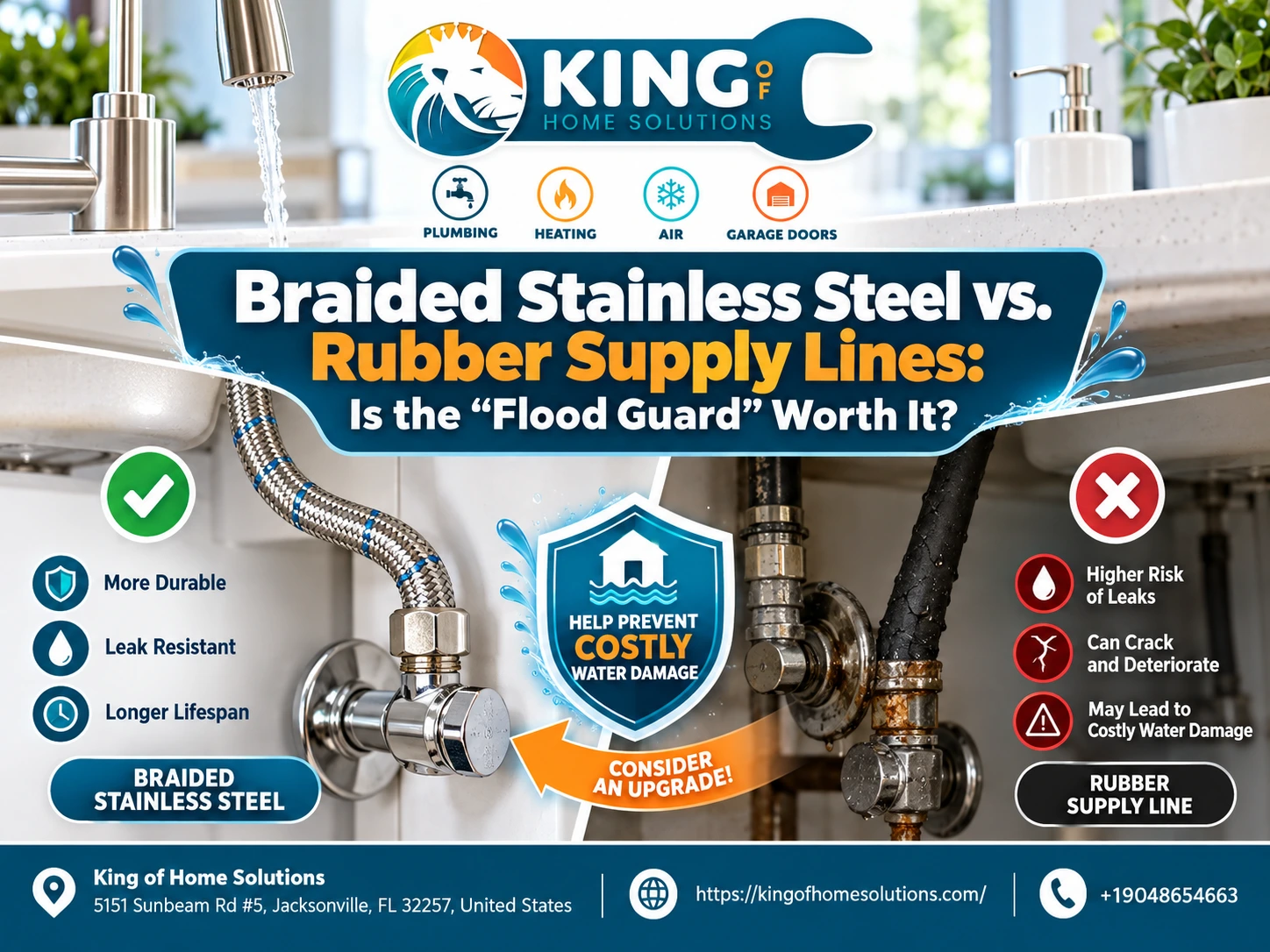
Braided Stainless Steel vs. Rubber Supply Lines: Is the “Flood Guard” Worth It?

5 Plumbing Upgrades That Can Increase a Jacksonville Home’s Resale Value