Serving The Jacksonville Area


Why Your Kitchen Sink Has “Low Pressure” but the Shower Is Fine
Why Your Kitchen Sink Has “Low Pressure” but the Shower Is Fine
You turn on the kitchen faucet and get a weak stream.
Then you walk into the bathroom, turn on the shower, and the water pressure feels completely normal.
That immediately tells you something important:
You probably do not have a whole-house water pressure problem.
When only the kitchen sink has weak flow, the issue is usually much closer to the faucet itself.
A clogged aerator, partially closed shutoff valve, kinked supply line, faucet cartridge problem, or debris inside the fixture can all reduce flow at one sink without affecting the shower, toilets, washing machine, or other plumbing fixtures.
The good news is that many of these problems are relatively simple to diagnose.
The important part is knowing where to look first.
First, Is It Really “Low Pressure”?
Homeowners often use the phrase “low water pressure” for any weak faucet.
But technically, you may be dealing with a flow restriction rather than low pressure throughout the plumbing system.
Your home’s water pressure could be perfectly normal.
The problem may simply be that something is preventing enough water from reaching the end of the kitchen faucet.
Think about a garden hose.
If the hose has full pressure at the spigot but someone pinches the hose halfway down, the water coming out of the nozzle becomes weaker.
The source pressure hasn’t necessarily changed.
The pathway has become restricted.
That is often what happens when one faucet is weak while everything else works normally.
Start With the Faucet Aerator
The most common culprit is also one of the easiest to check:
the aerator.
The aerator is the small screen assembly at the tip of many kitchen faucets.
Its job is to shape the stream, reduce splashing, and mix air into the water.
Unfortunately, it is also a perfect collection point for debris.
Over time, the aerator can become clogged with:
- Mineral deposits
- Rust particles
- Sand
- Sediment
- Pipe scale
- Small pieces of plumbing debris
When those openings become restricted, water flow drops dramatically.
The rest of the house can have excellent pressure while your kitchen faucet produces little more than a trickle.
If the problem began gradually, mineral buildup is a strong possibility.
If the problem appeared suddenly after plumbing work, a water shutoff, water-heater service, or utility repair, debris may have been disturbed and carried into the aerator.
Why the Shower Can Still Be Fine
The shower and kitchen sink are different fixtures with different pathways.
They may share the same main water supply, but each has its own:
- Branch piping
- Shutoff valves
- Supply connections
- Cartridges
- Screens
- Flow-control components
A restriction at the kitchen faucet doesn’t affect the bathroom shower because the shower water never passes through the kitchen faucet’s aerator or supply lines.
That’s why comparing multiple fixtures is so useful.
If every fixture in the house is weak, you investigate the main water supply.
If only one fixture is weak, you start locally.
Check Whether Both Hot and Cold Water Are Weak
This is one of the easiest ways to narrow down the problem.
Turn the kitchen faucet fully cold.
Then test it fully hot.
If both hot and cold have weak flow, the restriction is probably somewhere both water supplies share.
That could mean:
- A clogged aerator
- A blocked faucet cartridge
- A problem inside the faucet body
- A pull-down spray head restriction
If only the hot side is weak, the issue is likely on the hot-water side.
Possible causes include:
- A partially closed hot shutoff valve
- A blocked hot supply line
- Debris in the hot side of the faucet
- A localized plumbing restriction
If only the cold side is weak, investigate the cold side instead.
This simple comparison can save a lot of guesswork.
Look Under the Sink at the Shutoff Valves
Under most kitchen sinks are separate shutoff valves for hot and cold water.
These valves allow the faucet to be serviced without shutting off water to the entire house.
Sometimes one is not fully open.
This can happen after:
- Faucet replacement
- Garbage disposal work
- Dishwasher installation
- Cabinet repairs
- Leak repairs
- Plumbing inspections
A valve that is only partially open can restrict flow.
Older shutoff valves can also fail internally.
The handle may appear open even though the internal mechanism is not allowing full water flow.
Do not force an old or corroded valve.
If a valve looks heavily rusted, leaks around the stem, or feels stuck, forcing it can turn a minor flow problem into a water leak.
That is a good point to call a plumber.
Check the Supply Lines
The flexible lines connecting your shutoff valves to the faucet can also cause low flow.
A supply line may be:
- Kinked
- Bent sharply
- Pinched behind stored items
- Internally deteriorated
- Partially blocked with debris
This is especially worth checking if the faucet was recently replaced or if items under the sink were moved.
A flexible line can look normal at first glance but still have a tight bend that limits flow.
If both the hot and cold lines are affected, though, a shared faucet component remains more likely.
Pull-Down and Pull-Out Faucets Have Another Common Problem
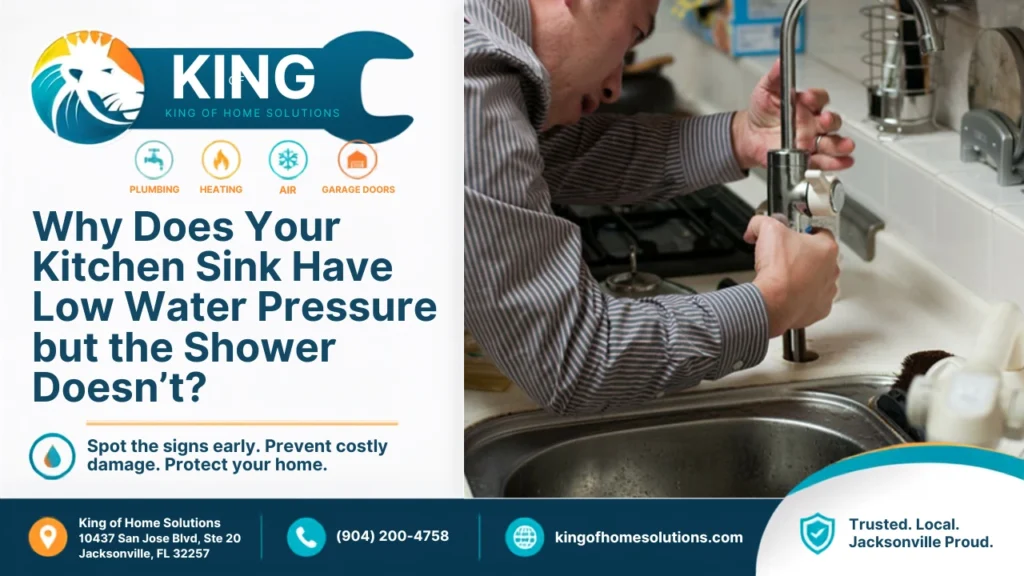
Modern kitchen faucets often use pull-down or pull-out spray heads.
These are convenient, but they add more places where water flow can become restricted.
The spray head itself may have:
- Mineral buildup
- A clogged screen
- Debris inside the nozzle
- A failing diverter
- A restricted hose
Some faucets also contain small filters or check valves inside the spray hose connection.
If those become clogged, the faucet may have weak flow even when the aerator looks clean.
You may also notice that one spray setting works better than another.
That points toward the spray head rather than the home’s water supply.
The Faucet Cartridge May Be Clogged or Failing
Inside many modern kitchen faucets is a cartridge that controls temperature and water flow.
Cartridges wear over time.
They can also collect sediment and mineral deposits.
A restricted cartridge may cause:
- Low flow
- Uneven hot and cold water
- Difficulty adjusting temperature
- Dripping
- Stiff handle movement
If the faucet has good supply pressure entering it but weak water leaving it, the cartridge becomes a strong suspect.
Replacing a faucet cartridge can sometimes restore normal flow without replacing the entire faucet.
However, if the fixture is old and several parts are failing, replacement may make more financial sense.
Did the Problem Start After the Water Was Shut Off?
This detail matters.
Suppose a plumber replaced your water heater.
Or the city shut down the water main for repairs.
Everything worked normally before.
After the water came back on, the kitchen faucet suddenly had poor flow.
That often suggests debris.
When water lines are depressurized and repressurized, sediment or mineral scale can break loose inside the plumbing.
Those particles move downstream until they reach a small opening.
The kitchen faucet aerator is often where they stop.
This is why a sudden one-fixture pressure problem following plumbing work is usually worth checking for debris before assuming something more serious has failed.
Could It Be a Bigger Plumbing Problem?
Yes, but the symptoms are usually different.
If the kitchen sink is weak and other fixtures are beginning to lose pressure, then you may have a broader issue.
Possible whole-house causes can include:
- A failing pressure regulator
- A partially closed main shutoff valve
- A water-main problem
- A private well issue
- A clogged whole-house filter
- Pipe corrosion
- A plumbing leak
If the shower remains strong and every other fixture works normally, these causes become less likely.
That is why fixture comparison is so valuable.
What If the Pressure Drops Only When Another Fixture Runs?
Suppose the kitchen faucet works reasonably well until someone starts the shower.
Then it becomes noticeably weaker.
That could indicate a supply-capacity issue rather than a clogged faucet.
The home may have:
- Small or restricted supply piping
- Aging galvanized pipes
- Low municipal pressure
- A pressure regulator problem
- A well-system issue
The difference is that the symptom appears when multiple fixtures compete for water.
A plumber can measure static and flowing water pressure to determine what is actually happening.
Don’t Ignore Old Galvanized Pipes
In older homes, galvanized steel piping can gradually corrode from the inside.
The pipe may look normal externally while the usable opening inside becomes much smaller.
This can create localized low-flow problems.
Sometimes one branch line becomes heavily restricted while another still works adequately.
If your kitchen sink has weak hot and cold flow, the faucet is clean, the valves are open, and the supply lines are clear, older branch piping may deserve inspection.
This is particularly important if your home has a history of rusty water or recurring low-flow problems.
When Should You Call a Plumber?
A homeowner can reasonably check the easy things:
- Compare hot and cold flow
- Inspect the aerator
- Look for obvious supply-line kinks
- Confirm the shutoff valves haven’t been accidentally closed
- Check the spray head for visible buildup
Call a plumber if:
- The shutoff valve is stuck or leaking
- Flow remains weak after cleaning the aerator
- Both hot and cold are restricted
- The faucet has internal cartridge problems
- You suspect pipe corrosion
- Multiple fixtures are losing pressure
- The problem appeared after plumbing damage
- You hear unusual sounds inside the pipes
The important thing is to avoid replacing random parts without knowing where the restriction is.
The Bottom Line
If your kitchen sink has weak water flow but the shower is fine, the problem is usually not your entire home’s water pressure.
It is probably local to the kitchen.
Start with the faucet aerator.
Then compare hot and cold flow.
Check the shutoff valves.
Inspect the supply lines.
Look at the spray head and faucet cartridge.
If those all check out, then it may be time to investigate the branch piping.
The key clue is the shower.
If your shower still delivers strong water pressure, your plumbing system is telling you something:
The water is reaching the house just fine. Something near the kitchen sink is probably getting in its way.