Serving The Jacksonville Area


Best “Salt-Resistant” Outdoor Finishes for Plumbing and HVAC
Best “Salt-Resistant” Outdoor Finishes for Plumbing and HVAC
You live near Jacksonville Beach and install a brand-new outdoor AC unit.
Two summers later, the cabinet screws are turning orange.
The condenser fins look chalky.
A pipe bracket beside the house is rusting.
And hardware that looked perfect when installed already seems years older than it should.
That’s coastal living.
Salt doesn’t have to arrive as visible ocean spray. Tiny chloride particles can travel inland on humid coastal air, settle on metal surfaces, absorb moisture, and accelerate corrosion.
Carrier notes that salt can affect HVAC equipment as far as roughly two miles from the coastline, although actual severity depends on wind direction, humidity, exposure, and local conditions.
For Jacksonville Beach, Atlantic Beach, Neptune Beach, Ponte Vedra, and other coastal properties, choosing outdoor plumbing and HVAC materials based only on appearance can therefore become expensive.
The better question is:
Which finishes can actually survive salt air?
For HVAC coils, factory-applied e-coat or baked phenolic coatings are among the strongest options.
For structural steel, a zinc-rich primer, epoxy intermediate coat, and polyurethane topcoat is a proven marine-style system.
For brackets and outdoor hardware, 316 stainless steel is generally preferable to ordinary plated steel.
And for galvanized supports, combining galvanizing with a compatible paint or powder coating—a duplex system—can provide even greater protection.
Let’s look at where each belongs.
#1: Factory E-Coat — Best Protection for HVAC Coils
If you are buying a new condenser for a house near the ocean, corrosion protection is easiest to address before the equipment arrives.
One of the strongest options is factory electro-deposition coating, commonly called e-coat.
The HVAC coil is immersed in a coating bath and electrically charged so the protective polymer deposits across the conductive surfaces.
Why does this matter?
An HVAC condenser coil contains an enormous number of thin fins, edges, tubes, joints, and hidden surfaces.
Trying to spray those areas afterward can leave microscopic gaps.
A properly applied e-coat can cover extremely complex coil geometry much more uniformly.
Modine’s ElectroFin system, for example, uses a cathodic epoxy e-coating process specifically for HVAC heat exchangers and reports passing ASTM B117 salt-spray testing beyond 15,000 hours.
That doesn’t mean every e-coated condenser will last forever beside the Atlantic.
Salt-spray testing is not a literal prediction of years in service.
But it does demonstrate why factory coil coating is a serious upgrade for severe coastal environments.
Best for:
- Condenser coils
- Heat-pump outdoor coils
- Microchannel coils
- Coastal HVAC replacements
Verdict:
My first choice when buying new HVAC equipment close to the coast.
#2: Baked Phenolic-Epoxy — Excellent for Severe Marine Exposure
Another premium HVAC option is a baked phenolic or phenolic-epoxy coating.
These coatings are widely used where coils encounter salt air, industrial contaminants, humidity, and corrosive chemicals.
Heresite’s P-413 phenolic-epoxy system, for example, was developed for heat exchangers and is tested to ISO 12944-9 conditions intended to represent severe offshore marine exposure. The manufacturer reports less than a 1% impact on heat-transfer performance.
That last detail matters.
You cannot simply cover an AC coil with ordinary thick exterior paint.
The fins need to transfer heat efficiently.
A protective coating must resist corrosion without insulating the heat exchanger so heavily that the air conditioner stops doing its job efficiently.
That is why specialized HVAC coil coatings are very different from ordinary spray paint.
Best for:
- Oceanfront HVAC systems
- Condenser and evaporator coils
- Particularly aggressive coastal locations
- Commercial or premium residential applications
Verdict:
Excellent marine-grade protection when properly factory or professionally applied.
#3: Zinc + Epoxy + Polyurethane — Best for Outdoor Steel
Your HVAC coil isn’t the only component exposed to salt.
Think about:
- Condenser stands
- Pipe supports
- Steel brackets
- Equipment platforms
- Protective cages
- Exterior plumbing supports
For carbon steel in a high-humidity, salt-exposed environment, AMPP identifies a zinc-epoxy-urethane system as one of the most common coating approaches.
Each layer has a different job.
The zinc-rich primer provides sacrificial protection to the steel.
The epoxy intermediate coat creates a tough moisture and chemical barrier.
The polyurethane topcoat improves resistance to sunlight while helping preserve color and appearance.
Think of it as three layers of defense rather than one decorative coat of paint.
For Jacksonville Beach equipment racks and exposed steel supports, this type of system is dramatically more appropriate than inexpensive household spray enamel.
Best for:
- Steel condenser stands
- Exterior equipment frames
- Pipe brackets
- Outdoor mechanical supports
Verdict:
One of the strongest coating systems for steel in exposed coastal environments.
#4: Hot-Dip Galvanizing — Excellent for Brackets and Supports
Galvanizing protects steel with zinc.
Instead of allowing the underlying steel to rust first, zinc provides barrier and sacrificial protection.
That can make hot-dip galvanized steel excellent for outdoor supports, stands, structural brackets, and miscellaneous mechanical components.
The American Galvanizers Association notes that galvanized steel performs in marine atmospheres, although chloride exposure, humidity, wind, temperature, and distance from the coastline all influence corrosion rates.
Very close to the ocean, even zinc has a difficult job.
That is where a duplex system becomes attractive.
A duplex system combines:
hot-dip galvanizing + paint or powder coating.
The galvanized zinc protects the steel if the outer coating becomes damaged, while the paint slows exposure of the zinc.
Current AGA guidance notes that duplex systems can considerably extend service life in aggressive coastal applications compared with either coating alone.
Best for:
- HVAC platforms
- Outdoor plumbing racks
- Pipe supports
- Coastal structural brackets
Verdict:
Very good alone; even better with a compatible marine topcoat.
#5: 316 Stainless Steel — Best for Small Hardware
Strictly speaking, stainless steel is a material rather than a finish.
But for coastal plumbing and HVAC hardware, material selection often matters more than coating.
Consider the small parts holding expensive equipment together:
- Screws
- Bolts
- Washers
- Pipe clamps
- Hose clamps
- Mounting brackets
Cheap zinc-plated hardware can begin rusting quickly in salt air.
For coastal use, 316 stainless steel is generally preferable to ordinary 304 stainless because its alloy composition provides improved resistance to chloride attack.
The Nickel Institute identifies Type 316 among the preferred fastener materials for marine service above the waterline.
That does not mean 316 is immune to salt.
Very aggressive marine environments can still cause pitting and crevice corrosion, particularly where salt remains trapped and wet.
But for residential exterior hardware near Jacksonville’s coast, 316 stainless is usually a substantial improvement over ordinary carbon steel hardware.
Best for:
- Fasteners
- Pipe clamps
- Outdoor screws
- Mounting hardware
Verdict:
Spend the extra money here. Small hardware is a bad place to save $20 on an oceanfront installation.
What About Powder Coating?
Powder coating can provide excellent protection when properly specified and applied.
Many outdoor HVAC cabinets already use polyester powder coatings.
Carrier’s current coastal equipment, for example, incorporates heavier polyester powder coatings along with increased zinc plating and additional protective layers on certain components.
But the phrase “powder coated” does not automatically mean “marine grade.”
Surface preparation, coating chemistry, thickness, edges, scratches, and the metal underneath all affect performance.
A cheap powder coating applied over poorly prepared steel can still begin rusting from a chip.
For extreme coastal exposure, powder coat over galvanized steel can be much more durable than powder coating over untreated carbon steel.
What About Exposed Copper Plumbing?
Copper presents a different problem.
Copper naturally develops oxidation and patina.
A little discoloration does not necessarily mean the pipe is failing.
For exposed plumbing near the coast, I would focus less on painting every copper surface and more on:
- Correct pipe material
- Proper insulation
- UV-resistant exterior jacketing
- Corrosion-resistant supports
- Avoiding incompatible metal contact
- Protecting fittings and valves from direct salt exposure
Refrigerant suction lines should already be insulated.
That insulation also needs weather-resistant exterior protection because sunlight and weather can destroy exposed foam insulation long before the copper tubing fails.
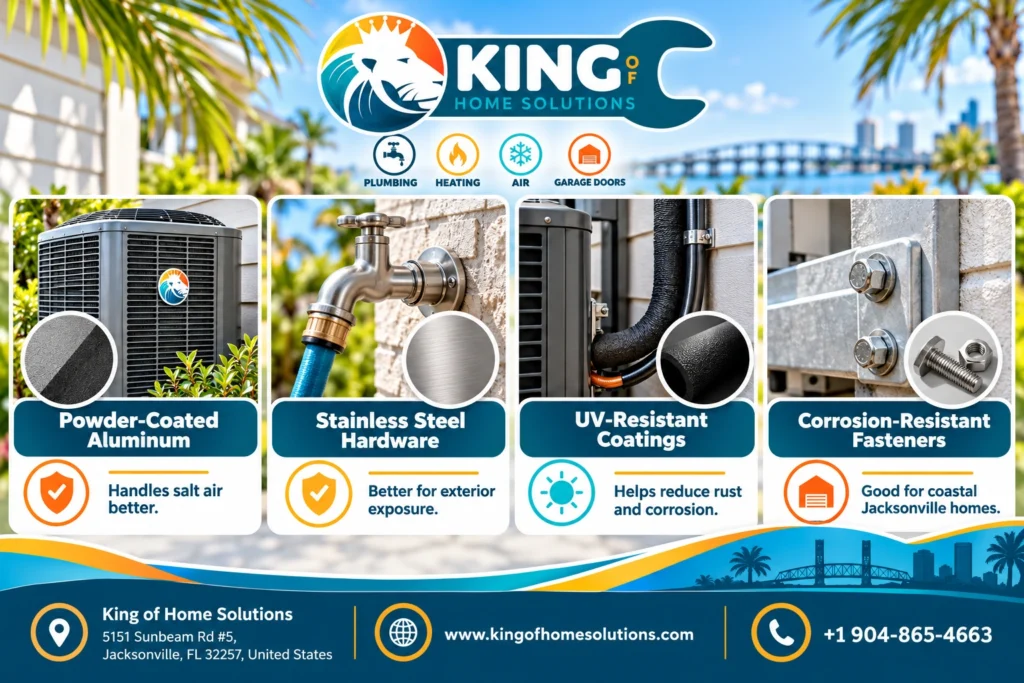
Don’t Create Galvanic Corrosion While Fighting Rust
This is an easy coastal mistake.
You replace a rusty steel fastener with beautiful stainless hardware.
But now you have dissimilar metals touching each other in a wet, salty environment.
Under certain circumstances, that can create galvanic corrosion.
Carrier specifically cites galvanic corrosion between dissimilar metals as one reason it redesigned portions of its coastal equipment around welded aluminum coil technology and isolated copper/aluminum transitions from seacoast air.
Material compatibility therefore matters.
A good coastal installation is not simply:
“Use stainless everywhere.”
It considers which metals touch each other and how moisture reaches those connections.
The Most Underrated “Coating”: Fresh Water
No finish makes maintenance irrelevant.
Salt accumulates.
Remove it.
Trane’s coastal HVAC guidance specifically recommends routinely washing seaside outdoor units with non-salty fresh water to remove accumulated salt from the coil, refrigerant piping, cabinet, and electrical enclosure surfaces.
Avoid blasting delicate condenser fins with excessive pressure.
Follow the equipment manufacturer’s cleaning instructions.
The goal is simply to keep chloride deposits from sitting on the unit indefinitely.
This is particularly important for sheltered equipment.
Rain may rinse an exposed condenser occasionally.
A unit beneath an overhang may actually retain salt longer because rainfall never reaches it.
What Would I Choose for a Jacksonville Beach Home?
For a new coastal HVAC system:
Factory coastal package with e-coated, phenolic-coated, or purpose-designed corrosion-resistant coils.
For steel stands and supports:
Hot-dip galvanized steel, preferably with a compatible marine coating in severe exposure.
For painted steel:
Zinc-rich primer + epoxy + polyurethane or polysiloxane system.
For screws, clamps, and fasteners:
316 stainless steel where compatible.
For equipment cabinets:
High-quality polyester powder coat or factory coastal coating.
And for everything:
Regular fresh-water salt removal and inspection.
The Bottom Line
There is no paint that makes outdoor equipment truly “salt proof.”
Jacksonville’s coastal environment will eventually challenge almost every exposed material.
The goal is to make corrosion work much harder.
For HVAC coils, factory e-coat or baked phenolic-epoxy protection offers some of the strongest defenses.
For exposed steel, zinc plus epoxy and polyurethane provides a proven layered system.
For structural components, hot-dip galvanizing especially with a duplex topcoat can provide excellent durability.
For hardware, 316 stainless is usually worth the premium.
And regardless of which finish you buy, wash away accumulated salt.
Because near Jacksonville Beach, the difference between equipment that looks ten years old after three summers and equipment that continues performing for years often isn’t the size of the AC or the brand of the plumbing valve.
It’s how well the metal was protected before the first salty breeze ever reached it.