Serving The Jacksonville Area


Fiberglass vs. Steel Entry Doors for Jacksonville Beach Homes
Fiberglass vs. Steel Entry Doors for Jacksonville Beach Homes
You replace the front door.
It looks perfect.
Then a few years of Jacksonville Beach weather get involved.
Salt air reaches the hardware. Humidity stays high for months. Afternoon thunderstorms repeatedly soak the entry. Strong sun hits the exterior finish. Eventually, you notice bubbling paint near the bottom edge or a tiny orange spot around a scratch.
That is why choosing an entry door for a Jacksonville Beach home is different from choosing one for a house 100 miles inland.
Two of the most popular options are fiberglass and steel.
Steel generally costs less, feels substantial, and can offer excellent security.
Fiberglass costs more in many configurations, but it has one enormous advantage near the coast:
Fiberglass itself does not rust.
For a home exposed to salty coastal air, that can make the higher upfront price easier to justify.
But material alone isn’t the whole decision. Wind rating, impact resistance, glass, frame material, hardware, installation, and maintenance can matter just as much as whether the door skin is steel or fiberglass.
The Quick Comparison
For many Jacksonville Beach homeowners, the tradeoff looks like this:
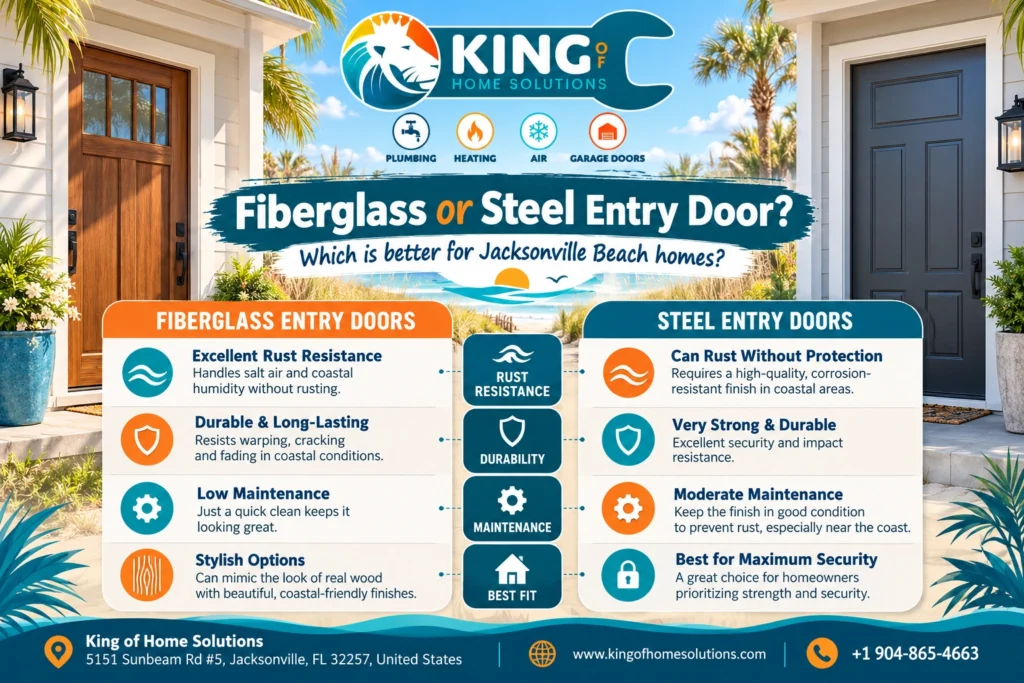
Steel: Lower upfront cost, strong, good insulation but vulnerable to dents, scratches, and corrosion if the protective finish is damaged.
Fiberglass: Usually more expensive, highly resistant to rust and dents, low maintenance, and available in convincing wood-look finishes.
Current 2026 Jacksonville-area estimates put many steel entry doors around $400 to $1,175 for the door itself, while fiberglass doors may run approximately $575 to $2,425 before installation, depending heavily on style, glass, and quality.
Broader installed estimates put steel doors around $900 to $2,500 and fiberglass around $1,500 to $4,000, with sidelights, decorative glass, impact ratings, and custom configurations pushing either material substantially higher.
For a Jacksonville Beach house, however, the upfront price is only half the calculation.
Why Salt Air Is Hard on Steel
A modern steel entry door is not a solid slab of bare metal.
Most residential steel doors use relatively thin steel skins over an insulated core, with factory-applied protective coatings and finishes.
As long as that protective surface remains intact, the door can perform very well.
The problem begins when the coating becomes damaged.
A scratch.
A dent.
A chipped lower edge.
A screw hole.
A poorly maintained section near the threshold.
Once moisture and oxygen reach exposed steel, corrosion can begin.
Near the beach, airborne salt can accelerate corrosion because chloride deposits help create a more aggressive environment for metal surfaces.
Real-world coastal building experience reflects this problem. A long-term coastal-home case study published by The Journal of Light Construction reported visible rust on a standard steel entry door and concluded that fiberglass held up better in that severe salt-air environment.
That does not mean every steel door at Jacksonville Beach will rust quickly.
It means finish damage deserves faster attention near the ocean than it might inland.
Fiberglass Has the Coastal Advantage
Fiberglass does not oxidize like steel.
So if the outer surface is scratched, you do not expose a layer of metal that can begin rusting.
That makes fiberglass particularly attractive for:
- Oceanfront properties
- Homes close to saltwater
- Exposed entrances
- Doors without deep porches
- Owners who want lower exterior maintenance
Fiberglass also generally resists denting better than thin steel skins.
That can matter when bicycles, beach equipment, coolers, pets, or everyday family traffic regularly pass through the front entry.
For a Jacksonville Beach home expected to remain in the family for years, these durability advantages can outweigh the initial price difference.
But Fiberglass Is Not Maintenance-Free
This is an important reality check.
A fiberglass door may not rust, but the rest of the door assembly still can deteriorate.
Your entry system includes:
- Hinges
- Locksets
- Deadbolts
- Screws
- Threshold components
- Strike plates
- Decorative trim
- Glass frames
- Weatherstripping
Salt air can attack metal hardware even when the door slab itself is fiberglass.
A beautiful fiberglass door with inexpensive exterior hardware can still develop corroded hinges and tarnished handles.
For coastal installations, ask specifically about the hardware finish and manufacturer recommendations for severe or coastal exposure.
Stainless or appropriately corrosion-resistant hardware may be worth the additional cost.
What About Florida Hurricane Requirements?
For Jacksonville Beach, storm performance deserves as much attention as door material.
A steel door is not automatically hurricane-rated.
A fiberglass door is not automatically impact-rated.
Those are separate product characteristics.
Florida maintains product approvals for exterior door assemblies, and approved configurations can list specific design pressures and impact-resistance characteristics.
For example, Florida currently lists approved fiberglass entry-door systems capable of meeting wind-borne-debris impact requirements and specified positive and negative design pressures. One approved Masonite fiberglass configuration is rated at +70/-70 psf for certain sizes outside Florida’s High Velocity Hurricane Zone.
Other approved fiberglass systems are specifically impact-rated under Florida standards.
The lesson is simple:
Do not buy based on material alone.
Ask for the exact Florida Product Approval number and confirm that the specific door size, glass configuration, frame, anchors, and installation method meet the requirements for your property.
Impact-Rated Glass Can Change the Price Dramatically
An opaque entry door is relatively straightforward.
Add a large decorative glass insert and the engineering changes.
For coastal homes in wind-borne-debris areas, the glass may need to be part of an approved impact-resistant assembly or receive other approved protection depending on the applicable requirements.
Florida’s current building-code provisions reference impact testing standards such as ASTM E1886 and E1996 for protected openings in applicable locations.
That is why two fiberglass doors that look almost identical online can have dramatically different prices.
One may be a decorative residential door.
The other may contain laminated impact glass, stronger framing, upgraded hardware, and an engineered anchoring system.
You’re not simply paying for prettier glass.
You’re buying a different structural assembly.
Which Door Is More Energy Efficient?
Both materials can perform well.
Most modern steel and fiberglass entry doors contain insulated cores.
Fiberglass often performs particularly well because the exterior material itself conducts heat less readily than metal.
That can be useful on a Jacksonville Beach entry receiving intense afternoon sun.
But don’t select a door based only on “fiberglass is more efficient.”
Glass area, weatherstripping, threshold sealing, frame condition, installation quality, and the exact product’s U-factor can influence performance significantly.
A poorly installed premium fiberglass door with air leaking around the frame may perform worse than a correctly installed steel door.
The entire opening needs to be sealed.
Steel Still Makes Sense for Many Homes
It would be unfair to declare fiberglass the winner in every situation.
Steel has legitimate advantages.
The biggest is price.
For a rental property, secondary entrance, protected porch, or budget-conscious replacement, a quality steel door can provide excellent value.
Steel also has a solid, secure feel that many homeowners like.
And if the entrance sits well back beneath a porch where it rarely receives rain or salty spray, the coastal corrosion concern may be considerably smaller.
The key is maintaining the finish.
Inspect the lower edge and corners periodically.
Touch up chipped coatings before corrosion gets established.
Pay attention around locks and hardware where scratches are common.
For a protected Jacksonville Beach entry, a well-maintained steel door can last many years.
When Fiberglass Is Worth the Extra Money
Fiberglass becomes especially attractive when your entrance faces severe exposure.
Suppose your door is only a few blocks from the ocean.
It receives wind-driven rain.
The morning sun hits it directly.
The previous steel door already has rust near the bottom.
And you plan to stay in the house for another 10 or 15 years.
That is exactly the situation where paying more for fiberglass may make sense.
You are buying:
- Resistance to rust
- Better dent resistance
- Lower exterior maintenance
- Wood-look design options
- Good insulation
- Long-term coastal durability
The price premium begins looking less painful when you consider the maintenance you may avoid.
Don’t Ignore the Door Frame
This is one of the most overlooked parts of entry-door replacement.
Homeowners spend thousands on a premium slab and then install it into a deteriorating frame.
At Jacksonville Beach, inspect the sill, jambs, exterior trim, and surrounding structure for:
- Rot
- Water damage
- Corroded fasteners
- Termite damage
- Failed caulking
- Soft wood
- Improper flashing
If the old frame has been allowing water into the wall, installing a new door without repairing the underlying condition simply hides the problem.
A complete prehung replacement often makes more sense when the existing frame is deteriorated.
It also allows the new door, frame, threshold, hinges, and weatherstripping to function as one system.
Fiberglass vs. Steel: Which Would I Choose at JAX Beach?
For a house several miles inland with a deeply protected entry and a limited budget:
Steel can be an excellent value.
For an exposed Jacksonville Beach property where the door regularly deals with salt air and moisture:
I would usually lean on fiberglass.
Not because steel is weak.
Not because fiberglass is indestructible.
But because rust resistance is a meaningful advantage when chloride exposure is part of everyday life.
The closer the house is to direct coastal exposure, the stronger that argument becomes.
The Bottom Line
For Jacksonville Beach homes, the fiberglass-versus-steel decision is not simply about appearance.
It is about what happens after years of salt, humidity, rain, sun, and storm exposure.
Steel usually wins on upfront price.
Fiberglass usually wins on corrosion resistance and low maintenance.
If you choose steel, protect the finish and inspect scratches quickly.
If you choose fiberglass, do not forget that hardware and fasteners still need to be appropriate for coastal conditions.
And regardless of material, verify the actual Florida-approved wind and impact performance of the complete door assembly.
Because at JAX Beach, the best front door isn’t simply the one that looks strongest in the showroom.
It’s the one that still looks good, seals properly, and performs as designed after years of living a few miles or a few blocks from the Atlantic.