Serving The Jacksonville Area


Best Leak Detection Tools for Jacksonville Slab Homes
Best Leak Detection Tools for Jacksonville Slab Homes
You hear water running.
But every faucet is off.
Or your JEA bill suddenly jumps even though nobody in the house changed their routine.
Maybe one section of tile feels strangely warm.
Then comes the question every slab-home owner dreads:
“Is there a pipe leaking underneath my concrete foundation?”
For many Jacksonville homes built on slab foundations, plumbing lines may run through or beneath the concrete. When one develops a leak, the water does not conveniently drip underneath a sink where you can see it.
It may travel beneath the flooring.
It can migrate through concrete.
And the wet spot you eventually notice may be several feet away from the actual pipe failure.
Fortunately, modern leak detection usually does not require a plumber to start jackhammering the floor and hope they find the pipe.
Professional technicians can combine pressure testing, acoustic listening equipment, thermal cameras, electronic pipe locators, tracer gas, and sewer cameras to narrow down the problem before demolition begins.
For Jacksonville homeowners, the best approach usually starts with the cheapest detection device of all:
your water meter.
Tool #1: Your JEA Water Meter
Before anyone brings sophisticated equipment into the house, determine whether water is actually escaping from the pressurized plumbing system.
Turn off faucets, toilets, irrigation, appliances, and anything else using water.
Then look at the meter.
JEA advises customers that if all water is turned off and the meter is still registering flow, a leak may be present. JEA’s newer advanced meters also allow many customers to monitor water consumption and receive alerts for unusual usage.
That does not tell you the leak is underneath the slab.
A running toilet can move the meter.
So can irrigation.
A leaking water softener can.
But it tells you something extremely useful:
Water is going somewhere when it shouldn’t be.
That gives the plumber a much better starting point.
JEA has also expanded proactive leak and high-usage alerts in 2026, giving customers another opportunity to catch hidden water loss before the monthly bill becomes the first warning.
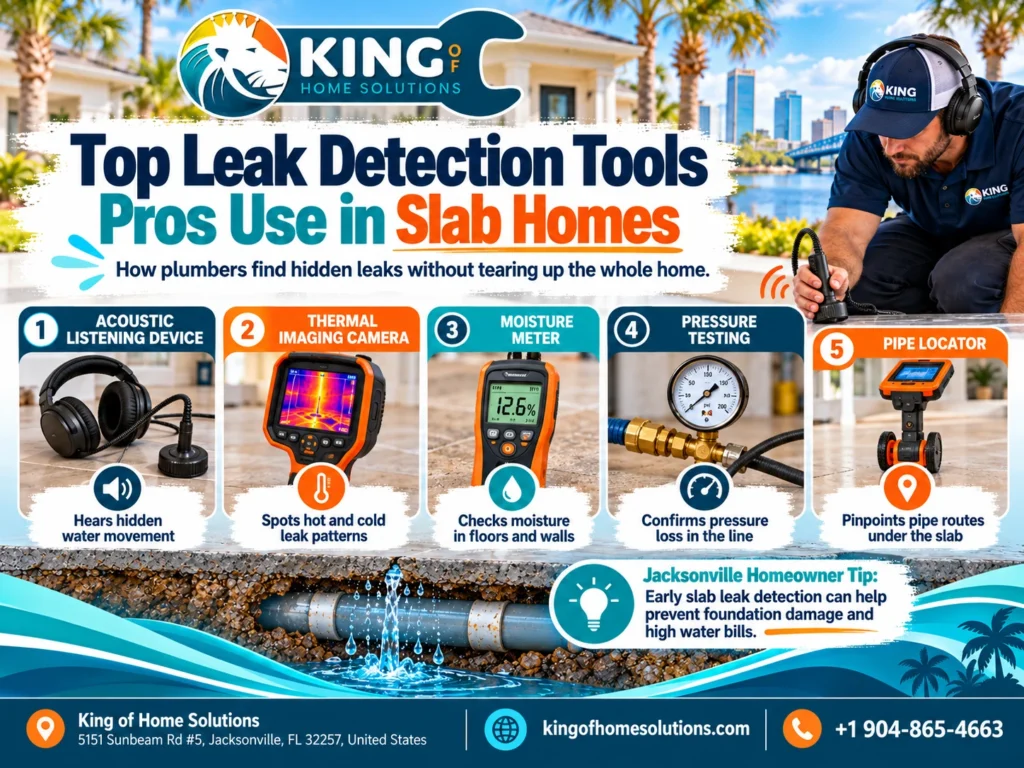
Tool #2: Pressure Testing
Once an underground water leak is suspected, pressure testing helps determine which plumbing system is losing water.
A plumber can isolate sections of the home’s supply piping and monitor whether pressure drops.
For example, the technician may separate hot-water plumbing from cold-water plumbing.
If the cold system holds pressure but the hot side loses it, the investigation immediately becomes much smaller.
That matters because searching the entire floor with electronic equipment takes longer than searching one known pipe route.
Pressure testing does not usually pinpoint the exact location.
Think of it as narrowing the neighborhood before searching for the house.
For professional slab-leak investigations, it is often one of the first steps before acoustic or thermal equipment is used. Current Jacksonville leak-detection providers describe meter and pressure testing as the basic confirmation step before electronic pinpointing.
Tool #3: Electronic Acoustic Leak Detection
For a pressurized water line beneath concrete, acoustic listening equipment is often the workhorse.
When pressurized water escapes through a pinhole, crack, or failed connection, it produces sound and vibration.
You may not hear it by putting your ear against the floor.
Professional electronic equipment can amplify those sounds.
A technician moves listening sensors across the floor, compares sound levels, and follows the leak noise toward its strongest point.
Modern systems may use:
- Ground microphones
- Electronic listening devices
- Acoustic amplifiers
- Headphones and digital filtering
- Leak-noise correlators
The goal is not simply to hear water.
It is to separate the sound of an underground leak from air-conditioning equipment, refrigerators, traffic, pumps, and normal plumbing noise.
Current slab-leak guidance identifies acoustic listening and leak-noise correlation among the primary professional methods used to locate hidden leaks.
For a typical Jacksonville slab-home pressurized supply-line leak, acoustic detection would usually be near the top of my list.
Tool #4: Thermal Imaging
This is particularly useful when the leak involves hot water.
Imagine a hot-water pipe leaking beneath the tile.
The water spreads through the surrounding slab.
That can create a temperature difference at the floor surface.
An infrared thermal camera can visualize those temperature variations.
Instead of seeing a wet pipe, the technician sees a warm pattern across the floor.
Thermal imaging can be extremely useful when homeowners report symptoms such as:
“There is one spot in the hallway that always feels warm.”
But a thermal camera is not an X-ray machine.
It cannot see directly through concrete.
It measures surface temperature.
The hottest visible point may therefore show where heat migrated rather than the exact location of the hole.
That’s why good leak detection often uses thermal imaging together with acoustic equipment and pressure testing rather than relying on one colorful infrared picture.
Jacksonville-area leak-detection services commonly use thermal imaging as a supplemental method, especially for hot-water slab leaks.
Tool #5: Electronic Pipe Locating
Finding the sound is easier when the technician knows where the pipe actually runs.
Unfortunately, the original plumbing plan is not always available.
And the pipe may not travel beneath the floor in the obvious direction.
Professional line-locating equipment can help trace buried piping before the technician marks the likely leak location.
That reduces another major source of unnecessary demolition:
knowing where the leak sounds strongest but not knowing exactly where the pipe is underneath the concrete.
A good detection process may therefore combine:
- Pressure isolation
- Pipe tracing
- Acoustic listening
- Thermal verification
When all four clues point toward the same small area, the plumber has much more confidence before anyone cuts flooring or concrete.
Tool #6: Tracer Gas for Difficult Leaks
Sometimes water leak detection becomes difficult.
The pipe may be deep.
The leak may be very small.
The surrounding material may absorb or distort sound.
That is when professionals may turn to tracer gas.
A section of plumbing is emptied or isolated and filled with a specialized detectable gas mixture.
The gas escapes through the same opening that was leaking water and migrates upward.
A sensitive detector is then moved across the surface to locate the highest concentration.
Modern tracer-gas systems are specifically designed for leaks beneath slabs, behind walls, and underground.
Tracer gas is not necessarily the first tool used on every Jacksonville leak.
Acoustic testing is often faster.
But for a stubborn leak that refuses to produce a clear acoustic signal, tracer gas can be extremely valuable.
Tool #7: Sewer Camera for Drain-Line Problems
Now we need to change tools completely.
Suppose your water meter does not move when everything is off.
But you notice:
- Repeated sewer backups
- Sewage odors
- Damp flooring
- Drain flies
- Recurring clogs
- Possible old cast-iron plumbing
You may not have a pressurized water leak at all.
You may have a drain or sewer problem underneath the slab.
Acoustic supply-line detection is not usually the primary tool for finding a cracked gravity sewer.
Instead, the plumber may insert a sewer camera through a cleanout and visually inspect the pipe.
A professional sewer scope can reveal:
- Cracks
- Cast-iron corrosion
- Missing pipe bottoms
- Root intrusion
- Offset joints
- Standing water
- Pipe bellies
- Collapsed sections
Many camera heads also contain a radio transmitter, or sonde, allowing the technician to locate the camera from above the floor and determine the approximate depth of the damaged section.
That is an entirely different diagnostic process from finding a pressurized copper pinhole.
Why Jacksonville Slab Homes Need More Than a Moisture Meter
A handheld moisture meter can be useful for confirming that drywall, baseboards, or flooring are wet.
But it generally cannot tell you why they are wet.
In Jacksonville, moisture could come from:
- Plumbing
- HVAC condensate
- Roof leakage
- Exterior rain intrusion
- High humidity
- Appliance leakage
- Groundwater
That is why detecting moisture and locating a plumbing leak are different jobs.
A $40 homeowner moisture meter can help identify a suspicious wet area.
It should not be treated as proof that a pipe directly beneath that exact point has failed.
How Much Does Professional Slab-Leak Detection Cost in Jacksonville?
Current 2026 Jacksonville pricing examples put professional electronic or acoustic leak detection at approximately $150 to $450, with more complex investigations potentially costing more depending on equipment, access, and the number of systems being tested.
That can seem expensive when there is no visible repair happening.
But consider the alternative.
Without detection, someone might cut through tile and concrete at the wrong location.
Now you are paying for:
- Plumbing repair
- Concrete repair
- Flooring replacement
- Labor
- Additional demolition
Spending a few hundred dollars to mark the actual leak can be far cheaper than treating the slab like an archaeological dig.
Jacksonville Homeowners Have One More Reason to Document the Repair
If a confirmed underground or slab leak causes unusually high water usage, keep the plumber’s paperwork.
JEA currently states that for water loss from situations such as an underground leak, slab leak, or broken pipe, customers seeking certain wastewater-bill adjustments need a plumber’s statement or receipt verifying that the repair was completed.
That does not mean every water bill will simply disappear.
But documentation may help when requesting an applicable adjustment.
Save:
- The leak-detection report
- Photographs
- Repair invoice
- Date of repair
- Description of the failed pipe
Do not throw away the paperwork once the floor is dry.
So What Is the Best Tool?
For a suspected pressurized water-line leak beneath a Jacksonville slab, the strongest professional combination is generally:
Pressure testing + electronic pipe locating + acoustic leak detection.
Add thermal imaging when hot water is involved.
Use tracer gas when normal acoustic detection cannot reliably pinpoint the leak.
For a suspected under-slab drain or sewer problem, a sewer camera with electronic locating capability is generally much more useful.
And before paying for any of them?
Check your water meter and JEA usage history.
That first piece of information can help determine which investigation you actually need.
The Bottom Line
The best slab-leak detection tool is not a magic scanner that sees every pipe beneath your Jacksonville home.
It is usually a combination of technologies used in the correct order.
First confirm that water is actually being lost.
Then isolate the plumbing system.
Trace the pipe.
Listen for the leak.
Check for heat when appropriate.
Use tracer gas when the signal is difficult.
And if the problem is a drain rather than a supply line, send in the camera.
The objective is simple:
Know where the problem is before you open the slab.
Because the expensive part of a slab leak should be repairing the failed plumbing not replacing half your flooring because someone started jackhammering on a guess.