Serving The Jacksonville Area


DIY Drain Cleaner vs. Professional Snaking: Why Chemicals Can Hurt Your Pipes
DIY Drain Cleaner vs. Professional Snaking: Why Chemicals Can Hurt Your Pipes
The kitchen sink is draining slowly.
You walk into the hardware store and see a bottle promising to destroy grease, hair, and clogs in minutes.
It costs $10 or $15.
Calling a plumber might cost $150, $200, or more.
The choice seems obvious.
Pour in the chemical.
Wait.
Problem solved.
Sometimes it works.
But homeowners should understand what is actually happening inside the drain.
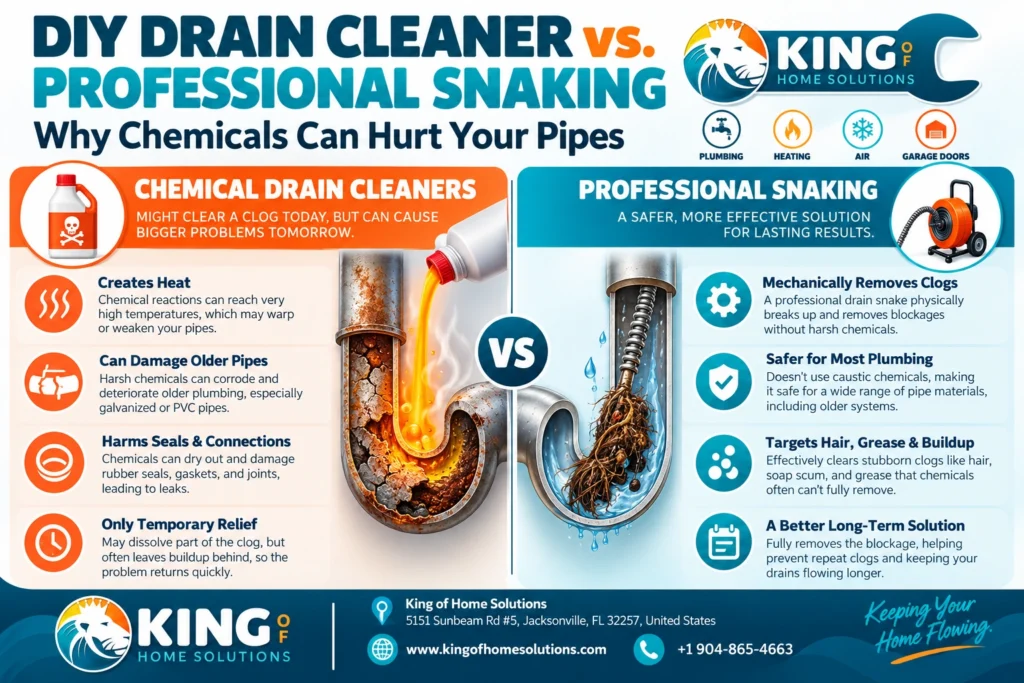
Many chemical drain cleaners rely on highly caustic or acidic ingredients that generate powerful chemical reactions. Some produce significant heat while breaking down grease and organic material. Poison Control notes that many non-enzymatic drain cleaners contain concentrated corrosive chemicals, and some generate heat as part of the clog-clearing process.
Used exactly according to the manufacturer’s instructions in compatible plumbing, a drain cleaner does not automatically destroy a pipe.
The bigger concern is repeated use, overuse, mixing products, or leaving aggressive chemicals sitting inside a drain because the clog never actually cleared.
That is where a $12 bottle can become an expensive plumbing mistake.
How Chemical Drain Cleaners Work
Most aggressive household drain openers fall into a few broad categories.
Some use strong alkaline ingredients such as sodium hydroxide commonly known as lye.
Others may contain strong acids.
These chemicals react with grease, hair, soap, and organic matter in an attempt to break the obstruction into material that can move farther down the drain.
MedlinePlus identifies ingredients such as sodium hydroxide, potassium hydroxide, hydrochloric acid, and sulfuric acid in certain drain-opening products.
That chemistry is powerful.
Which is exactly why the products can also be dangerous to people and plumbing when misused.
Why Heat Is a Problem Inside a Clogged Drain
Some drain cleaners create heat as they react.
That can help soften grease.
But imagine what happens when the chemical reaches a blockage it cannot dissolve.
Instead of flowing through the drain and being flushed away, the chemical remains concentrated in one section of pipe.
Now you potentially have:
A corrosive chemical sitting in stagnant water while producing heat.
This can be particularly undesirable in older plumbing systems where the pipe already has:
- Corrosion
- Thin walls
- Weak joints
- Old seals
- Previous repairs
- Cracks or deterioration
Plastic piping is also designed around specific temperature and chemical-exposure limits.
The lesson is not that one correctly used product will necessarily melt PVC.
It is that an unknown amount of chemical sitting inside an unknown pipe for an unknown length of time is not a great plumbing strategy.
Older Cast-Iron Pipes Deserve Extra Caution
This matters even more in older homes.
Cast-iron sewer and drain piping can develop internal corrosion and scaling after decades of service.
The interior may already be rough, thin, or heavily deteriorated.
Pouring aggressive chemicals into that system does not restore the missing metal.
And if the actual blockage is caused by:
- Heavy scale
- Root intrusion
- A collapsed section
- An offset joint
- A pipe belly
A chemical drain cleaner cannot correct the structural problem.
The homeowner may keep pouring more product into a drain that is physically incapable of draining properly.
At that point, you’re not solving the clog.
You’re filling a damaged sewer with corrosive liquid.
Chemicals Often Treat the Symptom Instead of Removing the Clog
Suppose your bathroom sink is clogged with a thick mass of hair and soap.
A chemical cleaner may dissolve enough material to create a narrow pathway.
Water begins flowing again.
You assume the drain is clean.
But much of the original obstruction may still be attached to the pipe.
Hair remains.
Soap residue remains.
More debris catches on it.
Two months later, the drain slows again.
So you buy another bottle.
This is where homeowners can accidentally create a cycle:
Chemical. Temporary improvement. New clog. More chemicals.
Professional snaking takes a different approach.
How Professional Snaking Works
A plumber uses a drain auger or cable machine to physically reach the obstruction.
Depending on the type of clog, the equipment may:
- Break through the blockage
- Retrieve hair and debris
- Cut through certain obstructions
- Restore a larger flow path
Instead of attempting to chemically dissolve everything in the drain, the plumber mechanically removes or breaks apart the material.
For common 2026 pricing, professional drain cleaning generally runs around $147 to $352, with an average near $246. A kitchen sink clog may commonly run around $110 to $215, while main sewer-line snaking can range much more widely depending on location and severity.
That obviously costs more than a bottle from the store.
But you’re also paying for diagnosis.
The Plumber Can Tell You Why the Drain Clogged
This is one of the biggest differences.
A chemical bottle cannot tell whether you have:
Hair in a bathroom drain.
Grease buildup in a kitchen line.
Roots inside the sewer.
A broken cast-iron pipe.
A sagging drain line.
A foreign object stuck in the pipe.
A professional can evaluate the symptoms and determine whether simple snaking is appropriate or whether the problem is farther downstream.
If several fixtures are backing up at once, for example, the problem may be in the main sewer rather than the individual sink.
Repeatedly pouring cleaner into individual drains will not fix that.
Snaking Isn’t Perfect Either
Professional snaking should not be marketed as a magical cure.
A snake can open a blockage without necessarily cleaning the entire inside surface of the pipe.
This is particularly true with heavy grease or sludge.
Imagine punching a hole through a block of hardened grease.
Wastewater can move again.
But substantial material may remain around the edges.
For certain recurring buildup problems, a plumber may recommend hydro-jetting, which uses high-pressure water to scour more of the pipe interior.
Current 2026 estimates put main-line snaking around $100 to $250 in many cases, compared with approximately $350 to $600 for residential hydro-jetting.
The correct method depends on the pipe’s condition and the type of blockage.
Chemical Drain Cleaner Creates Another Problem for the Plumber
Suppose the chemical does not work.
You call a plumber 30 minutes later.
Now the technician has to work on a drain containing corrosive liquid.
That creates a splash hazard when:
- Removing a trap
- Opening a cleanout
- Running a cable
- Disconnecting plumbing
Poison Control warns that caustic drain cleaners can cause severe chemical burns to skin and eyes.
If you have already poured chemical cleaner into a clogged drain, tell the plumber before they begin working.
Do not let them discover it when the trap comes apart.
Never Mix Drain Cleaners
This deserves its own warning.
If the first drain cleaner does not work, do not pour a second chemical into the drain hoping for a stronger reaction.
And do not combine drain opener with bleach, ammonia, toilet cleaner, or another household chemical.
Poison-control guidance specifically warns against mixing caustic cleaning products because dangerous chemical reactions can occur.
More chemicals does not equal more plumbing power.
It can equal dangerous fumes, splashing, heat, and chemical exposure.
Follow the product label exactly.
What About Enzyme Drain Cleaners?
Not every product labeled “drain cleaner” works the same way.
Enzyme- or bacteria-based products are generally very different from aggressive acid or lye drain openers.
They are often marketed for gradual maintenance of organic buildup rather than emergency removal of a completely blocked drain.
They may be less harsh, but they also work much more slowly.
If the sink is already full of standing water, an enzyme maintenance product is not the same thing as mechanically removing the obstruction.
Again, start with the problem.
Then choose the treatment.
When a DIY Approach Can Make Sense
Not every slow drain requires a plumber.
Homeowners can often safely address simple, accessible problems such as:
- Cleaning a removable sink stopper
- Removing visible hair near the drain opening
- Cleaning a faucet or drain strainer
- Using an appropriate hand-operated tool on a minor clog
- Preventing grease and food from entering kitchen drains
But once the same drain repeatedly clogs, the problem is telling you something.
That is when continually pouring chemicals stops being maintenance and starts becoming avoidance.
When You Should Call a Plumber
Professional drain cleaning makes more sense when:
- The clog keeps returning
- Several fixtures are backing up
- Water rises in the shower when a toilet flushes
- The main sewer may be involved
- The house has older cast-iron plumbing
- You suspect roots
- The drain is completely blocked
- Chemical cleaner already failed
- There are gurgling sounds throughout the house
- Sewage is backing up
A recurring clog may need a camera inspection rather than a stronger chemical.
The Bottom Line
DIY chemical drain cleaner wins on one thing:
Upfront price.
A bottle may cost a fraction of a professional service call.
But professional snaking has an important advantage:
It physically addresses the blockage without relying on aggressive chemicals sitting inside your plumbing.
Chemical drain openers are not guaranteed to destroy every pipe they touch.
But repeated or improper use can expose aging plumbing, joints, seals, and plastic components to corrosive chemistry and heat while doing nothing to repair roots, collapsed lines, pipe bellies, or decades of deterioration.
So if the drain slows once, start with the simple possibilities.
If it keeps coming back, stop asking:
“What stronger chemical can I pour down there?”
Ask:
“Why does this drain keep clogging?”
Because clearing the pipe once is useful.
Finding the reason you keep having to clear it is what actually saves money.