Serving The Jacksonville Area


Cast Iron vs. PVC: The Sewer Line Showdown for Older Jacksonville Homes

Cast Iron vs. PVC: The Sewer Line Showdown for Older Jacksonville Homes
You find the perfect older Jacksonville house.
Original hardwood floors. Mature oaks. A shaded front porch. The kind of character you don’t get from new construction.
Then the sewer camera goes underground.
Suddenly you’re looking at a dark, rough pipe with rust, buildup, questionable joints, and standing water.
The plumber says two words:
“Cast iron.”
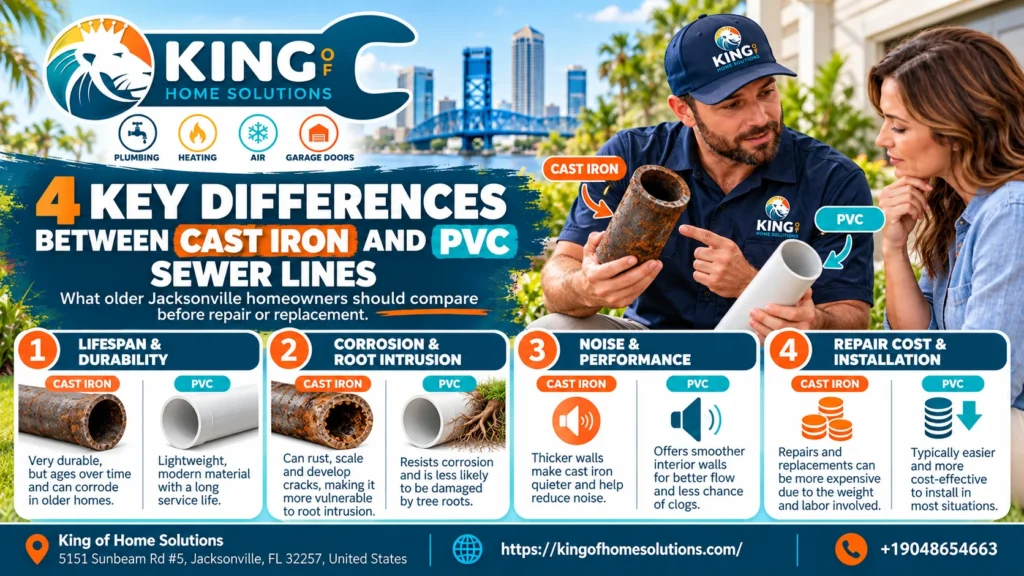
For homeowners in Jacksonville’s older neighborhoods, aging cast-iron drain and sewer piping can become one of the most expensive hidden systems in the house. Cast iron was widely used for residential drain, waste, and vent systems before plastic piping became common. Industry guidance notes that before roughly 1970, cast iron was the predominant DWV material in many homes.
Today, when sections finally need replacement, PVC is often the material homeowners see going back in.
Does that mean cast iron is bad and PVC is automatically better?
Not quite.
Modern cast iron remains a legitimate plumbing material with some significant advantages. The problem in an older Jacksonville house isn’t usually that someone originally chose cast iron.
It’s that the pipe may have already spent many decades buried beneath your home or yard.
Why Older Jacksonville Cast Iron Starts Causing Trouble
Cast iron is incredibly strong.
That is one reason it remained a plumbing standard for generations. It is rigid, durable, excellent at reducing plumbing noise, and capable of handling substantial loads.
The Cast Iron Soil Pipe Institute still identifies strength, rigidity, low expansion, and sound attenuation as major advantages of the material.
But iron can corrode.
Inside an old sewer line, decades of wastewater exposure can leave the interior increasingly rough.
That rough surface can begin collecting:
- Grease
- Toilet paper
- Soap residue
- Scale
- Sludge
- Hair and debris
Instead of wastewater traveling through a relatively smooth passage, it has to move across an increasingly irregular interior.
Jacksonville itself has dealt with this issue in public infrastructure. City budget documents describe deteriorated original cast-iron sewer piping restricting flow badly enough that sections required replacement.
If your drains keep backing up despite repeated cleaning, the issue may no longer be what is inside the pipe.
It may be the condition of the pipe itself.
The Classic Cast-Iron Failure: The Bottom Starts Going
One of the nastier problems with old horizontal cast iron happens where wastewater continuously travels along the bottom of the pipe.
Corrosion and deterioration can become concentrated there.
Eventually, the pipe can become badly weakened, develop cracks, or lose portions of its bottom.
A sewer camera may show severe scaling before the damage becomes obvious from above.
The homeowner may simply notice:
The kitchen keeps backing up.
Or:
The plumber has to snake the same line every six months.
Repeated cleaning can restore flow temporarily.
It cannot replace the missing pipe wall.
That’s the point where the conversation changes from drain cleaning to sewer rehabilitation or replacement.
Why PVC Usually Wins the Replacement Conversation
PVC has one enormous advantage in a sewer application:
It doesn’t rust like iron.
That means you are not installing a new pipe that will gradually develop the same type of iron corrosion.
PVC is also much lighter than cast iron, making it easier to handle when plumbers are replacing long underground sections.
Its relatively smooth interior helps wastewater and solids travel through the pipe with less opportunity to catch on heavy corrosion deposits.
And properly solvent-welded PVC connections can create a continuous, watertight piping system.
That makes PVC particularly attractive when replacing deteriorated cast iron beneath a Jacksonville yard or slab.
However, PVC has one weakness homeowners shouldn’t overlook.
It depends heavily on good installation.
Jacksonville’s Soil Makes Installation Quality Important
A PVC pipe can be perfectly corrosion-resistant and still perform badly if it isn’t supported correctly underground.
Sewer piping needs proper slope.
Wastewater moves mainly by gravity.
If the ground beneath the pipe settles or the trench was poorly prepared a section of PVC can develop a low spot.
Plumbers often call this a belly.
Water sits in the depression.
Solids settle.
Eventually the homeowner develops recurring backups even though the PVC itself is in excellent condition.
This matters in areas with sandy or disturbed soil.
PVC needs appropriate bedding, compaction, support, and slope.
The lesson is simple:
The material doesn’t compensate for bad excavation work.
A professionally installed PVC sewer line can be an excellent long-term solution.
A badly installed one can create an entirely different problem.
What About Jacksonville’s Huge Oak Trees?
Older Jacksonville neighborhoods and mature trees often go together.
Those roots are beautiful above ground.
They become less charming when they reach sewer piping.
Tree roots don’t normally attack a perfectly sealed sewer pipe simply because they enjoy PVC or cast iron.
They exploit opportunities.
A cracked pipe.
A deteriorated joint.
A separated connection.
Once roots find moisture leaking from a damaged sewer, they can grow into the opening and begin catching waste.
Old sewer systems with numerous joints can therefore develop recurring root intrusion.
Replacing a badly damaged line with properly joined PVC can eliminate the openings that were allowing roots inside.
But don’t confuse root removal with pipe repair.
Hydro-jetting or mechanical cutting may remove roots temporarily.
If the crack remains, the roots may return.
But Cast Iron Isn’t Obsolete
This is an important correction because the internet sometimes turns the comparison into:
Cast iron – ancient and terrible. PVC – modern and perfect.
That isn’t accurate.
New cast-iron soil pipe is still manufactured, standardized, and used in modern construction.
It offers excellent sound control.
If you’ve ever heard wastewater rushing loudly through plastic drainpipe inside a wall, you can understand why cast iron remains popular in certain higher-end homes, hotels, apartments, and commercial buildings.
Cast iron’s rigidity can also be beneficial in certain installations.
Current industry standards continue to cover modern hubless cast-iron soil pipe and fittings for sanitary drainage applications.
So the problem is not cast iron as a category.
The problem is very old cast iron that has already experienced decades of corrosion and use.
How Do You Know Whether Yours Needs Replacement?
Don’t replace sewer piping based only on the home’s age.
Inspect it.
A sewer camera is one of the most valuable tools when evaluating older Jacksonville plumbing.
The plumber is looking for:
- Heavy corrosion
- Severe scaling
- Cracks
- Holes
- Root intrusion
- Offset joints
- Standing water
- Collapsed sections
- Pipe bellies
- Repeated blockages
The condition can vary dramatically within the same home.
One section may look remarkably good.
Another 15 feet away may be badly deteriorated.
That is why a good inspection matters before someone tells you the entire house needs to be repiped.
Can You Repair Cast Iron Without Replacing Everything?
Sometimes.
A localized damaged section can often be removed and replaced.
For accessible piping, that may be the most economical solution.
In other situations, trenchless technologies such as cured-in-place pipe lining may be considered depending on pipe diameter, condition, configuration, and the nature of the damage.
But lining is not appropriate for every sewer.
A badly collapsed pipe or a line with serious grading problems may still require excavation.
If the pipe has a belly, for example, coating the inside doesn’t correct the slope underneath it.
The diagnosis should determine the repair not the repair technology the contractor happens to sell.
What About Cast Iron Under a Concrete Slab?
This is where older Florida homes can become expensive.
If deteriorated cast iron runs beneath the slab, conventional replacement may require cutting flooring and concrete to reach the drain.
The plumbing itself might be relatively straightforward.
Access and restoration can dominate the project.
Depending on the layout, plumbers may discuss:
- Selective slab cutting
- Exterior rerouting
- Pipe lining
- Trenchless methods
- Partial replacement
- Complete drain replacement
There is no single best solution for every house.
The right approach depends on what the camera finds and where the damaged piping runs.
Don’t Forget Permits and Inspections
Major sewer work isn’t simply a landscaping project.
Jacksonville’s Building Inspection Division says plumbing installations must comply with Florida Building Code plumbing requirements and identifies inspections involving the building sewer between the cleanout and sewer or septic connection.
As of September 2026, Jacksonville still identifies the 8th Edition (2023) Florida Building Code as its current code; Florida’s 9th Edition is scheduled to take effect December 31, 2026.
If sewer work enters public right-of-way, Jacksonville has additional requirements, including permitting and licensed-contractor requirements for utility construction.
That is worth verifying before excavation starts.
So Which One Wins: Cast Iron or PVC?
For new construction, there isn’t one universal winner.
Cast iron remains exceptionally strong, quiet, and durable when properly specified.
PVC is lightweight, corrosion-resistant, economical, and widely suited to residential sewer and DWV installations.
But that isn’t usually the decision facing an older Jacksonville homeowner.
Your real comparison is often:
60-, 70-, or 80-year-old deteriorating cast iron versus newly installed PVC.
In that matchup, PVC frequently makes sense.
Not because plastic is magically indestructible.
Because you’re replacing an aging, corroded system with a new material that doesn’t suffer from iron rust and scaling.
The Bottom Line
If your older Jacksonville home still has cast-iron sewer piping, don’t panic.
Cast iron can remain serviceable for a remarkably long time.
But recurring backups deserve investigation.
If you’re calling for drain cleaning every few months, seeing rust flakes coming from accessible drains, finding sewage beneath the slab, or repeatedly cutting roots from the same section, stop asking:
“How do we clear this clog again?”
Ask:
“What does the pipe actually look like?”
Get the sewer camera.
Find the failure.
Determine whether the problem is isolated or widespread.
Then compare spot repair, rehabilitation, rerouting, and PVC replacement based on what is actually underground.
Because in an older Jacksonville home, the cast-iron-versus-PVC showdown isn’t really about which plumbing material wins on paper.
It’s about whether the pipe beneath your house still has enough life left to do its job.