Serving The Jacksonville Area


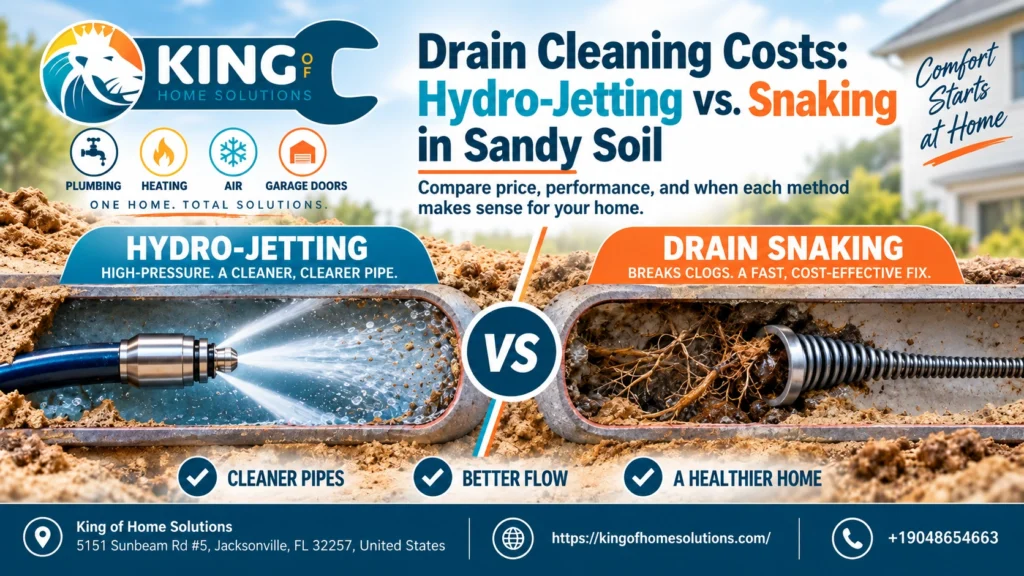
Drain Cleaning Costs: Hydro-Jetting vs. Snaking in Sandy Soil
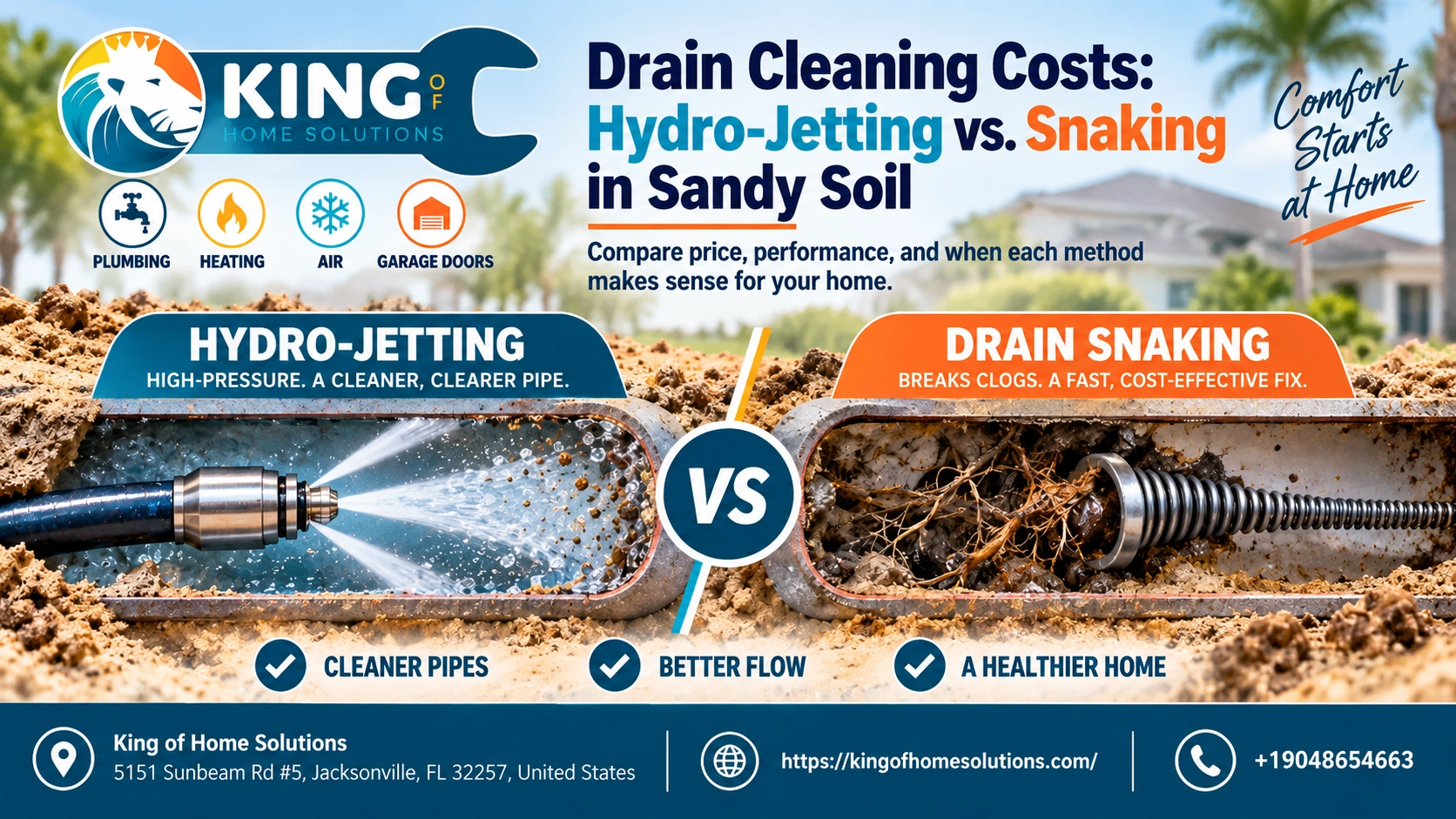
Drain Cleaning Costs: Hydro-Jetting vs. Snaking in Sandy Soil
The drain backs up. A plumber clears it. Everything seems fine.
Then a few months later, the same drain slows down again.
For homeowners in areas with sandy or shifting soil, recurring drain problems can be especially frustrating because the blockage may not be the entire problem. Underground sewer lines can develop offset joints, low spots, cracks, or openings that allow roots and debris to enter. Cleaning the pipe restores flow, but it doesn’t necessarily correct the condition that caused the clog.
That raises an important question:
Should you pay for traditional drain snaking or spend more for hydro-jetting?
In 2026, professional snaking may cost roughly $100 to $250 for many main-line clogs, while hydro-jetting commonly runs around $350 to $600 for a residential sewer line. Severe blockages, difficult access, root intrusion, camera inspections, and damaged pipes can push the final price considerably higher.
The cheapest option isn’t always the least expensive in the long run.
Stop Recurring Drain Clogs
Sandy soil can make drain problems frustrating. Get the right cleaning solution before the blockage gets worse.
What Does Drain Snaking Cost?
Drain snaking—also called auguring or rodding—is usually the more affordable approach.
A plumber feeds a flexible cable into the drain. A cutting or retrieving head at the end of the cable breaks through the obstruction, grabs material, or creates an opening that allows wastewater to flow again.
Current 2026 estimates put general professional drain cleaning at approximately $147 to $352, with an average around $246. For a main sewer line specifically, snaking often costs approximately $100 to $250, although difficult blockages can cost more.
Snaking can be an excellent solution for:
- A relatively simple localized clog
- Hair and organic material
- A blockage near an accessible cleanout
- A sewer line that hasn’t developed heavy interior buildup
- Situations where pipe condition makes high-pressure cleaning inappropriate
The limitation is that a snake often opens the blockage rather than thoroughly cleaning the pipe walls.
Imagine pushing a hole through a thick layer of grease inside a pipe. Water may begin flowing again, but plenty of residue can remain around the edges.
That’s one reason some drains clog again.
What Does Hydro-Jetting Cost?
Hydro-jetting takes a more aggressive approach.
Instead of using a mechanical cable, the plumber sends a specialized hose into the drain and uses high-pressure water to scour the inside of the pipe.
For a standard residential job, homeowners can expect hydro-jetting to cost approximately $350 to $600, with a national average of about $475 according to current 2026 estimates. Severe clogs can reach $1,000 or more depending on accessibility and the type of obstruction.
Hydro-jetting can remove or reduce:
- Grease buildup
- Sludge
- Soap residue
- Scale
- Accumulated debris
- Some root intrusion
Instead of simply punching a pathway through a clog, properly performed hydro-jetting can clean much more of the pipe’s interior surface.
That’s the performance homeowners are paying extra for.
Why Does Sandy Soil Matter?
Sandy soil doesn’t automatically mean your sewer will clog.
The bigger concern is what happens around an underground pipe over time.
Sewer lines depend on proper bedding and support to maintain alignment and slope. Settlement, erosion, poor compaction, groundwater movement, or previous excavation can contribute to pipe movement or loss of support.
The EPA identifies variable soil conditions, erosion, washouts, faulty pipe joints, failed bedding, and root intrusion among factors that can contribute to sewer lateral problems.
If sections of a sewer line shift, several problems can develop.
A joint may separate.
One section may become misaligned with another.
A portion of pipe may sag and create a belly, allowing water and waste to collect instead of flowing freely toward the sewer.
Seattle Public Utilities notes that offset joints can allow debris to accumulate, while significant sags can cause solids to settle and eventually contribute to sewer backups.
This changes the snaking-versus-jetting decision.
If your real problem is a sagging or displaced sewer line, neither cleaning method permanently repairs it.
Sandy Soil and Tree Roots
Roots are another reason recurring sewer clogs deserve closer investigation.
Tree roots don’t normally break into a perfectly sealed modern sewer line simply because they are nearby. They typically take advantage of an existing crack, failed joint, or opening where moisture and nutrients are available.
Once roots enter, they can continue growing inside the pipe and collect toilet paper, grease, and other debris.
Seattle Public Utilities identifies older concrete and clay sewer pipes with non-watertight joints as especially vulnerable to root intrusion.
Snaking may cut through a root mass and restore flow.
Hydro-jetting may provide a more extensive cleaning after appropriate mechanical root removal.
But if roots keep returning through a broken joint, repeatedly cleaning the sewer treats the symptom.
The damaged pipe remains.
When Snaking Makes More Sense
Paying $400 or $500 for hydro-jetting doesn’t make sense for every blocked drain.
Suppose your shower suddenly stops draining because of hair near the trap.
A snake may solve the problem quickly and economically.
Likewise, if a plumber identifies a straightforward main-line obstruction without significant buildup, snaking may restore normal flow at a fraction of the cost of hydro-jetting.
Snaking is also worth considering when the sewer pipe is old, deteriorated, or structurally questionable.
Hydro-jetting uses considerable water pressure. A qualified plumber should understand the pipe’s condition before deciding how aggressively it can be cleaned.
When Hydro-Jetting Is Worth the Extra Money
Now consider a different situation.
Your kitchen drains slowly every six months.
You’ve had the sewer snaked repeatedly.
Each service restores drainage temporarily, but the problem always comes back.
That is when hydro-jetting may provide better value.
It can be particularly useful when grease, sludge, scale, and other material are coating the pipe instead of creating one isolated obstruction.
HomeAdvisor notes that snaking tends to work well for localized clogs, while hydro-jetting can provide more thorough cleaning for persistent slow drains, recurring backups, grease buildup, and scale deposits.
Paying more once for a thorough cleaning can make more sense than repeatedly paying for temporary openings through the same buildup.
But there is an important step before turning on the jetter.
Get a Sewer Camera Inspection
For recurring drain problems in sandy or shifting soil, the most valuable service may not be snaking or hydro-jetting.
It may be the camera inspection.
A sewer camera can reveal:
- Separated joints
- Cracked pipe
- Root intrusion
- Standing water
- Pipe bellies
- Offset sections
- Corrosion
- Collapsed areas
- Heavy interior buildup
Camera inspections vary widely in price. Current estimates can run from a few hundred dollars to well over $1,000 depending on the length, accessibility, location, and complexity of the sewer line.
That may feel like another expense when you simply want the drain cleared.
But if you’ve paid for three drain cleanings in two years, knowing why the sewer keeps clogging can be more valuable than paying for another temporary fix.
A camera inspection is also particularly important before hydro-jetting an older sewer line. Current industry guidance recommends inspecting the system first to identify damaged sections and determine whether the pipe can safely tolerate high-pressure cleaning.
Why Your Kitchen Sink Has “Low Pressure” but the Shower Is Fine
You turn on the kitchen faucet and get a weak stream. Then you walk into the bathroom, turn on the…
Read The BlogWhich Is Cheaper in the Long Run?
For a one-time ordinary clog:
Snaking usually wins on price.
You might spend $100 to $250 instead of $350 to $600 for hydro-jetting.
For a heavily coated but structurally sound sewer line:
Hydro-jetting may deliver better long-term value because it removes substantially more buildup.
For a line with a belly, separated joint, root opening, or collapse:
Neither method is the permanent solution.
The pipe itself may need spot repair, lining, trenchless rehabilitation, or replacement.
That’s especially important in properties with recurring sewer trouble. Spending $200 every few months to snake a structurally damaged pipe isn’t really saving money. It’s postponing the repair.
The Bottom Line
If your drain has clogged once, traditional snaking may be all you need.
If the line repeatedly backs up because of grease, sludge, scale, or extensive buildup, spending approximately $350 to $600 on hydro-jetting may provide a much more complete cleaning.
And if your home sits on sandy or shifting ground and the problem keeps returning, don’t assume you simply have a stubborn clog.
The underground sewer line may have moved.
Ask for a camera inspection.
Because the best drain-cleaning method isn’t the machine with the most power or the service with the lowest price.
It’s the one chosen after you know what is actually happening inside the pipe.
Clogged Drain? Know Your Best Option
Compare hydro-jetting and snaking for sandy-soil plumbing problems. Call now for professional drain service.