Serving The Jacksonville Area



Heat Pump vs. Straight-Cool HVAC: Which One Saves More on a JEA Bill?
Heat Pump vs. Straight-Cool HVAC: Which One Saves More on a JEA Bill?
When replacing an HVAC system in Jacksonville, homeowners often face two similar-looking options:
- A heat pump
- A straight-cool air conditioner
Both can cool the home during a 95-degree Florida afternoon. The major difference appears when temperatures drop.
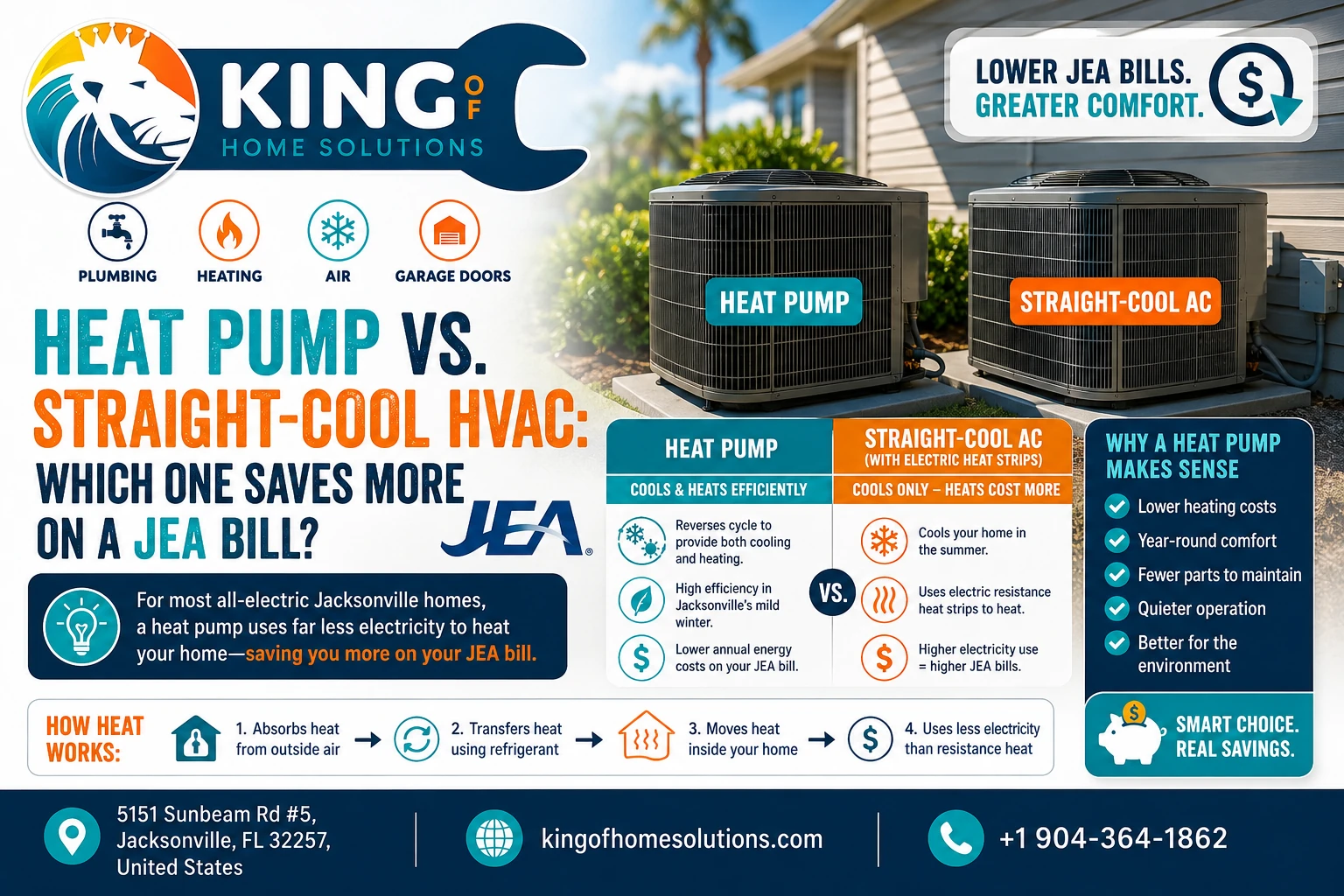
A heat pump can reverse its refrigeration cycle and provide efficient heating. A straight-cool system cannot. It must be paired with a separate heat source, often electric resistance heat strips in an air handler or an electric furnace.
For most all-electric homes served by JEA, a properly sized heat pump will generally cost less to operate over the year than a straight-cool system using electric resistance heat.
The summer cooling costs may be nearly identical when the two systems have comparable efficiency ratings. Most of the heat pump’s utility-bill advantage comes during Jacksonville’s heating season.
Want Lower JEA Cooling Bills?
Find out whether a heat pump or straight-cool HVAC system can save you more. Call today for expert recommendations.
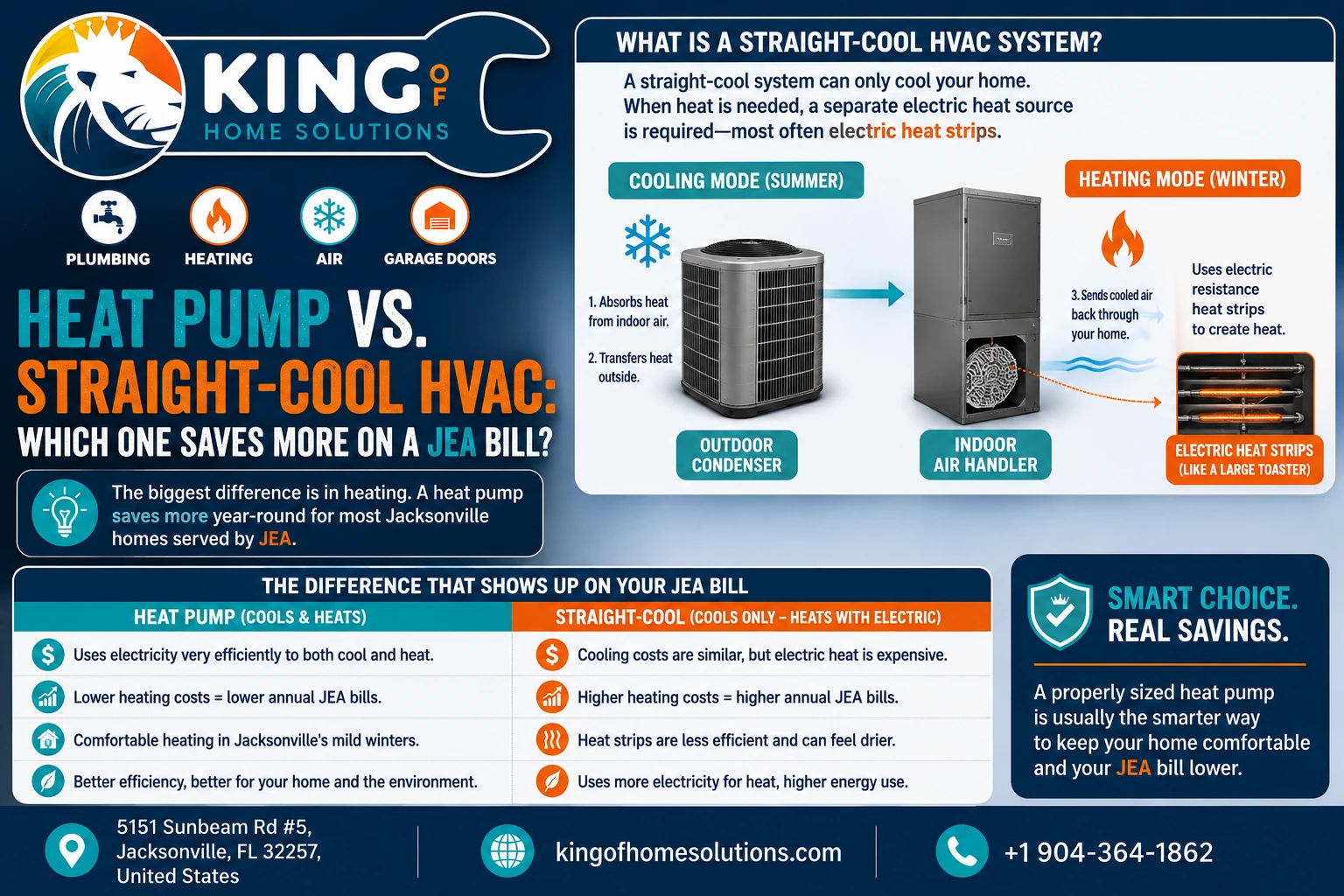
What Is a Straight-Cool HVAC System?
A straight-cool system is a conventional central air conditioner.
During warm weather, it:
- Absorbs heat from the indoor air.
- Transfers that heat through refrigerant lines.
- Release it through the outdoor condenser.
- Sends cooled air back through the home.
The outdoor unit operates only in cooling mode.
When the thermostat calls for heat, the home needs another heating source. In many Jacksonville homes, that source is an electric resistance heater inside the air handler.
Electric resistance heat works much like a large toaster. Electricity passes through heating elements, and the blower moves air across them.
The equipment is simple and produces heat quickly, but it can consume a substantial amount of electricity.
What Is a Heat Pump?
A heat pump is also an air conditioner during the summer.
In heating mode, however, it reverses the refrigerant flow. Instead of moving heat from inside the home to the outdoors, it extracts available heat from the outdoor air and moves it inside.
That may sound impossible on a cold morning, but outdoor air still contains usable heat even when it feels chilly.
Because a heat pump moves heat rather than creating all of it through electric resistance, it can deliver substantially more heat energy than the electrical energy it consumes. The U.S. Department of Energy says a properly installed air-source heat pump can provide approximately two to four times as much heat energy as the electricity it uses.
That efficiency is the reason a heat pump usually wins in an all-electric Jacksonville home.
Which System Uses Less Electricity for Cooling?
If a heat pump and straight-cool air conditioner have the same:
- SEER2 rating
- Capacity
- Compressor technology
- Blower efficiency
- Duct conditions
- Installation quality
their cooling costs should be reasonably similar.
A heat pump does not automatically use less electricity during the summer simply because it can also provide heat. In cooling mode, both systems operate according to the same basic refrigeration process.
A 16-SEER2 straight-cool system may cost less to cool the home than a 14.3-SEER2 heat pump. Likewise, a high-efficiency variable-speed heat pump may outperform a basic single-stage straight-cool unit.
The label on the system matters less than the actual efficiency, sizing, and installation.
When comparing proposals, review:
- SEER2 cooling efficiency
- EER2 performance
- Compressor type
- Indoor blower efficiency
- AHRI-certified equipment match
- Heating efficiency for heat pumps
- Ductwork condition
- Contractor sizing calculations
The heat pump’s biggest advantage generally appears in heating mode not necessarily during air-conditioning season.
Why Electric Resistance Heat Costs More
Electric resistance heating converts electricity directly into heat. At the equipment itself, nearly all incoming electrical energy becomes heat.
That sounds efficient, but a heat pump can deliver multiple units of heat for each unit of electricity because it transfers existing outdoor heat.
The Department of Energy says heat pumps can easily reduce electricity use for heating by approximately 50% compared with electric resistance systems. Modern equipment may achieve even greater reductions under favorable conditions.
Consider a simplified example.
Suppose a home needs 30 units of electrical energy to meet part of its winter heating demand with resistance heat.
A heat pump operating at an average coefficient of performance of 3 might provide the same usable heat with approximately 10 units of electrical energy.
The exact result varies with outdoor temperature, equipment condition, thermostat settings, auxiliary-heat use, and building efficiency. But the underlying advantage remains: moving heat usually requires less electricity than producing it through resistance elements.
What Could That Mean on a JEA Bill?
JEA’s published bill breakdown shows a total electric charge of approximately $149.41 for 1,000 kilowatt-hours under the rate example in effect through September 30, 2026. The actual bill depends on usage, applicable charges, taxes, and the billing period.
Using approximately 15 cents per kilowatt-hour as a simplified bill-impact estimate:
| Electricity avoided | Approximate bill savings |
| 100 kWh | $15 |
| 250 kWh | $37.50 |
| 500 kWh | $75 |
| 1,000 kWh | $150 |
| 2,000 kWh | $300 |
These are illustrations rather than guaranteed savings. Some JEA charges are fixed and will not decrease when HVAC usage falls.
JEA has also approved rate adjustments beginning October 1, 2026, so future dollar savings for the same number of avoided kilowatt-hours may differ. JEA estimates that a residential customer using 1,000 kWh per billing cycle will see an average increase of about $3.02 per month under the new adjustment.
A Realistic Jacksonville Heating Example
Assume an all-electric home would use 2,000 kWh of resistance heat during a winter.
At an illustrative effective cost of 15 cents per kWh:
2,000 kWh × $0.15 = $300
Now assume a heat pump reduces the heating electricity requirement by 50%.
The heat pump would use approximately:
1,000 kWh × $0.15 = $150
Estimated seasonal savings:
$300 − $150 = $150
If the heat pump reduces heating consumption by 65%, the estimated annual heating cost would fall to approximately $105, producing about $195 in seasonal savings.
A larger, poorly insulated home with higher heating demand could save more. A small, efficient home whose occupants rarely use heat could save much less.
How Much Can a Heat Pump Save Per Year?
For many Jacksonville-area all-electric homes, a reasonable planning range may be approximately $75 to $300 per year compared with straight cooling plus electric resistance heat.
Some households may save more when:
- The home is large.
- The thermostat is kept warm all winter.
- The existing heat strips run frequently.
- The old HVAC system is inefficient.
- The building has substantial air leakage.
- The new heat pump has strong heating performance.
- The household previously used emergency heat excessively.
Savings may be smaller when:
- The home is compact and well insulated.
- Heating is rarely used.
- Occupants keep a low winter thermostat setting.
- The straight-cool system is paired with gas rather than electric heat.
- The heat pump frequently activates auxiliary heat.
- The two systems have different cooling-efficiency ratings.
- The heat pump costs significantly more to maintain or repair.
National ENERGY STAR figures estimate average savings of about $460 per year when an ENERGY STAR air-source heat pump replaces electric resistance heating. Jacksonville’s shorter and milder heating season means a local household may save less than that national average.
Why Jacksonville Is Well Suited to Heat Pumps
Heat pumps become less efficient as outdoor temperatures fall and the equipment must work harder to extract heat.
Jacksonville’s relatively mild winters are favorable because the system spends much of the heating season operating at temperatures where air-source heat pumps perform effectively.
A heat pump may need help from auxiliary electric heat during:
- Unusually cold mornings
- Defrost cycles
- Rapid thermostat increases
- Equipment malfunctions
- Periods when the heating demand exceeds compressor capacity
But Jacksonville typically experiences fewer extreme cold-weather hours than northern climates.
That allows the heat pump to provide a larger share of the home’s annual heating without relying as heavily on resistance backup.
The Hidden Cost: Auxiliary Heat Strips
Most central heat pumps in all-electric homes include auxiliary electric heat strips.
These strips serve several purposes:
- Supplementing the heat pump during cold conditions
- Providing heat during defrost
- Helping the home recover from a large thermostat change
- Providing emergency heat if the outdoor unit fails
The problem occurs when the strips operate unnecessarily or for long periods.
A common residential heat-strip package may draw 5, 10, 15, or more kilowatts while energized.
For example, a 10-kW strip heater operating for three hours uses:
10 kW × 3 hours = 30 kWh
At an illustrative 15 cents per kWh, that is:
30 kWh × $0.15 = $4.50
If that pattern occurred for 20 cold days, it would add approximately $90.
This is why homeowners can own an efficient heat pump and still receive a surprisingly high winter JEA bill.
Why “Emergency Heat” Can Be Expensive
The emergency-heat setting usually turns off normal heat-pump operation and relies primarily or entirely on resistance heat.
It is intended for situations such as an outdoor-unit failure not routine winter heating.
Some homeowners switch to emergency heat because:
- The supply air from a heat pump feels less intensely hot.
- They believe it will warm the home faster.
- The thermostat displays an auxiliary-heat message.
- They misunderstand the setting.
- The outdoor unit makes unfamiliar defrost sounds.
Leaving emergency heat on can erase much of the heat pump’s operating-cost advantage.
If the home is heating normally, keep the thermostat in its standard HEAT mode unless an HVAC professional advises otherwise.
Large Thermostat Changes Can Trigger Heat Strips
A heat pump is most efficient when maintaining a relatively steady temperature.
Raising the thermostat several degrees at once may cause the system to activate auxiliary resistance heat to reach the new setting quickly.
For example, lowering the temperature substantially overnight and raising it five or six degrees in the morning may use more strip heat than maintaining a smaller setback.
A compatible smart thermostat may help control auxiliary-heat operation, but it must be configured correctly for the specific heat-pump system.
Poor thermostat setup can cause:
- Premature strip-heat activation
- Excessive auxiliary runtime
- Incorrect staging
- The outdoor unit and strips to operate improperly
- Higher electric bills
- Reduced comfort
What About Defrost Mode?
During heating operation, the outdoor coil can become cold enough for frost to form.
The heat pump periodically enters a defrost cycle to remove that frost. During defrost, the refrigeration cycle temporarily changes direction. Auxiliary heat may energize to prevent cool air from blowing into the home.
A brief defrost cycle is normal.
Possible warning signs of a problem include:
- The outdoor unit remains covered in heavy ice.
- Defrost cycles occur excessively.
- The unit never seems to complete defrost.
- The heat strips run for long periods.
- The outdoor fan does not operate correctly.
- The home loses heat during mild weather.
A malfunctioning sensor, control board, refrigerant system, airflow component, or outdoor coil can increase electricity use.
Does a Heat Pump Cost More to Buy?
A heat pump commonly costs more upfront than a comparable straight-cool outdoor unit because it requires additional components, including:
- A reversing valve
- Heating-mode controls
- Defrost controls
- Additional refrigerant-system functions
The price difference varies by brand, efficiency, capacity, equipment configuration, and contractor.
The important calculation is not simply which proposal has the lowest installation price.
Compare:
Additional heat-pump cost ÷ estimated annual energy savings = simple payback period
For example, if a heat pump costs $1,200 more and saves $200 per year:
$1,200 ÷ $200 = six-year payback
If it costs $2,000 more and saves only $100 per year:
$2,000 ÷ $100 = 20-year payback
That second scenario may not provide a compelling financial return unless the heat pump also offers better comfort, efficiency, or equipment features.

The Future of Home Solutions: “Smart, Salt-Resistant, and Storm-Ready”
For years, homeowners judged upgrades with a fairly simple question: “Will this make my house more comfortable?” In Jacksonville, that…
Read The BlogWhen Straight Cool May Make More Sense
A straight-cool system is not always the wrong choice.
It may be reasonable when:
- The home already has an efficient gas furnace.
- Heating demand is extremely low.
- The homeowner rarely turns on the heat.
- Upfront budget is the primary concern.
- The property is used only during warm months.
- The straight-cool proposal is substantially less expensive.
- A dual-fuel or specialized heating arrangement is already installed.
- Simplicity and lower initial equipment cost outweigh potential winter savings.
A straight-cool air conditioner paired with a high-efficiency gas furnace requires a different operating-cost comparison. The homeowner must compare the local cost of gas with the heat pump’s electricity use not compared the heat pump with electric strips.
When a Heat Pump Usually Makes More Sense
A heat pump is generally the stronger option when:
- The home is all electric.
- Electric heat strips are the alternative.
- The occupants use heat regularly.
- The system is expected to remain in service for many years.
- The heat pump’s price premium is reasonable.
- The equipment is correctly sized and installed.
- The thermostat controls auxiliary heat properly.
- The home’s ducts are in good condition.
For an all-electric Jacksonville home, choosing straight cool often means paying less upfront but using a more expensive form of heat every winter.
Efficiency Ratings Homeowners Should Compare
SEER2
SEER2 measures seasonal cooling efficiency.
A higher SEER2 generally means less electricity used for the same cooling output, although actual performance depends on installation and operating conditions.
Compare SEER2 when estimating summer costs.
EER2
EER2 reflects cooling performance under specific test conditions and can be useful in hot climates where the system spends long periods operating under high outdoor temperatures.
HSPF2
HSPF2 measures seasonal heat-pump heating efficiency.
A higher HSPF2 indicates better heating performance across the test season.
Do not compare only the SEER2 ratings when choosing between a heat pump and straight-cool system. The heat pump’s HSPF2 rating helps show how efficiently it will heat the home.
COP
Coefficient of performance compares heat output with electrical input.
A COP of 3 means the system provides three units of heat for each unit of electricity consumed.
Electric resistance heat has an equipment-level COP near 1. Heat pumps can operate well above that under suitable conditions.
Installation Quality Can Erase the Expected Savings
A high-efficiency heat pump will not deliver its rated performance when it is:
- Oversized or undersized
- Paired with the wrong indoor coil
- Charged incorrectly
- Connected to leaking ducts
- Installed with poor airflow
- Controlled by an incompatible thermostat
- Programmed to use heat strips too aggressively
The contractor should perform or verify:
- A Manual J heating-and-cooling load calculation
- Equipment selection based on the calculated load
- Airflow and static-pressure measurements
- Refrigerant charging
- Thermostat staging
- Auxiliary-heat configuration
- Duct leakage and condition
- Temperature-rise and temperature-split testing
Replacing equipment without addressing damaged attic ducts can leave a homeowner paying for conditioned air that never reaches the rooms.
How to Estimate Your Potential JEA Savings
Review 12 to 24 months of JEA electric usage.
Look for the difference between mild-weather months and colder months.
For example:
- Mild month: 900 kWh
- Cold month: 1,500 kWh
- Estimated additional cold-weather usage: 600 kWh
Not all 600 kWh is necessarily heating. Lighting, water heating, holiday use, occupancy, and other appliances may also change.
But if most of the increase comes from resistance heat, a heat pump might reduce a meaningful portion of it.
Suppose half of that extra consumption 300 kWh could be avoided during each of three winter billing cycles:
300 kWh × 3 = 900 kWh saved annually
At approximately 15 cents per kWh:
900 × $0.15 = $135 per year
A detailed HVAC load analysis and equipment-performance estimate will be more accurate than this simplified method, but the bill history provides a useful starting point.
Ask These Questions Before Choosing
Before signing an HVAC proposal, ask:
- Is the straight-cool option paired with electric strips, a furnace, or another heat source?
- What are the SEER2 and EER2 ratings of each system?
- What is the heat pump’s HSPF2 rating?
- What is the installed price difference?
- What size heat-strip package is included?
- How will auxiliary heat be controlled?
- Is the thermostat designed for this heat pump?
- Was a load calculation performed?
- Are the indoor and outdoor components an AHRI-rated match?
- Does the estimate include duct repairs or airflow corrections?
- What are the parts and labor warranties?
- What annual operating-cost difference does the contractor expect—and what assumptions support it?
Be cautious when a salesperson promises a specific percentage reduction without reviewing the home, ductwork, existing equipment, and historical electricity use.
The Bottom Line
For most all-electric homes in Jacksonville, a heat pump will usually produce the lower annual JEA bill compared with straight cooling paired with electric resistance heat.
The cooling costs may be similar when both systems have comparable efficiency ratings. The savings come mainly from heating.
A heat pump may cut heating electricity use by approximately 50% or more compared with resistance heat under suitable conditions. For many Jacksonville households, that could translate to roughly $75 to $300 in annual savings, although actual results depend heavily on heating habits, home efficiency, equipment performance, and auxiliary-heat use.
Straight cool may still make sense for a home with gas heat, extremely limited winter use, or a substantial difference in installation cost.
For a typical all-electric Jacksonville residence, however, the heat pump is usually the better long-term bill-saving tool provided it is sized correctly, installed properly, and not allowed to rely unnecessarily on expensive heat strips.
Stop Overpaying on Your JEA Bill
The right HVAC system can make a difference. Call now to explore energy-efficient options for your Jacksonville home.