Serving The Jacksonville Area


Single-Stage vs. Variable-Speed AC: Is the Comfort Worth the Cost?
Single-Stage vs. Variable-Speed AC: Is the Comfort Worth the Cost?
You’re replacing the air conditioner, and the contractor gives you two options.
The first is familiar:
Single-stage AC. Lower price. Gets the house cold.
Then comes the premium option:
Variable-speed AC. Better humidity control. Quieter. More efficient. More expensive.
The price difference can be thousands of dollars.
So naturally, you ask:
“Am I actually going to feel the difference?”
In a hot, humid climate such as Florida, the answer is often yes.
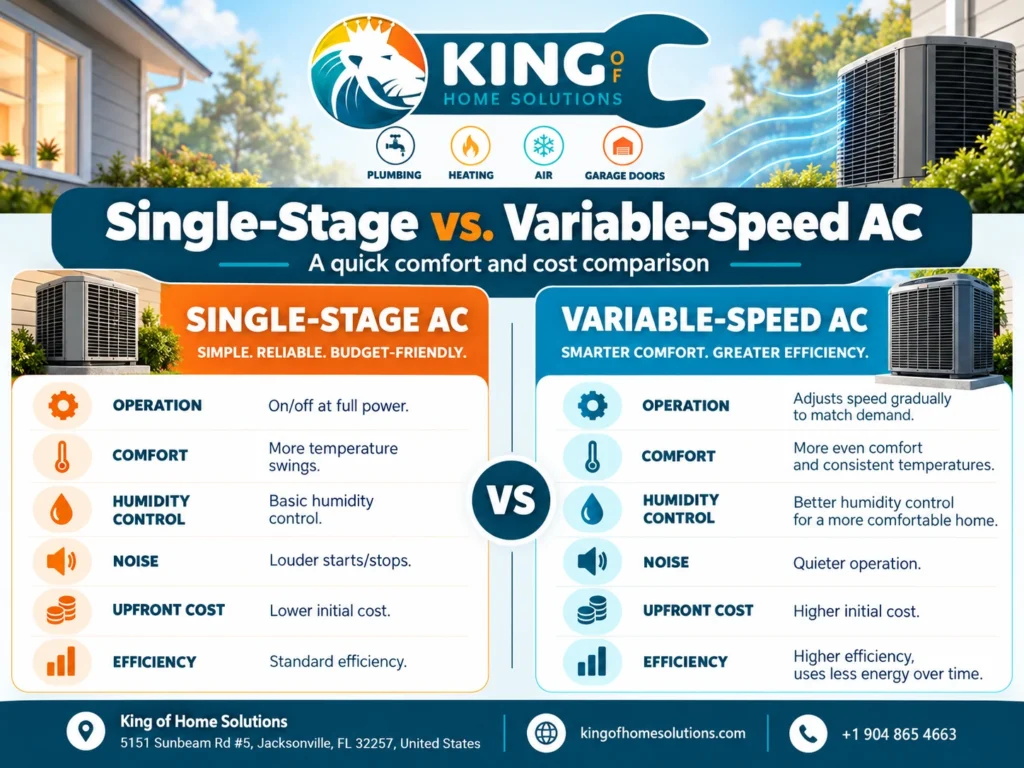
Variable-speed air conditioning can provide noticeably steadier temperatures, longer cooling cycles, better moisture removal, quieter operation, and higher efficiency than conventional single-stage equipment.
But that doesn’t automatically make it the smartest purchase for every home.
A properly sized single-stage system can still provide excellent cooling. And a badly installed $12,000 variable-speed system can perform worse than a much cheaper AC installed correctly.
The decision comes down to what you’re paying extra for and whether those benefits matter in your house.
What Is a Single-Stage Air Conditioner?
A single-stage compressor operates like a basic light switch.
ON or OFF.
When the thermostat calls for cooling, the compressor operates at essentially full capacity.
If you have a three-ton system, the AC does not decide:
“Today isn’t that hot. I’ll operate like a 1.5-ton system.”
It turns on at its designed capacity.
Once the thermostat reaches the desired temperature, the compressor shuts off.
Then the house warms.
The system starts again.
Carrier describes single-stage equipment as operating at 100% capacity whenever cooling is required, while variable-speed equipment can adjust output to match changing cooling demand.
Single-stage technology has one enormous advantage:
It costs less.
It is relatively straightforward, widely available, and perfectly capable of cooling a properly designed home.
For budget-conscious homeowners, that matters.
How Does Variable-Speed AC Work?
Variable-speed equipment behaves more like a dimmer switch.
Instead of choosing between 0% and 100%, the compressor can operate across a range of capacities.
Depending on the equipment, that might mean running at approximately 25% or 30% capacity during mild conditions and gradually increasing output as the cooling load rises.
Trane describes variable-speed systems as capable of operating from roughly 25% to 100% capacity, adjusting based on temperature, humidity, and changing conditions.
That means your AC doesn’t have to constantly blast the house with maximum cooling.
Most of the time, it can run more gently.
And that changes how the house feels.
The Biggest Comfort Difference: Longer Cooling Cycles
Imagine driving through Jacksonville traffic.
A single-stage AC is like accelerating hard, hitting the brakes, accelerating again, then stopping.
Variable speed is more like maintaining a steady speed.
Because variable-speed systems can operate at lower capacity, they often run for much longer periods.
That sounds inefficient until you understand what’s happening.
The compressor is not necessarily consuming full power during those extended cycles.
Instead, it is matching output more closely to what the house actually needs.
Those longer, lower-capacity cycles can maintain temperatures more consistently instead of allowing the house to repeatedly warm and cool.
Carrier and Trane both identify tighter temperature control as one of the major benefits of variable-capacity equipment.
For some homeowners, this is the biggest difference they notice.
The house simply feels more even.
In Florida, Humidity May Be the Real Reason to Upgrade
Temperature isn’t the whole comfort equation.
Humidity matters enormously.
Air conditioners remove moisture when humid indoor air passes across the cold evaporator coil.
The moisture condenses and drains away.
But moisture removal requires runtime.
A single-stage AC can sometimes satisfy the thermostat relatively quickly, especially when the cooling load is moderate.
The compressor shuts down.
Moisture removal stops.
Variable-speed equipment can operate longer at reduced output, giving the system more opportunity to dehumidify.
Carrier says variable-speed systems generally provide better humidity control because of those longer low-speed cycles.
This is particularly valuable in a Florida house where you have experienced the classic problem:
The thermostat says 74°F, but the house still feels clammy.
You may discover that a house at 76°F with better humidity control actually feels more comfortable than a damp house at 72°F.
That can be a meaningful quality-of-life improvement not just a specification on a brochure.
But Variable Speed Cannot Fix an Oversized System
This may be the most important part of the buying decision.
Do not let a contractor use variable-speed technology as an excuse to skip proper HVAC sizing.
ENERGY STAR warns that oversized HVAC equipment can cycle excessively, reduce comfort, hurt humidity control, and operate inefficiently. It recommends that contractors perform a proper Manual J load calculation rather than selecting equipment using rough rules of thumb.
Variable-speed technology can compensate for some sizing limitations because it can reduce capacity.
But that doesn’t mean:
“Bigger is better because it can always slow down.”
The best system is still one properly designed for the home’s actual heating and cooling load.
Before worrying about compressor stages, ask:
“Did you perform a Manual J calculation?”
That question may matter more than the brand printed on the condenser.
How Much More Does Variable Speed Cost?
This is where homeowners hesitate.
Current 2026 national pricing guides place many standard-efficiency central AC replacements around $5,000 to $8,300, although actual costs vary dramatically by equipment size, region, efficiency, duct modifications, electrical requirements, and installation complexity.
Premium variable-speed equipment can move well beyond that range.
For example, current 2026 Carrier cost estimates place many single-stage Comfort-series installations around $3,000 to $8,000, while premium variable-speed Infinity installations may run roughly $8,000 to $15,000 or more depending on configuration.
American Standard estimates show a similar progression, with single-stage equipment around $3,500 to $5,500 in some configurations and variable-speed Platinum systems around $6,000 to $12,000 installed.
Those are examples not universal price lists.
But they illustrate the point:
Variable-speed comfort can carry a substantial upfront premium.
Will Energy Savings Pay for the Upgrade?
Maybe.
But don’t buy a variable-speed system based solely on someone promising that the utility savings will quickly pay for it.
Variable-speed compressors can be very efficient because they avoid repeatedly operating at maximum output when full capacity isn’t required.
Higher efficiency generally means lower electricity consumption.
But your actual savings depend on:
- The efficiency of your existing AC
- New equipment SEER2 rating
- House insulation
- Duct leakage
- Thermostat settings
- Electricity rates
- Equipment sizing
- Hours of operation
- Installation quality
If you’re replacing an ancient inefficient system, almost any modern correctly installed AC may deliver substantial savings.
The difference between a new single-stage system and a new variable-speed system may be smaller than the difference between your old equipment and either new option.
So treat efficiency savings as one benefit.
For many homeowners, comfort and humidity control are the stronger reasons to pay the premium.
Variable Speed Is Usually Quieter
A condenser operating at reduced speed tends to produce less sound than one starting and running at full capacity every time.
The same applies to indoor airflow.
Instead of suddenly hearing a rush of air every time cooling begins, a matched variable-speed system can ramp airflow up and down more gradually.
Carrier and Trane both identify lower sound levels as a benefit of variable-capacity systems.
This matters most when:
- The outdoor condenser sits near a patio
- The air handler is near bedrooms
- Supply vents are already noisy
- The system starts frequently overnight
If your current AC wakes you every time it starts, quieter operation may be worth more to you than a small difference on the power bill.
Be Careful With the Phrase “Variable Speed”
Here is a question every homeowner should ask:
“Is the compressor variable speed, or just the indoor blower motor?”
They are not the same thing.
A system may have a variable-speed indoor air handler while still using a single-stage outdoor compressor.
A variable-speed blower can provide useful airflow control.
But it does not transform a single-stage compressor into a true variable-capacity cooling system.
For maximum modulation, the outdoor compressor and indoor equipment need to be appropriately matched and controlled.
If a quote says “variable speed,” ask exactly which component is variable.
What Is the Downside Besides Price?
Complexity.
Premium variable-speed systems rely more heavily on sophisticated electronics, sensors, communicating controls, and inverter technology.
That technology is what allows precise operation.
It also means you should pay attention to:
- Parts warranty
- Labor warranty
- Local dealer expertise
- Replacement-part availability
- Thermostat compatibility
- Surge protection recommendations
A basic single-stage system has fewer sophisticated control components.
For homeowners who value mechanical simplicity and lower upfront expense, that can be appealing.
For homeowners buying variable-speed equipment, the quality of the installing contractor becomes especially important.
Don’t Overlook Two-Stage AC
There is another option between the two extremes.
Two-stage equipment.
A typical two-stage compressor can operate at a lower capacity for much of the day and switch to full capacity when necessary.
Carrier describes two-stage systems as the middle ground between single-stage affordability and variable-speed comfort, with improved dehumidification and quieter operation compared with basic single-stage systems.
For homeowners who want better humidity control without paying the full variable-speed premium, two-stage equipment can offer an attractive compromise.
When Variable Speed Is Probably Worth It
Variable-speed AC deserves serious consideration when:
- You live in a hot, humid climate
- Humidity control is a major comfort problem
- You plan to stay in the house for years
- You value quiet operation
- You notice significant temperature swings
- You want higher efficiency
- Your home has varying cooling loads throughout the day
- Your budget allows for premium equipment
The comfort difference can be particularly noticeable in humid climates where AC systems operate for much of the year.
When Single Stage May Be the Better Buy
A single-stage system can still make excellent sense when:
- Upfront budget is the priority
- Your current single-stage system already keeps the home comfortable
- Indoor humidity is well controlled
- The house is relatively small
- You don’t care about minor temperature fluctuations
- You’re unlikely to stay long enough to value the premium
- You prefer simpler equipment
There is nothing inherently wrong with single-stage air conditioning.
Correctly sized and correctly installed equipment matters far more than buying premium technology simply because it is available.
The Bottom Line
Is variable-speed AC worth the extra money?
If your only goal is:
“Make my house cold.”
Probably not always.
A properly sized single-stage system can do that very well.
But if your definition of comfort includes steadier temperatures, lower humidity, quieter operation, longer gentle cooling cycles, and higher efficiency, variable-speed equipment can provide a noticeable upgrade especially in a hot, humid Florida climate.
Just don’t spend thousands more until the fundamentals are right.
Get the load calculation.
Inspect the ductwork.
Verify airflow.
Compare SEER2 ratings.
Ask whether the compressor itself is variable speed.
And compare the warranties.
Because a premium compressor cannot rescue poor HVAC design.
But when a variable-speed system is correctly sized, matched, and installed, the difference isn’t simply that the house gets cold.
It’s that you stop noticing the air conditioner working so hard to keep you comfortable.