Serving The Jacksonville Area



Insulated vs. Non-Insulated Garage Doors: Understanding the “Garage Sweat” Problem
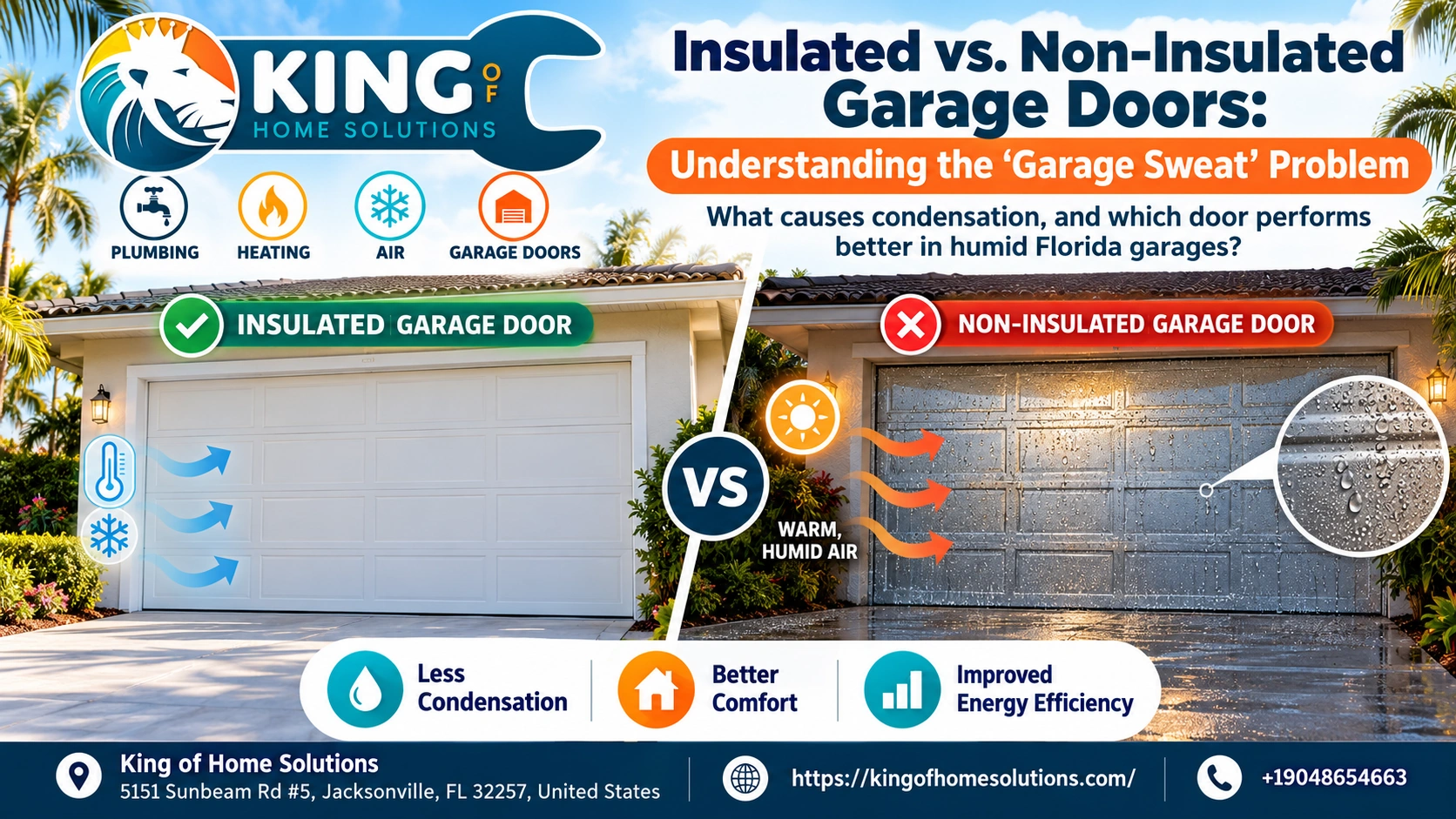
Insulated vs. Non-Insulated Garage Doors: Understanding the “Garage Sweat” Problem
You open the garage on a humid morning and notice water beads across the inside of the door.
The panels look damp. Metal hinges are wet. Moisture may even be dripping onto the floor.
At first, it is easy to assume the door is leaking.
But in many cases, the water did not come through the door. It formed on the door.
This is commonly called garage sweat. It happens when warm, moisture-filled air touches a surface cold enough for condensation to form.
An insulated garage door can reduce the problem by keeping the interior surface temperature closer to the garage air temperature. However, insulation is not a guaranteed cure. If humidity is high, air is leaking into the garage, or the door contains thermal bridges, condensation may still appear.
The right solution depends on why the door is sweating in the first place.
Garage Door Sweating?
Reduce condensation and improve comfort with the right garage door. Call today to explore insulated options.
What Is Garage Sweat?
Garage sweat is condensation.
Air always contains some amount of water vapor. Warm air can hold more moisture than cool air. When humid air touches a cold garage-door surface, the air next to that surface cools.
If it cools below its dew point, the vapor changes into liquid water.
That is why a garage door may look wet even when:
- It has not rained
- The roof is not leaking
- The door seals appear intact
- No plumbing lines are nearby
- The outside of the door is completely dry
The same process causes condensation on a cold drink, bathroom mirror, or air-conditioning vent.
Why Garage Doors Sweat
Garage doors are large surfaces that can change temperature quickly.
A metal door may become cold overnight, especially during cooler weather. When warmer, humid air enters the garage the next morning, moisture can condense on the interior panel.
Condensation can also develop when:
- An air-conditioned room is located next to or above the garage
- Cold air leaks into the garage from the home
- Outdoor humidity is high
- Wet vehicles are parked inside
- Laundry equipment adds moisture
- The garage lacks ventilation
- Door seals allow humid air infiltration
- The garage is cooled occasionally
- A portable air conditioner is used without controlling humidity
- The door has little or no insulation
The visible water is the symptom. The real cause is the combination of moisture and a cold surface.
How a Non-Insulated Garage Door Behaves
A basic non-insulated garage door is often made from a single layer of steel.
That metal panel transfers heat quickly. When the outside temperature changes, the inside surface follows it closely.
During cool weather, the interior metal may become cold enough for humid garage air to condense on it. During hot weather, the panel can also transfer substantial heat into the garage.
Common characteristics of non-insulated doors include:
- Rapid temperature changes
- A cold interior surface during winter
- A hot interior surface in direct sun
- More noticeable condensation
- Greater noise and vibration
- Less protection for adjacent living spaces
- A lighter construction
- Lower initial cost
A non-insulated door may be adequate for a detached garage used only for parking and storage. It becomes less attractive when the garage is attached to the home, used as a workshop, or affected by condensation.
How an Insulated Garage Door Behaves
An insulated door usually contains foam or another insulating material between metal layers.
The insulation slows heat transfer. This helps keep the inside surface from becoming as cold as the outside panel during cool weather and as hot during summer sun exposure.
Because the interior surface temperature stays closer to the garage temperature, condensation may be less likely.
Potential benefits include:
- Reduced heat transfer
- Less surface-temperature fluctuation
- Lower condensation risk
- Improved comfort
- Less noise
- Greater panel stiffness
- Better conditions in rooms beside or above the garage
The amount of improvement depends on the door construction, insulation type, panel joints, weather seals, garage humidity, and installation quality.
Will an Insulated Door Stop Garage Sweat?
It may reduce it significantly, but it may not eliminate it.
Condensation forms when the door surface falls below the dew point. Insulation can raise the interior surface temperature, making that less likely.
However, an insulated door may still sweat when:
- Garage humidity is extremely high
- Warm outdoor air leaks around the perimeter
- Cold air leaks from the home into the garage
- Metal framing creates thermal bridges
- The door is cooled from one side
- The garage is poorly ventilated
- Wet vehicles add large amounts of moisture
- The bottom seal traps damp air
- Insulation is thin or poorly installed
The door can only control one part of the condensation equation: surface temperature.
Humidity must also be controlled.
The Importance of the Dew Point
Relative humidity alone does not fully explain condensation.
The dew point is the temperature at which air becomes saturated and water begins forming on surfaces.
For example, suppose the garage air is warm and humid. If the interior surface of the garage door becomes colder than the dew point, the door will sweat.
This means two garages at the same temperature may behave differently if one contains more moisture.
It also explains why condensation may appear only:
- Early in the morning
- After a sudden weather change
- After parking a wet vehicle
- When the home’s air conditioner is running
- During cool nights followed by humid mornings
- Near certain sections of the door
A surface-temperature or infrared reading, combined with indoor humidity measurements, can help confirm the cause.
Can Insulation Make Condensation Worse?
In some situations, yes.
Insulation generally reduces condensation risk when it is properly installed. But incomplete insulation or trapped moisture can create new problems.
Moisture trapped behind retrofit insulation
Homeowners sometimes attach foam panels or reflective material to the inside of an existing metal door.
If humid air reaches the cold metal behind the insulation, condensation may form where it cannot be seen.
That hidden moisture can contribute to:
- Corrosion
- Mold growth on dust or paper surfaces
- Adhesive failure
- Odors
- Staining
- Damaged insulation
Retrofit insulation should fit tightly and be compatible with the door design.
Thermal bridging
Metal hinges, stiles, tracks, fasteners, and panel edges can transfer heat around the insulation.
These areas may remain colder than the center of the insulated panel. As a result, condensation may collect in lines, spots, or around hardware.
Poor air sealing
A highly insulated door with worn perimeter seals may still allow humid air to enter around the sides and top.
Insulation without air sealing may improve panel temperature while leaving the moisture source unchanged.
Insulated Does Not Mean Airtight
A garage door can have a high insulation rating and still leak air.
Common leakage points include:
- Bottom weather seal
- Side seals
- Top seal
- Panel joints
- Track alignment
- Uneven flooring
- Corners
- Damaged trim
- Gaps around service penetrations
Air leakage matters because it carries moisture.
Warm, humid air entering through a gap can condense on colder metal surfaces nearby. This is why sweating is sometimes heaviest around the edges of the door rather than the center.
Replacing damaged weather stripping can be as important as upgrading the door itself.
R-Value and What It Means
Garage-door insulation is often described using an R-value.
R-value measures resistance to heat flow. In general, a higher R-value means better insulation.
However, homeowners should not compare R-values without understanding how they were measured.
A manufacturer may report:
- The insulation material’s R-value
- The entire door section’s R-value
- A center-of-panel value
- A tested assembly value
These numbers are not always directly comparable.
Also, a high center-panel R-value does not account for air leakage, panel joints, framing, or installation gaps.
For condensation control, the complete door assembly matters more than a single marketing number.
Common Garage-Door Construction Types
Single-layer steel
This is the simplest and least expensive design.
It usually has:
- One steel skin
- No insulation
- Exposed structural framing
- Low thermal resistance
It is more likely to develop a cold interior surface and visible condensation.
Double-layer door
A double-layer door generally includes:
- An exterior steel skin
- Insulation attached to the inside
- An exposed insulation surface or protective backing
It provides better thermal performance than a single-layer door but may be less durable than a fully enclosed insulated panel.
Triple-layer door
A triple-layer door typically includes:
- Exterior steel
- A foam-insulated core
- An interior steel or composite skin
This design usually offers better rigidity, appearance, noise control, and thermal performance.
For an attached garage with recurring condensation, triple-layer construction is often the strongest option.
Polystyrene vs. Polyurethane Insulation
Two common garage-door insulation materials are polystyrene and polyurethane.
Polystyrene
Polystyrene is usually installed as rigid foam panels.
Advantages may include:
- Lower cost
- Straightforward construction
- Moderate insulation
- Easy replacement in some designs
Possible limitations include:
- Gaps between foam and metal
- Lower insulation performance at the same thickness
- Less panel reinforcement
- Greater risk of air spaces behind retrofit pieces
Polyurethane
Polyurethane foam is commonly injected between the door skins, where it expands and adheres to the panels.
Potential advantages include:
- Higher insulation value per inch
- Better panel rigidity
- Fewer internal air gaps
- Improved sound reduction
- Stronger bonding between door layers
Polyurethane-insulated doors usually cost more, but they can provide better overall thermal performance.
Why Attached Garages Need More Attention
An attached garage affects more than the vehicles parked inside.
The garage may share:
- A wall with conditioned living space
- A ceiling with a bedroom above
- Ductwork
- Plumbing
- Electrical equipment
- Storage areas
- A door into the home
An uninsulated garage door can allow more heat to enter during summer and more heat to escape during cooler weather.
That may affect comfort in adjacent rooms and increase the load on the home’s HVAC system.
Condensation can also increase humidity near stored belongings, tools, metal equipment, cardboard boxes, and building materials.
For an attached garage, insulation and air sealing usually provide more value than they would in a detached storage building.
Why Jacksonville-Style Humidity Makes the Problem Worse
In humid climates, the air often contains enough moisture for condensation to form with only a modest surface-temperature difference.
A garage door does not need to be covered in frost. It only needs to become cooler than the air’s dew point.
This can happen when:
- The door cools overnight
- Humid morning air enters the garage
- An adjacent conditioned space cools part of the structure
- A storm brings a rapid temperature change
- A wet vehicle increases indoor moisture
- The garage is closed with little air movement
Coastal and humid conditions can also accelerate corrosion once condensation forms regularly.
That makes recurring garage sweat more than a cosmetic concern.
What Damage Can Garage Sweat Cause?
Occasional light condensation may not cause immediate harm.
Repeated moisture can contribute to:
- Rust on door panels and hardware
- Corroded tracks, hinges, and springs
- Peeling paint
- Damaged stored boxes
- Musty odors
- Mold on organic materials
- Slippery floors
- Swollen wood trim
- Moisture damage near the bottom seal
- Premature deterioration of fasteners
- Water staining
Garage-door springs, cables, bearings, and rollers are especially vulnerable to moisture and corrosion.
A sweating door may therefore affect both the building and the door’s operating components.
How to Tell Condensation From a Leak
Before replacing the door, determine whether the water is truly condensation.
Signs of condensation
- Moisture is spread across the metal surface
- Water forms during humid weather
- The outside of the door is dry
- Droplets appear most heavily on cold panels
- Moisture occurs without rain
- Hinges and metal framing are also damp
Signs of rain intrusion
- Water appears mainly during storms
- Moisture enters around the top or sides
- The bottom seal allows water underneath
- The exterior trim is damaged
- Water follows a clear path inward
- One corner is consistently wet
Signs of plumbing or roof problems
- Moisture appears above the door
- Stains remain after the weather changes
- Drywall or framing is wet
- Water collects away from the door
- The problem continues when humidity is low
A door upgrade will not solve a roof, drainage, or plumbing leak.
Simple Ways to Reduce Garage Sweat
An entirely new door may not be the first step.
Improve ventilation
Air movement can help equalize temperatures and reduce localized moisture buildup.
Possible options include:
- Opening the door briefly when outdoor conditions are drier
- Using an appropriately installed exhaust fan
- Adding passive vents where permitted
- Running a circulation fan
- Avoiding tightly packed storage against exterior surfaces
Ventilation is not always helpful when the outdoor air is more humid than the garage air. Bringing in wet air can make condensation worse.

Control indoor humidity
A dehumidifier may help in enclosed garages with persistent moisture.
It should be:
- Sized for the space
- Drained properly
- Rated for expected temperatures
- Kept away from vehicle impact areas
- Used with reasonable air sealing
A dehumidifier may struggle if the garage door has major gaps or is opened frequently.
Replace worn weather seals
Inspect the:
- Bottom seal
- Side jamb seals
- Top seal
- Panel seals
- Threshold
Seals should make consistent contact without preventing the door from operating safely.
Dry wet vehicles when practical
Vehicles can bring substantial water into the garage after rain.
Floor drains, squeegeeing, ventilation, and air movement can help moisture evaporate or leave the space.
Avoid venting dryers into the garage
A clothes dryer should not discharge warm, moisture-filled air into the garage.
That can sharply raise humidity and create condensation on cold surfaces.
Check air leakage from the home
Conditioned air leaking into the garage may cool certain surfaces.
Inspect:
- The door between the home and garage
- Ductwork
- Utility penetrations
- Attic access
- Wall gaps
- Ceiling openings
The garage should also remain properly separated from living space for safety.

Cost of a “Smart Garage” Upgrade in Jacksonville
You’re halfway to work when the question hits you: “Did I close the garage door?” For many Jacksonville homeowners, that…
Read The BlogCan You Add Insulation to an Existing Door?
Many garage doors can accept retrofit insulation kits.
These may use:
- Rigid foam
- Vinyl-backed insulation
- Reflective panels
- Precut inserts
A retrofit can improve comfort and reduce surface-temperature swings, but it has limitations.
Before installing one, consider:
- The additional weight
- Door balance
- Spring capacity
- Panel clearance
- Moisture trapping
- Fire and material requirements
- Manufacturer warranty
- Opener load
Adding insulation changes the door’s weight. The spring system may need adjustment or replacement to keep the door balanced.
A poorly balanced door can strain the opener and create a safety hazard.
When Full Door Replacement Makes More Sense
Replacing the entire door may be more practical when:
- The existing door is damaged
- Panels are rusting
- The door lacks structural strength
- Retrofit insulation would add too much weight
- Weather seals cannot fit properly
- The garage is attached to conditioned space
- Noise is a major concern
- The door is old and requires frequent repairs
- Condensation is combined with air leakage
- Appearance and resale value matter
A factory-insulated door usually provides a cleaner and more durable result than piecing insulation into an older single-layer door.
Will an Insulated Door Lower Energy Bills?
Possibly, but the savings vary widely.
The financial benefit is usually greater when:
- The garage is attached
- Conditioned rooms are above or beside it
- The door receives intense afternoon sun
- The garage is used as a workspace
- The garage contains HVAC equipment
- The existing door leaks air badly
- The wall and ceiling insulation are already adequate
The benefit may be limited when:
- The garage is detached
- It is rarely occupied
- The ceiling and walls are uninsulated
- The door is opened for long periods
- Large air leaks remain
- No conditioned space is nearby
Replacing the door alone does not convert a garage into conditioned living space.
Insulation Is Only One Part of the Garage Envelope
A high-performance door cannot overcome major weaknesses elsewhere.
Heat and moisture may still move through:
- Uninsulated walls
- An uninsulated ceiling
- Attic openings
- Single-pane windows
- Gaps around framing
- An unsealed service door
- Duct leaks
- Plumbing penetrations
- Poorly sealed electrical openings
For the best result, evaluate the entire garage rather than treating the overhead door as an isolated component.
Questions to Ask Before Buying an Insulated Door
Ask the installer:
- What is the full-door R-value?
- Is the rating for the complete assembly or only the insulation?
- Is the insulation polystyrene or polyurethane?
- Is the door double-layer or triple-layer?
- What seals are included?
- Will the perimeter weather stripping be replaced?
- Is the door rated for local wind requirements?
- Will the spring system be sized for the new door weight?
- Is the opener compatible?
- How are panel joints insulated and sealed?
- What warranty covers rust, delamination, and hardware?
- Will the installation address existing gaps?
A good proposal should describe more than the door’s appearance and R-value.
When to Call a Garage-Door Professional
Schedule an inspection when:
- The door is heavily rusted
- Condensation is affecting springs or cables
- Retrofit insulation has made the door difficult to lift
- The opener strains or reverses
- The door is out of balance
- Water enters around the frame
- Panels are sagging
- Weather seals no longer make contact
- The door has wind or structural damage
- You are considering adding substantial weight
Garage-door springs operate under high tension. Balance adjustments and spring changes should be handled by trained technicians.
When to Call Another Type of Professional
Garage sweat is not always solely a garage-door issue.
You may also need:
- An HVAC technician for duct leakage or pressure problems
- A roofer for overhead water intrusion
- A plumber for pipe leaks
- A building-envelope specialist for air leakage
- A mold professional when widespread growth is present
- An electrician when water reaches electrical equipment
The correct repair depends on the actual moisture source.
Insulated vs. Non-Insulated: Which Is Better?
For a detached garage used only for parking, a non-insulated door may be sufficient.
For an attached garage, workshop, laundry area, or space with recurring condensation, an insulated door usually offers meaningful advantages.
Non-insulated doors are best suited for:
- Detached garages
- Mild indoor-comfort requirements
- Low upfront budgets
- Spaces with little stored property
- Garages without adjacent conditioned rooms
Insulated doors are better suited for:
- Attached garages
- Rooms above the garage
- Workspaces
- Humid climates
- Temperature-sensitive storage
- Homes with recurring door condensation
- Homeowners who value quieter operation and stronger panels
The best door is the one that fits the garage’s use, climate exposure, and moisture conditions.
The Bottom Line
Garage sweat happens when humid air touches a garage-door surface that is colder than the dew point.
A non-insulated metal door changes temperature quickly, making condensation more likely.
An insulated garage door can help by keeping the interior surface warmer during cool conditions and reducing rapid temperature swings. It may also improve comfort, reduce noise, and protect adjacent living spaces.
But insulation alone may not solve the problem.
Persistent condensation may also require:
- Better air sealing
- New weather stripping
- Humidity control
- Improved ventilation
- Duct-leak repairs
- Moisture-source correction
- Properly installed insulation
For an attached garage in a humid climate, a well-sealed, factory-insulated door is usually the stronger long-term choice.
The goal is not merely to buy a door with a higher R-value. It is to keep humid air away from cold surfaces and prevent the garage from becoming a place where moisture quietly damages the door, hardware, and everything stored around it.
Stop Garage Door Condensation
A properly insulated garage door can help control temperature and moisture. Call now for professional recommendations.