Serving The Jacksonville Area


Protecting Your Outdoor AC Unit During a Florida Hurricane
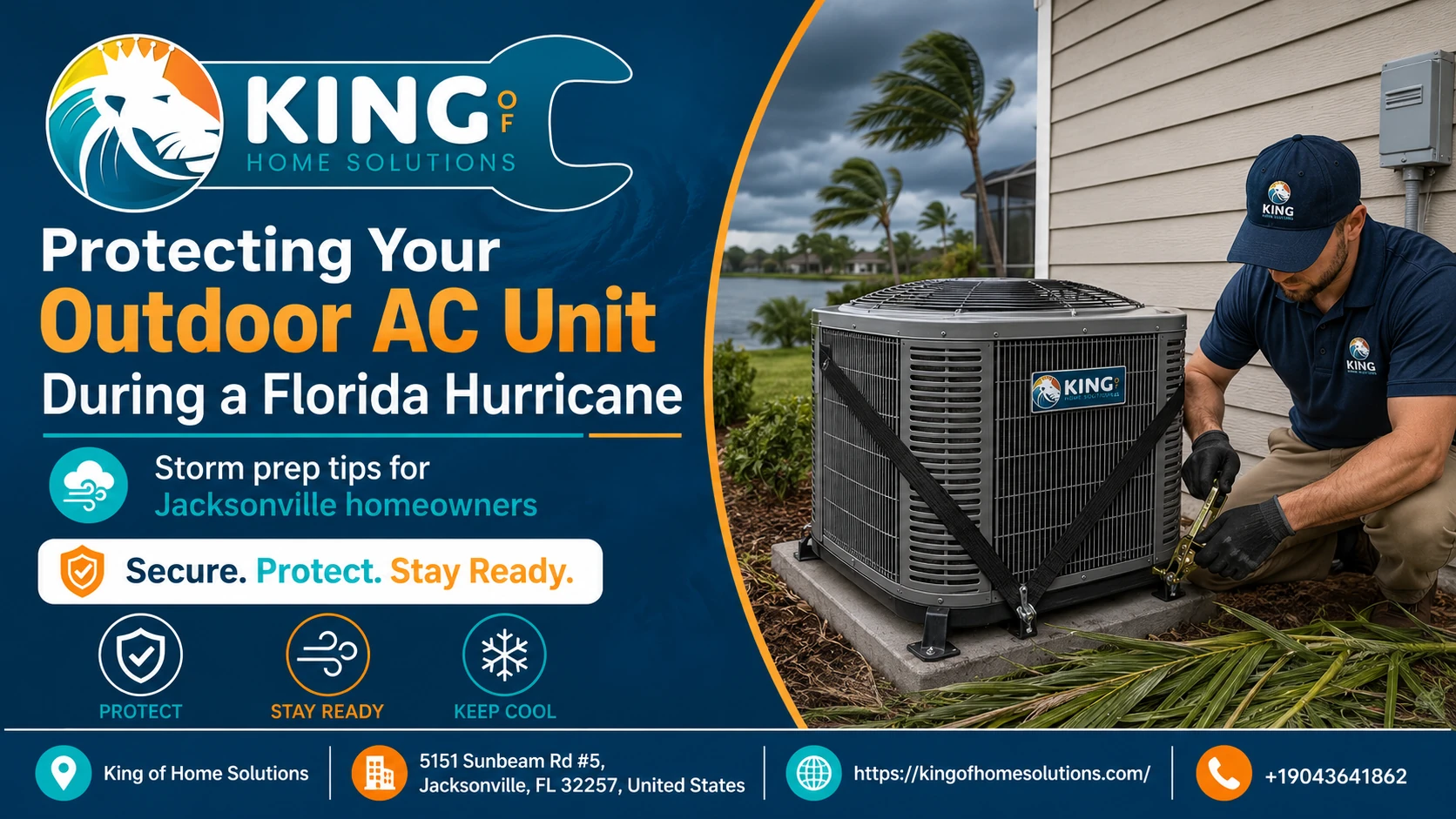
Protecting Your Outdoor AC Unit During a Florida Hurricane
When a hurricane is headed toward Florida, most homeowners know what to do first.
Bring in the patio furniture.
Secure the grill.
Check the shutters.
Clear the yard.
But there’s one expensive piece of equipment sitting outside that often gets overlooked:
Your air conditioner’s condenser.
That outdoor AC unit is designed to handle normal Florida rain, heat, and weather.
A hurricane is different.
Now you’re dealing with flying branches, roof shingles, fence panels, wind-driven debris, electrical surges, and depending on where you live, flooding or storm surge.
A few smart precautions before the storm can reduce the chances of turning hurricane cleanup into an unexpected HVAC replacement.
First: Your Outdoor AC Unit Is Supposed to Get Wet
This surprises some homeowners.
You do not need to wrap your condenser in plastic every time a tropical storm approaches.
Outdoor condensers are manufactured to operate outside and routinely encounter rain and moisture. FEMA even notes that exterior condensing units are naturally exposed to water during normal service.
The bigger hurricane threats are:
Flying debris.
Extreme wind.
Floodwater.
Electrical surges.
Physical movement of the equipment.
That’s where your preparation should focus.
Step 1: Clear Everything Around the Condenser
Start with the easiest protection.
Walk around the outdoor unit and look for anything that could become airborne.
That includes:
- Patio chairs
- Children’s toys
- Flowerpots
- Garden tools
- Loose branches
- Decorative signs
- Small grills
- Trash cans
- Hanging decorations
- Loose fencing
- Landscaping debris
If the wind can pick it up, it can throw it into the condenser.
And condenser coils are more vulnerable than they look.
The thin metal fins surrounding the unit are designed to transfer heat efficiently. A piece of wind-driven debris can bend those fins, damage the coil, puncture refrigerant tubing, or damage the fan assembly.
Trane similarly recommends removing loose debris and objects around outdoor HVAC equipment ahead of severe wind events.
Step 2: Trim Problem Branches Before the Storm Is Close
Look above the AC unit too.
Is there a dead branch hanging directly over it?
A loose palm frond?
A tree limb rubbing against the house?
Take care of obvious hazards while conditions are still safe.
Don’t wait until tropical-storm-force winds have already started.
And don’t attempt major tree work yourself immediately before a hurricane if you’re dealing with large limbs, power lines, or unstable trees.
The goal is simple:
Reduce the amount of material that can land on the condenser.
Step 3: Don’t Wrap the Unit Tightly in Plastic
This is one of the most common hurricane-prep mistakes.
Homeowners think:
“If rain comes, I’ll make the AC waterproof.”
So they wrap the entire condenser in plastic or a tarp.
That can create several problems.
If the AC accidentally operates while tightly covered, airflow through the condenser is severely restricted.
That’s bad for the system.
A poorly secured tarp can also tear loose and become storm debris itself.
And wrapping equipment can trap moisture unnecessarily.
If you use any manufacturer-approved protective system, follow the HVAC manufacturer’s instructions and never operate the unit while airflow is obstructed.
Your condenser needs an enormous amount of airflow when it’s running. Trane emphasizes that keeping the area around an outdoor condenser clear is essential for proper operation.
What About Plywood Over the AC?
You may have seen homeowners place plywood over the top or around their condenser before a storm.
The idea makes sense:
Protect the coil from debris.
The execution is where things can go wrong.
Do not drill random screws into the condenser cabinet.
You could hit a refrigerant line, coil, wiring, or other component.
Do not attach heavy materials in a way that transfers excessive loads to the equipment.
And do not create a makeshift cover that can detach and become a projectile.
If your property has a serious debris-exposure problem, talk with an HVAC contractor about a purpose-built protection strategy well before hurricane season.
Whatever protection you use needs to account for both impact resistance and proper anchoring.
Step 4: Check Whether the Condenser Is Actually Secured
Your outdoor condenser shouldn’t simply be sitting loose on the pad.
In hurricane-prone areas, mechanical equipment must be adequately secured against wind forces.
FEMA hurricane guidance specifically identifies securing HVAC equipment including the use of straps or other appropriate anchoring as a wind-damage mitigation strategy.
Look at your unit.
Does it appear firmly attached to its pad or stand?
Are brackets heavily rusted?
Are screws missing?
Has the concrete or equipment pad shifted?
Does the unit rock when lightly touched?
Don’t start installing homemade hurricane straps hours before landfall.
But if the condenser looks poorly secured during your normal pre-season inspection, have an HVAC professional evaluate the anchoring.
This is particularly important with larger modern condensers.
They have a lot of surface area for wind to push against.
Step 5: Think About Flooding Before Wind
For many Florida homes, floodwater may pose an even greater threat than rain or wind.
The condenser contains:
- Electrical components
- A compressor
- Motors
- Controls
- Refrigerant-system components
If floodwater rises into those systems, the equipment may require professional inspection before it is safe to operate.
Trane recommends elevating outdoor HVAC equipment in hurricane-prone or flood-prone areas where appropriate, while FEMA guidance similarly identifies elevating HVAC components as a flood-mitigation measure.
Obviously, you aren’t going to lift your condenser onto a platform the afternoon before a storm.
Elevation is something to consider when:
Installing a new system.
Replacing an existing condenser.
Rebuilding after flood damage.
Living in a location with a known history of flooding.
If your current condenser repeatedly gets threatened by rising water, its elevation should become part of the replacement conversation.
Don’t Try to Move the Condenser Yourself
A condenser is not like a generator or grill.
You cannot simply disconnect it, move it into the garage, and reconnect it after the storm.
It is connected to:
- Refrigerant lines
- High-voltage electrical wiring
- Low-voltage controls
Moving it requires proper HVAC procedures.
Bending, cutting, or damaging those refrigerant lines can turn an otherwise healthy system into a very expensive repair.
Leave relocation to licensed professionals.
Step 6: Know When to Turn the AC Off
This question comes up during almost every hurricane:
“Should I leave my AC running during the storm?”
There isn’t one universal moment when every Florida homeowner should shut the system down.
But there are conditions where turning it off becomes prudent.
Severe lightning and unstable electrical service can expose HVAC equipment to damaging voltage events. Trane specifically identifies electrical surges from storms as a potential source of air-conditioning damage.
If power begins repeatedly flickering, the outdoor area is flooding, the condenser has been physically struck, or local emergency guidance calls for power to be shut down, continuing to operate the equipment may be unwise.
If you do shut the system off, follow the manufacturer’s instructions.
For many central systems, that may involve turning the thermostat off and, where appropriate and safe, shutting off the HVAC circuit at the electrical panel.
Never work around electrical equipment while standing in water.
Why Power Flickering Is Hard on an AC System
An air conditioner doesn’t appreciate this:
Power on.
Power off.
Power on again.
Voltage drop.
Power off.
The compressor and controls rely on stable electrical power.
Modern systems may have protective electronics built in, but storm-related electrical events can still damage:
- Capacitors
- Contactors
- Circuit boards
- Compressor components
- Variable-speed electronics
- Communication boards
That is one reason whole-home surge protection and HVAC-specific surge protection are commonly discussed in hurricane-prone areas.
They cannot guarantee your system survives every electrical event.
But surge protection can add another layer of defense.
Step 7: Don’t Forget the Disconnect Box
Next to your condenser, you’ll usually see a small electrical disconnect mounted on the exterior wall.
Look at it while preparing the house.
Is the cover secure?
Is the box hanging loose?
Is it badly rusted?
Are wires exposed?
If anything appears damaged, don’t touch it.
Have an electrician or HVAC professional address it.
A hurricane is not the time to discover that your outdoor electrical connection has been deteriorating for years.
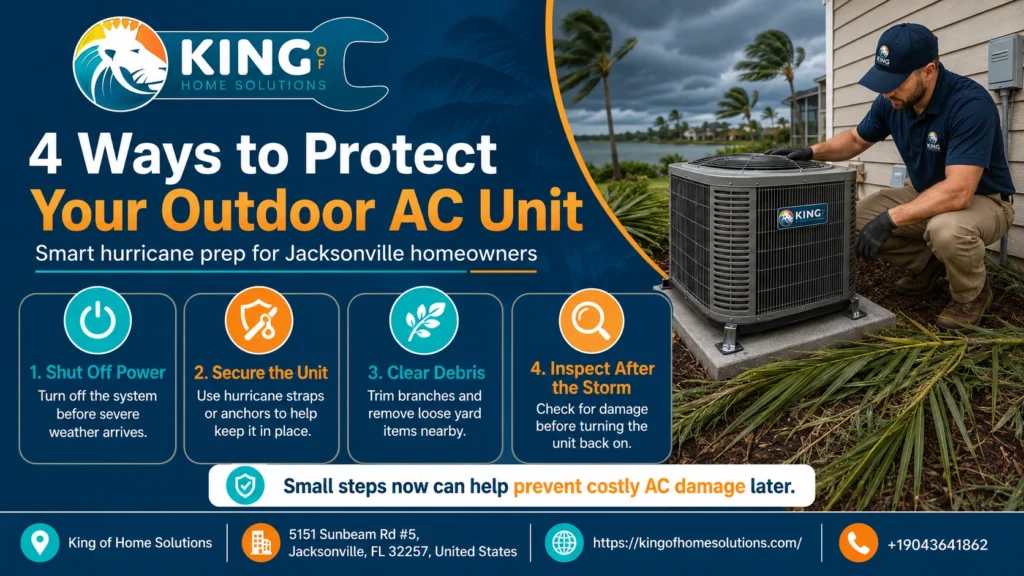
After the Hurricane: Don’t Immediately Turn the AC Back On
This is where patience can save equipment.
The storm passes.
The power returns.
The house is hot and humid.
Your first instinct is:
AC ON.
Before you do that, walk outside if authorities have said conditions are safe.
Inspect the condenser.
Look for These 8 Things Before Restarting
1. Debris Inside the Unit
Look through the grille.
Are there branches, leaves, roofing pieces, or other objects around the fan?
Do not operate the system with debris inside.
2. A Damaged Fan
Look through the top.
Does the fan blade appear bent?
Is something preventing it from rotating?
A damaged fan can cause additional damage if energized.
3. Crushed Condenser Fins
Minor bent fins may be repairable.
Major impact damage can indicate the coil itself has been struck.
4. Refrigerant-Line Damage
Look at the copper refrigerant lines between the condenser and house.
Do they appear kinked, crushed, broken, or pulled away?
If so, leave the system off.
5. A Shifted Condenser
The unit should still be sitting squarely on its pad or stand.
If it has moved, tipped, or twisted, do not simply push it back into place.
Movement can stress the refrigerant connections.
6. Standing Water
If floodwater reaches the electrical components or condenser, don’t energize it.
FEMA notes that electrical and HVAC controls can be damaged when inundated.
Have the system evaluated first.
7. Electrical Damage
Look for:
- Burn marks
- Damaged conduit
- A broken disconnect
- Exposed wires
- Fallen electrical equipment
Stay away if you see any electrical hazard.
8. Strange Odors or Sounds
If the unit starts and immediately produces unusual grinding, buzzing, banging, or electrical odors, shut it back down and have it inspected.
“It Was Underwater but It Dried Out” Is Not Enough
This is especially important after storm surge or significant flooding.
You cannot determine that submerged HVAC equipment is safe simply because the exterior looks dry.
Floodwater may affect electrical components, motors, controls, wiring, insulation, and other internal parts.
FEMA advises having a qualified technician inspect outdoor HVAC equipment when flood-related damage is in question.
Do not energize flood-damaged equipment just to “see if it works.”
That test can create a safety hazard and potentially cause additional damage.
Saltwater Creates an Extra Problem
Coastal homeowners have another concern.
Salt.
If storm surge or salt-laden water reaches HVAC equipment, corrosion can become an issue even after the immediate storm is over.
Salt deposits are particularly aggressive around:
- Aluminum fins
- Copper tubing
- Electrical terminals
- Steel cabinets
- Fasteners
If your condenser was exposed to storm surge, have the equipment professionally evaluated rather than assuming a quick garden-hose rinse makes everything normal again.
Your Landscaping Can Help or Hurt
Many Florida homeowners hide their outdoor condenser behind shrubs.
That’s fine when done correctly.
But landscaping should not crowd the equipment.
The condenser needs airflow to reject heat.
Trane recommends keeping vegetation and other obstructions away from outdoor HVAC equipment so the unit can breathe properly.
Before hurricane season, trim back branches and shrubs that:
Touch the condenser.
Could break into the fan.
Prevent you from inspecting the equipment.
Restrict airflow.
You want some separation between the machine and the vegetation surrounding it.
What About Mini-Splits?
Ductless mini-split systems have outdoor condensers too.
The same basic hurricane concerns apply:
- Wind
- Debris
- Flooding
- Anchoring
- Electrical damage
Wall-mounted or elevated mini-split condensers may have an advantage when it comes to shallow flooding, but their brackets and supporting structure need to be capable of handling the applicable loads.
Again, don’t improvise structural modifications immediately before a storm.
Have mounting systems evaluated before hurricane season.
The Best Hurricane Protection Happens Before There’s a Named Storm
The worst time to discover your condenser isn’t anchored is when every hardware store in town is packed.
The best time to protect your HVAC system is during normal maintenance.
Ask your technician:
Is the outdoor unit properly anchored?
Is the pad stable?
Is the disconnect in good condition?
Would elevation make sense at this property?
Is surge protection installed?
Are the refrigerant lines properly supported?
Those are easy conversations in May.
They become considerably harder when a hurricane warning has already been issued.
A Simple Florida AC Hurricane Checklist
Before the storm:
- Clear loose objects away from the condenser.
- Trim obvious dead branches while conditions are safe.
- Verify that the unit appears firmly secured.
- Inspect the equipment pad or stand.
- Check the exterior disconnect for obvious damage.
- Do not tightly wrap an operating condenser.
- Do not drill makeshift protection into the cabinet.
- Follow local emergency guidance regarding electricity and flooding.
After the storm:
- Wait until outdoor conditions are safe.
- Remove debris from around the condenser.
- Inspect the fan and cabinet.
- Look for bent or damaged refrigerant lines.
- Check whether the unit shifted on its pad.
- Do not energize equipment that was flooded.
- Do not operate equipment with obvious electrical damage.
- Call an HVAC professional if anything looks wrong.
The Florida Homeowner Takeaway
Your outdoor AC unit is tougher than it looks.
It was designed to live outside.
So ordinary hurricane rain isn’t the part you should obsess over.
Focus instead on what the equipment was not designed to handle:
A fence panel flying into the coil.
A tree branch dropping through the fan.
A loose condenser shifting in extreme wind.
Five feet of storm surge.
Or damaged electrical equipment being energized after flooding.
Clear the area before the storm.
Make sure the condenser is properly secured.
Think about flood exposure before you replace or relocate equipment.
And when the hurricane is over, inspect before you restart.
Because after spending days preparing your Florida home for a hurricane, the last thing you want is to survive the storm and damage your AC by turning it on five minutes too soon.