Serving The Jacksonville Area



Low-Flow Toilet Installation: How Much Will It Really Save You on Your JEA Bill?
Low-Flow Toilet Installation: How Much Will It Really Save You on Your JEA Bill?
Replacing an old toilet with a low-flow model sounds like an easy way to lower your water bill. But will the monthly savings be noticeable or will it take years to recover the installation cost?
For most JEA customers, a low-flow toilet can save approximately $30 to $150 per year, depending on the age of the existing toilet, household size, flushing habits, water-usage tier, and whether the home is connected to JEA sewer service.
The biggest savings usually come from replacing a toilet that uses 3.5 to 6 gallons per flush, leaks between flushes, or serves a frequently used bathroom.
Replacing a modern 1.6-gallon toilet with a 1.28-gallon model will save water, but the financial return will be much smaller.
How Much Water Does a Low-Flow Toilet Use?
A WaterSense-certified toilet uses 1.28 gallons per flush or less. That is at least 20% less water than the current federal standard of 1.6 gallons per flush. WaterSense models must also satisfy independent flushing-performance requirements.
The difference becomes more dramatic when compared with older toilets:
| Existing toilet | New toilet | Water saved per flush |
| 1.6 gallons per flush | 1.28 gallons | 0.32 gallons |
| 3.5 gallons per flush | 1.28 gallons | 2.22 gallons |
| 5 gallons per flush | 1.28 gallons | 3.72 gallons |
| 6 gallons per flush | 1.28 gallons | 4.72 gallons |
According to the EPA, replacing older, inefficient toilets with WaterSense models can reduce toilet water use by approximately 20% to 60%. The average family may save nearly 13,000 gallons per year when replacing its inefficient toilets.
What Does 1,000 Gallons Cost on a JEA Bill?
JEA charges residential customers for both water consumption and sewer usage. Water rates rise as monthly consumption enters higher tiers, while residential sewer usage is charged at one rate.
Current JEA residential water rates are:
- First 4,000 gallons: $1.34 per 1,000 gallons
- 5,000–8,000 gallons: $2.99 per 1,000 gallons
- 9,000–15,000 gallons: $5.13 per 1,000 gallons
- More than 15,000 gallons: $6.45 per 1,000 gallons
Residential sewer usage is currently $5.17 per 1,000 gallons. Duval County customers also pay a 3% franchise fee on water and sewer and a 10% public service tax on water.
After those usage charges and local fees, saving 1,000 gallons is worth approximately:
| Monthly water tier | Approximate water-and-sewer savings |
| First tier | $6.84 per 1,000 gallons |
| Second tier | $8.70 per 1,000 gallons |
| Third tier | $11.12 per 1,000 gallons |
| Highest tier | $12.61 per 1,000 gallons |
These calculations assume the property receives both JEA water and sewer service. Homes with septic systems will save only the water portion, so their dollar savings will be considerably lower.
The toilet will not reduce JEA’s fixed monthly water or sewer charges. It reduces only the charges connected to consumption.
Realistic Annual Savings Examples
Replacing a 1.6-gallon toilet
Suppose four people use the toilet five times per day.
Reducing each flush from 1.6 gallons to 1.28 gallons saves approximately:
4 people × 5 flushes × 365 days × 0.32 gallons = 2,336 gallons per year
That produces an estimated JEA water-and-sewer savings of approximately:
- $16 per year in the first water tier
- $20 per year in the second tier
- $26 per year in the third tier
Replacing a properly working 1.6-gallon toilet for utility savings alone usually does not create a fast financial payback.
Replacing a 3.5-gallon toilet
Under the same four-person household example:
4 × 5 × 365 × 2.22 gallons = 16,206 gallons saved per year
Estimated annual JEA savings:
- $111 in the first tier
- $141 in the second tier
- $180 in the third tier
This is where a low-flow toilet begins to make stronger financial sense.
Replacing a 5-gallon toilet
A four-person household replacing a 5-gallon toilet could save approximately:
4 × 5 × 365 × 3.72 gallons = 27,156 gallons per year
Estimated annual JEA savings:
- $186 in the first tier
- $236 in the second tier
- $302 in the third tier
Actual savings may be lower when household members use bathrooms at work, school, or other locations during the day.
What If You Replace Only One Toilet?
The EPA’s nearly 13,000-gallon estimate generally reflects an average family replacing inefficient toilets in the home, not necessarily one lightly used fixture.
Replacing one toilet will produce the greatest savings when it is:
- In the primary bathroom
- Used by several household members
- Flushed frequently throughout the day
- An older 3.5- to 6-gallon model
- Running or leaking between flushes
A low-use guest-bathroom toilet may not generate enough annual savings to justify replacement purely as a bill-reduction project.
A Leaking Toilet Can Cost More Than an Inefficient Toilet
Before replacing the entire fixture, determine whether the existing toilet leaks.
A worn flapper can allow water to flow silently from the tank into the bowl. The EPA reports that household leaks can waste approximately 180 gallons per week, and toilets are a common source.
At 180 gallons per week, the waste reaches approximately 9,360 gallons per year.
For a JEA water-and-sewer customer, that could represent roughly $64 to $118 per year, depending on the water tier.
In many cases, replacing a defective flapper, fill valve, or tank seal is more cost-effective than replacing the entire toilet. However, replacement may make more sense when the toilet is both leaking and inefficient.
How Much Does Low-Flow Toilet Installation Cost in Jacksonville?
A standard toilet installation in Jacksonville commonly costs approximately $250 to $630, although premium fixtures, damaged flanges, old shutoff valves, floor repairs, and plumbing modifications can increase the total.
A typical project may include:
- The new toilet
- Removal of the existing toilet
- New wax ring or seal
- New mounting hardware
- Supply-line replacement
- Installation labor
- Testing for leaks
- Disposal of the old fixture
Ask whether the quoted price includes the toilet itself. Some estimates cover labor only.
How Long Does It Take to Recover the Cost?
Assume the total installed cost is $400.
| Estimated annual savings | Approximate payback period |
| $20 per year | 20 years |
| $50 per year | 8 years |
| $100 per year | 4 years |
| $150 per year | 2.7 years |
| $200 per year | 2 years |
A low-flow toilet usually pays for itself fastest when replacing a pre-1994 toilet, a leaking toilet, or a heavily used fixture.
When replacing a functioning 1.6-gallon model, the upgrade may still make sense for comfort, appearance, reliability, or remodeling but not necessarily for rapid utility savings.
How to Check Your Existing Toilet’s Water Use
Look inside the tank, behind the seat, or near the base for a stamp showing gallons per flush. Common markings include:
- 1.28 GPF
- 1.6 GPF
- 3.5 GPF
- 5 GPF
You can also check the model number printed inside the tank and look up the manufacturer’s specifications.
If no marking is visible, perform a simple tank-volume estimate:
- Turn off the toilet’s water supply.
- Mark the water level inside the tank.
- Flush the toilet.
- Refill the tank using a measured container.
- Record how many gallons it takes to reach the original mark.
This is only an estimate because some toilets retain water in the tank after flushing.
Will a Low-Flow Toilet Flush Properly?
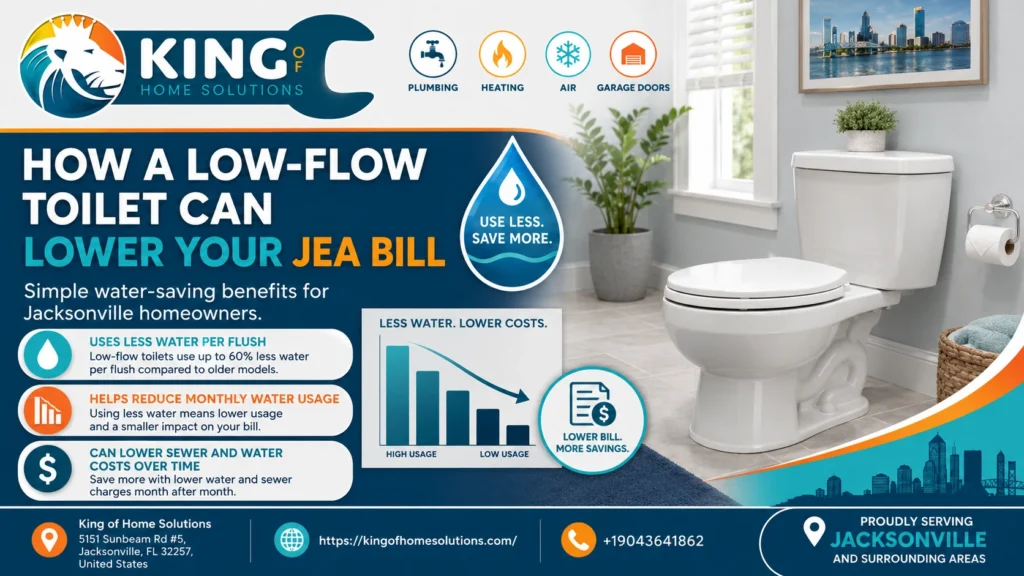
Early low-flow toilets developed a reputation for weak flushing and frequent clogs. Modern WaterSense toilets are different.
WaterSense-certified toilets must meet efficiency and performance standards, and the EPA says current models can provide equal or better performance while using 1.28 gallons per flush or less.
For better results, look for:
- WaterSense certification
- A strong independent flush-performance rating
- A fully glazed trapway
- The correct rough-in measurement
- A bowl height and shape suited to the household
- Reliable replacement parts
A poorly chosen toilet that requires frequent double flushing can erase part of the expected water savings.
The Bottom Line
For most JEA customers, replacing an old toilet with a low-flow WaterSense model can save approximately $30 to $150 per year. Households replacing extremely inefficient or leaking toilets may save more.
The upgrade offers the strongest return when the existing toilet:
- Uses 3.5 gallons per flush or more
- Leaks between flushes
- Serves several people
- Is used throughout the day
- Is connected to both JEA water and sewer service
Replacing a functioning 1.6-gallon toilet with a 1.28-gallon model may save only $15 to $30 per year in a typical household.
Before scheduling installation, check the existing toilet’s gallons-per-flush rating, inspect it for leaks, estimate how often it is used, and confirm which JEA water tier normally appears on your bill. Those four details will tell you whether the upgrade is a meaningful savings tool or simply a modest efficiency improvement.