Serving The Jacksonville Area


The Future of Home Solutions: “Smart, Salt-Resistant, and Storm-Ready”
The Future of Home Solutions: “Smart, Salt-Resistant, and Storm-Ready”
For years, homeowners judged upgrades with a fairly simple question:
“Will this make my house more comfortable?”
In Jacksonville, that question is changing.
Today, the better question is:
“Will this make my home easier to manage, more resistant to Florida’s environment, and better prepared when the weather turns ugly?”
That is where the next generation of home improvements is heading.
Not toward houses filled with unnecessary gadgets.
Toward homes that are:
Smart enough to warn you before a small problem becomes expensive.
Durable enough to survive heat, humidity, hard water, and coastal salt.
Strong enough to handle the realities of hurricane season.
For North Florida homeowners, the future of home solutions can increasingly be summarized in three words:
Smart. Salt-resistant. Storm-ready.
Smart Homes Are Becoming Less About Convenience and More About Prevention
The first wave of smart-home technology was mostly about convenience.
Turn the thermostat down from your phone.
Open the garage remotely.
Ask a speaker to turn off the lights.
Useful?
Sure.
But the more valuable generation of smart technology does something different.
It watches the house when you aren’t watching it.
Consider water leaks.
A tiny supply-line failure underneath a Jacksonville sink can run for hours before anyone notices.
An under-slab leak may continue even longer.
Modern flow-monitoring systems can track water usage, detect unusual patterns, send alerts, and depending on the system even shut off the home’s water automatically.
JEA itself has moved further in this direction. In 2026, the utility highlighted daily-use monitoring and proactive leak and high-bill alerts that can notify customers when unusual water consumption appears.
That’s a fundamental change in home maintenance.
The old model was:
Find the damage, then repair it.
The emerging model is:
Identify the abnormal condition before substantial damage occurs.
Smart electrical panels can provide better visibility into energy use.
Connected garage-door systems can tell you when a door was left open.
Smart thermostats can monitor HVAC runtime and help homeowners identify unusual operating patterns. ENERGY STAR-certified smart thermostats are specifically required to provide HVAC energy-use information and meet demonstrated energy-saving criteria based on field performance.
The best smart-home technology isn’t the technology you constantly interact with.
It’s the technology quietly watching the systems that can cost you thousands when they fail.
The Smart Jacksonville Home Starts With Water
If I had to pick one area where smart technology makes exceptional sense in Jacksonville, it would be plumbing.
Why?
Because so much of our plumbing is hidden.
Pipes can run through walls.
Supply lines may disappear beneath slabs.
Water heaters sit unnoticed in garages.
Washing-machine hoses remain under pressure day and night.
And Jacksonville’s very hard water can accelerate scale accumulation on equipment and fixtures.
A future-ready plumbing system might combine:
- Whole-house flow monitoring
- Automatic main-water shutoff
- Point sensors near the water heater and washing machine
- Braided stainless fixture connections
- Quarter-turn shutoff valves
- Smart irrigation monitoring
- Regular water-hardness testing
None of those features is particularly glamorous.
But neither is replacing flooring after a hidden leak.
The future of smart plumbing is therefore less:
“My faucet talks to Alexa.”
And more:
“My house noticed a leak while I was at work and shut the water off.”
That’s technology solving a real homeowner problem.
Salt Resistance Will Become a Bigger Buying Decision Near the Coast
Move east toward Jacksonville Beach, Neptune Beach, Atlantic Beach, or Ponte Vedra and the house faces another enemy:
salt.
Salt doesn’t need to arrive as visible ocean spray.
Moist, chloride-rich coastal air settles on metal surfaces and accelerates corrosion.
HVAC manufacturers have responded by designing equipment specifically around coastal environments. Carrier, for example, now uses welded aluminum coil technology, zinc cladding, heavier protective coatings, and additional isolation between dissimilar metals on its coastal equipment.
That points toward a larger trend.
In the future, coastal homeowners shouldn’t simply ask:
“Which AC has the highest efficiency rating?”
They should ask:
“Which AC is designed to survive where I live?”
The same principle applies throughout the property.
Garage-door hardware.
Exterior plumbing brackets.
Heat-pump water-heater components.
Outdoor electrical enclosures.
Fasteners.
Condenser stands.
Exterior lighting.
A component with a beautiful finish but poor corrosion resistance may look great in the showroom and terrible three summers later.
“Stainless” Will Need to Mean More Than “Shiny”
Material selection will increasingly become part of the home-upgrade conversation.
For coastal properties, that may mean:
316 stainless hardware where appropriate.
Hot-dip galvanized structural supports.
Marine-grade coating systems.
Factory-coated HVAC heat exchangers.
Powder-coated or corrosion-resistant garage-door components.
UV-resistant pipe and refrigerant-line protection.
The cheapest fastener in the project can sometimes become the first thing to fail.
Imagine installing a premium coastal condenser on an inexpensive untreated steel stand.
Or hanging expensive exterior plumbing with hardware already beginning to rust.
The future of home improvement should treat the entire installation environment as a system.
A salt-resistant HVAC unit isn’t truly salt-resistant if every bolt holding the installation together is corroding around it.
Storm-Ready Will Mean Engineered, Not Improvised
Then there is the reality every Jacksonville homeowner eventually faces:
Storm season.
For decades, hurricane preparation often meant plywood, sandbags, flashlights, and whatever could be improvised before landfall.
Modern storm resilience is becoming far more engineered.
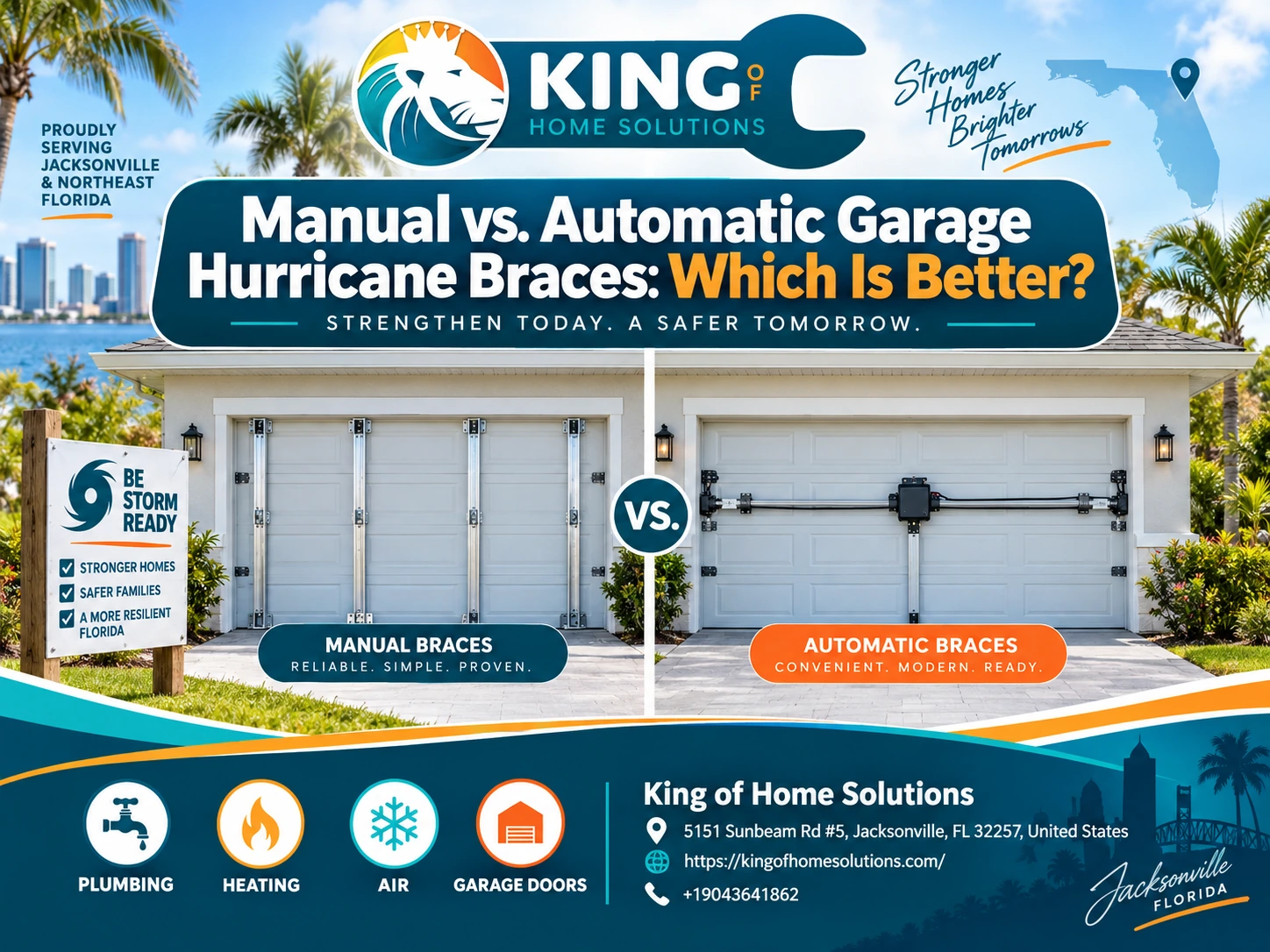
Garage doors are a perfect example.
FEMA continues to identify garage doors as particularly vulnerable during high-wind events because their large surface area can fail under wind pressure. Once the garage opening fails, wind can enter the structure and increase pressure on walls and roof components.
A future-ready garage therefore isn’t simply equipped with a stronger opener.
It may include:
A properly wind-rated garage door.
Documented positive and negative design-pressure ratings.
Impact-resistant glazing where appropriate.
Engineered track and jamb attachments.
Permanent or approved storm reinforcement.
Battery-backed garage-door operation.
And clear documentation identifying exactly what was installed.
That last item matters more than many homeowners realize.
“Storm-rated” should not be a vague marketing phrase.
The product should have documentation.
Florida Building Standards Are Moving Forward Too
The regulatory environment keeps evolving alongside technology.
As of September 2026, Florida is still operating under the 8th Edition (2023) Florida Building Code, effective since December 31, 2023. The Florida Building Commission is preparing the 9th Edition (2026), currently scheduled to become effective December 31, 2026.
Homeowners don’t need to become building-code experts.
But they do need to understand something important:
A Florida home is not the place to buy structural products solely because an online listing says “hurricane resistant.”
Windows.
Garage doors.
Exterior doors.
Roofing products.
Storm shutters.
Anchoring systems.
The exact approved assembly and installation matter.
The future of storm preparation will be less about buying something that looks strong and more about verifying how it was tested and installed.
Backup Power Will Become Part of Ordinary Home Planning
Storm resilience also means asking what still works when the grid doesn’t.
Think about the modern house.
Your tankless gas water heater may still require electricity.
Your smart garage opener needs power.
Your well pump, if you have one, needs power.
Your refrigerator obviously needs power.
Your internet equipment needs power if you expect smart devices to communicate.
A future-ready home will increasingly be designed around layers of backup, not necessarily a giant generator for everyone.
That could include:
Battery-backed garage-door openers.
Whole-home batteries.
Portable power stations.
Generator interlocks and transfers equipment.
Solar plus storage.
Dedicated backup for critical electronics.
The goal isn’t to operate every appliance exactly as normal during an outage.
It’s to identify:
“What absolutely needs to continue working?”
Then design around those loads.
Florida HVAC Will Get Smarter, Not Just More Efficient
For years, AC upgrades were marketed almost entirely around efficiency ratings.
SEER.
Then SEER2.
Higher numbers equals better systems.
But Jacksonville homeowners are learning that comfort is more complicated.
Humidity matters.
Runtime matters.
Airflow matters.
Duct leakage matters.
A modern variable-capacity heat pump may run much longer at low output than an old single-stage AC.
That’s not necessarily wasted energy.
In Florida, longer controlled runtime can help maintain more consistent temperature and humidity.
Connect that system to a smart thermostat that understands equipment stages, monitors runtime, and provides performance information, and HVAC maintenance begins moving from reactive to predictive.
The future isn’t merely:
“My AC is more efficient.”
It’s:
“My home understands how the HVAC system is behaving.”
The Best Future Upgrade May Be the Least Visible One
This is where home improvement is heading in an interesting direction.
For years, resale upgrades were overwhelmingly cosmetic.
Granite.
Flooring.
Cabinets.
Paint.
Those will always matter.
But homeowners increasingly understand the value of invisible infrastructure.
A whole-house repipe.
Automatic leak protection.
A wind-rated garage door.
Corrosion-resistant HVAC equipment.
A modern electrical panel.
A properly designed heat pump.
An upgraded roof-to-wall connection.
A battery system.
Those upgrades may not produce the dramatic Instagram before-and-after.
But they can create something more valuable:
confidence.
Confidence that the house will tell you when something goes wrong.
Confidence that exterior equipment isn’t quietly dissolving in salt air.
Confidence that the garage door was designed for real wind pressure.
Confidence that the plumbing can be shut down automatically.
Confidence that the house will remain functional when the neighborhood loses power.
The Future Jacksonville Home Is a System
The biggest change may be philosophical.
Stop thinking about home upgrades as isolated products.
A garage door isn’t just a garage door.
It interacts with the opener, structural framing, storm protection, insulation, smart controls, and backup power.
An air conditioner isn’t merely an outdoor condenser.
It interacts with humidity, ductwork, insulation, thermostat controls, electrical protection, and coastal corrosion.
A plumbing upgrade isn’t simply a new faucet.
It includes the shutoff valve, supply connector, water quality, leak detection, and condition of the pipes behind the wall.
The future belongs to companies that understand those connections.
Because homeowners don’t actually want a collection of equipment.
They want a house that works.
The Bottom Line
Jacksonville homes face a combination of challenges that few markets experience all at once:
Extreme summer heat.
Heavy humidity.
Very hard water.
Coastal salt.
Tropical storms.
Occasional extended outages.
And a huge inventory of older homes now reaching the age when major systems require replacement.
That is why the future of local home improvement shouldn’t simply be newer.
It should be smarter.
More durable.
Better prepared.
Smart enough to catch problems early.
Salt-resistant enough to survive the environment where it was installed.
Storm-ready enough to protect the house when conditions stop being normal.
Because the best home solution isn’t the one with the longest feature list.
It’s the one designed around the problems Jacksonville homeowners actually live with.