Serving The Jacksonville Area


UV Lights vs. Ionizers: Cleaning the Air in a Humid Jacksonville Home
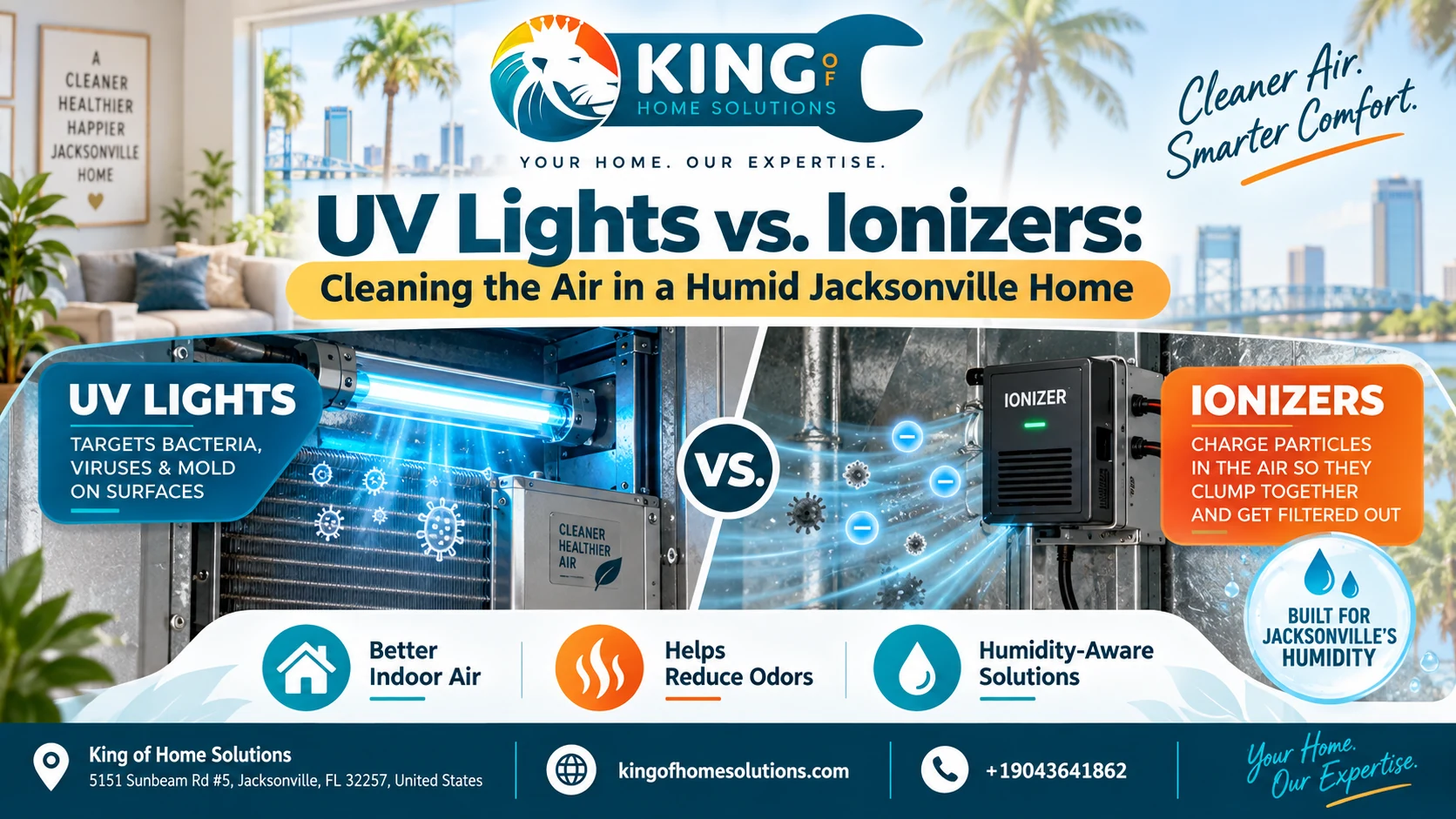
UV Lights vs. Ionizers: Cleaning the Air in a Humid Jacksonville Home
Jacksonville homeowners know what humidity can do.
Bathrooms stay damp longer.
Closets can develop musty smells.
Air conditioners run for hours removing moisture from the air.
And inside the HVAC system, the evaporator coil may stay wet for much of the cooling season.
That is exactly why indoor-air-quality products are marketed so aggressively in Northeast Florida.
Two of the most common upgrades are:
HVAC UV lights and ionizers.
Both are advertised as ways to make indoor air “cleaner.”
But they work very differently and they are not equally useful for every problem.
If your goal is controlling biological growth on a damp AC coil, UV-C light has a practical advantage.
If your goal is removing dust, pollen, smoke, or other airborne particles, neither technology should replace good mechanical filtration.
And if you are considering an ionizer, there is another issue Jacksonville homeowners need to understand:
Some electronic air-cleaning technologies can produce ozone or other unwanted by-products.
So before paying for either upgrade, it helps to understand what each one actually does.
What Does an HVAC UV Light Do?
Residential HVAC UV systems typically use germicidal ultraviolet light—often called UV-C or UVGI.
The lamp is installed inside the air handler or duct system.
Depending on the design, it may be positioned to shine continuously on:
- The evaporator coil
- Drain pan
- Nearby HVAC surfaces
- Moving air inside the ductwork
Ultraviolet germicidal irradiation can damage the genetic material of certain microorganisms, preventing them from reproducing.
CDC describes germicidal ultraviolet technology as a supplemental method capable of inactivating airborne microorganisms when properly designed and applied. In-duct UV systems can also be used inside central ventilation systems.
But residential UV systems have one application where they tend to make the most sense:
keeping wet HVAC surfaces cleaner.
Why UV Lights Make Sense in a Humid Jacksonville HVAC System
Your evaporator coil is designed to get wet.
As warm Jacksonville air passes over the cold coil, moisture condenses onto it.
That water should drain into the condensate pan and leave the home through the drain line.
But moisture plus dust can create favorable conditions for microbial growth.
EPA guidance notes that UVGI can inhibit biological growth on HVAC cooling coils and drain pans because microorganisms sitting on those surfaces receive prolonged UV exposure.
That is very different from trying to disinfect air flying through a duct.
Air may pass a UV lamp in a fraction of a second.
A coil surface sits in front of the light continuously.
That longer exposure is why coil irradiation is generally the stronger residential UV use case.
If your Jacksonville air handler has repeatedly developed microbial buildup around the evaporator coil or drain pan, a properly installed UV-C lamp may help keep those surfaces cleaner.
But it still does not eliminate the need to control moisture.
UV Light Does Not Fix a Humidity Problem
This is where homeowners sometimes receive an unrealistic sales pitch.
A contractor finds mold or microbial growth in the air handler and recommends UV lights.
That may be useful.
But ask another question:
Why is the area staying excessively wet?
EPA emphasizes that air cleaners do not solve mold problems because mold is fundamentally a moisture problem. The source of moisture needs to be corrected and existing mold needs to be cleaned appropriately.
For a Jacksonville home, that could mean investigating:
- A clogged condensate drain
- Standing water in the drain pan
- Poor AC dehumidification
- An oversized air conditioner
- Leaking ducts
- Wet insulation
- Air leakage from a humid attic
- Building-envelope moisture problems
Installing UV without correcting an active water problem is like putting a brighter light over a leaking roof.
You have added technology.
You have not fixed the leak.
Can UV Lights Clean the Air You Breathe?
To a degree—but homeowners should keep expectations realistic.
Typical residential UV systems are not magic whole-house sterilizers.
EPA’s residential air-cleaner technical guidance states that many home UVGI systems do not provide enough exposure to effectively deactivate some airborne viruses, mold spores, and bacterial spores. UV should therefore be used in addition to filtration, not instead of it.
That distinction matters.
UV may inactivate certain microorganisms.
It does not physically remove:
- Dust
- Pet hair
- Pollen
- Dead mold particles
- Smoke particles
- General household debris
Those particles still need to be captured.
That is the filter’s job.
How Does an Ionizer Work?
Ionizers use electrical energy to charge particles suspended in the air.
Once charged, those particles may attach to:
- Other particles
- Walls
- Floors
- Furniture
- Surfaces
- Collector plates in certain devices
The theory is that larger charged particles become easier to remove from the air.
There are several versions of the technology, including traditional ion generators and newer systems marketed as bipolar or needlepoint ionization.
Manufacturers sometimes promote these products for reducing particles, odors, bacteria, viruses, and other contaminants.
The problem is that real-world evidence is less established than it is for conventional filtration.
EPA currently describes bipolar ionization as an emerging technology and says research evaluating its performance outside laboratory conditions remains limited.
That does not mean every ionizer is useless.
It means homeowners should be skeptical of sweeping claims such as:
“This device removes virtually everything from your air.”
Ask for independent test data for the exact model.
The Ozone Problem With Ionizers
This is the biggest issue to understand before installing an electronic air cleaner.
Some ionizers and similar devices can create ozone as a by-product.
Ozone is not something you want intentionally accumulating inside an occupied Jacksonville home.
EPA identifies ozone as a lung irritant and warns that ion generators and certain electronic air-cleaning technologies may produce it.
EPA also states that ozone generators should not be used in occupied spaces and notes that ozone concentrations considered acceptable for health protection are not particularly effective at removing many indoor contaminants.
If you are considering a bipolar ionization system, EPA recommends selecting equipment certified to UL 2998, a validation standard for zero ozone emissions from air-cleaning devices.
That is a much more useful question to ask a salesperson than:
“Does it make the house smell fresh?”
Ask:
“Is this exact device UL 2998 validated for zero ozone emissions?”
UV Light Can Produce Ozone Too Depending on the Lamp
Ionizers are not the only devices that require attention.
Some UV air-cleaning products can also produce ozone if they emit inappropriate wavelengths or use inadequate lamp coatings.
EPA’s current residential air-cleaner guidance specifically cautions that certain UV lights, electrostatic devices, ionizers, and plasma systems can potentially emit ozone.
That is why equipment selection matters.
A properly designed germicidal HVAC lamp intended for residential use should be chosen and installed according to the manufacturer’s specifications.
Do not simply buy the most powerful “UV sterilizer” available online and place it in your air handler.
What Actually Removes Dust and Allergens Better?
A filter.
This is the part that often gets lost in expensive indoor-air-quality packages.
If your biggest complaints are:
- Dust
- Pollen
- Pet dander
- Smoke particles
- Fine airborne particles
mechanical filtration should usually be the foundation of the solution.
EPA states that filtration is an effective supplement to source control and ventilation and recommends appropriately selected HVAC filters or portable air cleaners for reducing airborne particles.
CDC similarly recommends properly fitted HVAC filters and HEPA filtration when increased particle removal is needed.
That does not automatically mean installing the highest-MERV filter you can find.
Your HVAC system must be able to handle the added airflow resistance.
An overly restrictive filter in an improperly designed system can create a new set of AC problems.
The filter should be matched to the equipment.

Which Is Better for Mold?
If the concern is microbial growth directly on the evaporator coil, UV-C generally has the clearer use case.
If mold is growing on drywall, insulation, furniture, ducts, or other parts of the house, neither UV nor an ionizer solves the underlying moisture problem.
And there is another misconception worth clearing up:
Killing mold does not automatically eliminate its allergenic material.
EPA notes that dead mold particles can still trigger reactions in sensitive people.
So if visible mold exists, the goal is not simply to “kill” it from across the room.
The contamination should be properly removed and the moisture source corrected.
Which Is Better for a Jacksonville Home?
For most homeowners, the decision becomes much simpler when you start with the problem instead of the gadget.
If your AC coil repeatedly develops biological buildup:
Consider properly installed UV-C coil irradiation.
If your house is dusty:
Improve filtration and find sources of air leakage.
If indoor humidity is consistently too high:
Fix the humidity problem first.
If you are considering an ionizer:
Demand independent performance evidence and verify that the device does not produce ozone.
If someone is selling either technology as a replacement for filters, moisture control, ventilation, or proper HVAC maintenance:
Be skeptical.
The Best Jacksonville Setup May Be Less Exciting
The most effective indoor-air-quality strategy often involves equipment that is far less dramatic than the sales brochure.
Start with:
- Correctly sized AC equipment
- Good humidity control
- A clean evaporator coil
- Properly draining condensate
- Sealed ductwork
- A properly selected HVAC filter
- Source control
- Adequate ventilation where appropriate
Then consider supplemental technology.
UV-C can be a useful addition when the application makes sense.
Ionization may have specific uses, but EPA still considers bipolar ionization less established than conventional filtration, and ozone production must be taken seriously.
The Bottom Line
For a humid Jacksonville home, UV lights and ionizers should not be treated as interchangeable air cleaners.
UV-C is most compelling when installed to continuously irradiate damp HVAC components such as the evaporator coil and drain-pan area.
Ionizers electrically charge airborne particles, but their real-world performance is less established, and certain devices can produce ozone or other unwanted by-products.
And neither one replaces the basics.
If your Jacksonville house feels muggy, smells musty, or constantly develops HVAC microbial growth, don’t begin by asking:
“Which air purifier should I buy?”
Begin with:
“Why is this moisture or contamination here in the first place?”
Fix the humidity.
Fix the drainage.
Fix the airflow.
Use effective filtration.
Then, if your HVAC system would benefit from an additional layer of protection, add the technology that solves the specific problem you actually have.
Because in a Jacksonville home, cleaner air usually starts with better moisture control—not a glowing light or an impressive-sounding ion generator.