Serving The Jacksonville Area


Why Your AC Unit Is “Short Cycling” in the July Humidity
Why Your AC Unit Is “Short Cycling” in the July Humidity
It is the middle of July.
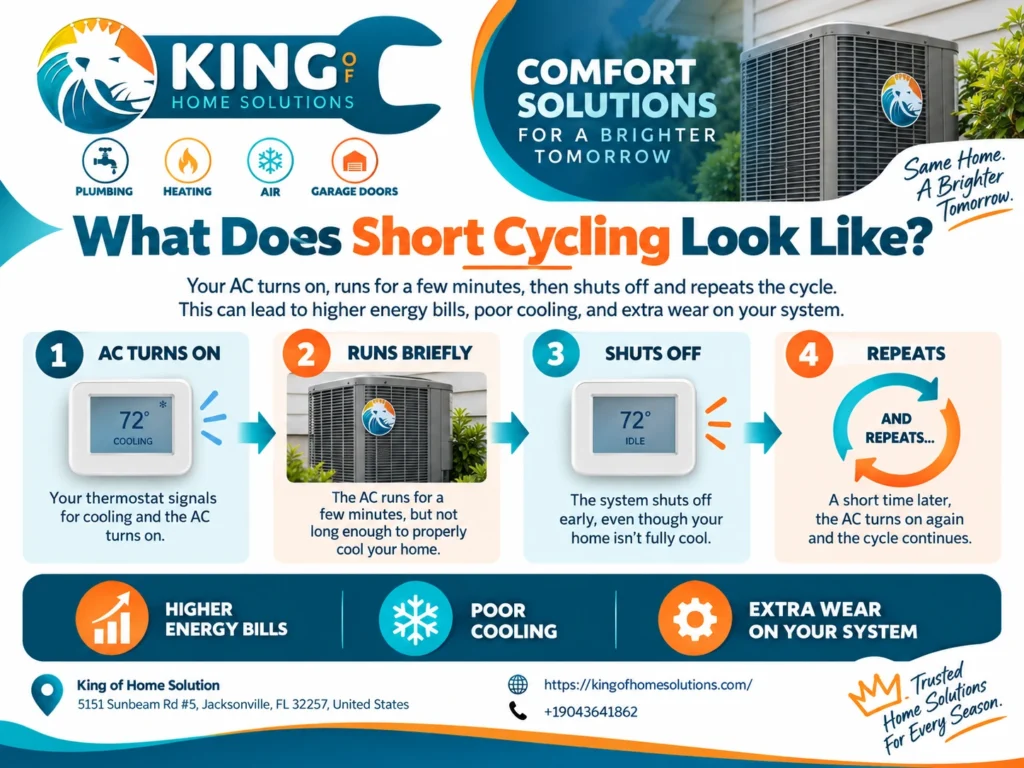
The air outside feels heavy. The humidity is high. Your air conditioner starts, runs for a few minutes, shuts off—and then starts again shortly afterward.
The house may technically reach the thermostat setting, but it still feels sticky.
That behavior is known as short cycling.
And while homeowners often blame extreme summer humidity, there is an important distinction:
High humidity usually does not make a healthy, properly sized AC suddenly short cycle.
In fact, hot and humid weather normally gives an air conditioner more work to do, which often means longer cooling cycles.
What July humidity can do is expose an existing problem.
An oversized AC may cool the air before it has enough time to remove moisture. A clogged condensate drain may trip a safety switch. Restricted airflow can cause the evaporator coil to freeze. Refrigerant or electrical problems may cause the system to shut down prematurely.
The humidity isn’t necessarily the failure.
It can be the condition that reveals it.
What Does “Short Cycling” Actually Mean?
An air conditioner is supposed to run long enough to accomplish two jobs:
Lower the temperature and remove moisture from the air.
Short cycling occurs when the system repeatedly turns on and shuts off before completing a normal cooling cycle.
You may notice:
- The outdoor unit starting and stopping repeatedly
- Cooling cycles lasting only a few minutes
- The thermostat reaching temperature quickly, then calling for cooling again soon afterward
- Indoor temperatures that feel uneven
- A house that feels cool but clammy
- Rising electricity bills
- Frequent clicking from the outdoor equipment
Short cycling is more than irritating.
Frequent starts and stops increase wear on compressors and motors, can increase energy consumption, and interfere with humidity removal. Carrier and Trane both identify poor humidity control and increased equipment wear among the major consequences of repeated short cycling.
Why July Humidity Makes the Problem So Noticeable
Your AC does not simply blow cold air.
As warm, humid indoor air moves across the cold evaporator coil, moisture condenses on the coil.
That water falls into a drain pan and leaves through the condensate drain.
The longer a normal cooling cycle runs, the more opportunity the system has to remove moisture.
This matters enormously during humid summer weather.
If the air conditioner runs for only a few minutes before shutting off, it may lower the temperature without removing enough moisture.
The result is the familiar Florida summer complaint:
“The thermostat says 74, but the house still feels uncomfortable.”
ENERGY STAR notes that oversized equipment may cycle too frequently, creating poorer comfort and humidity control.
So the humidity may not be causing the short cycling.
The short cycling may be preventing your AC from controlling the humidity.
Cause #1: Your Air Conditioner May Be Too Large
This surprises homeowners because bigger AC equipment sounds better.
If three tons of cooling is good, wouldn’t four tons cool the house even better?
It might cool it faster.
And that can be exactly the problem.
An oversized air conditioner can lower the indoor temperature so quickly that the thermostat shuts the system off before the evaporator coil has had enough time to remove significant moisture.
Then the indoor temperature rises again.
The AC restarts.
The cycle repeats.
The house becomes cool but humid, while the equipment keeps starting and stopping.
DOE guidance warns that oversized air-conditioning equipment can lead to excessive on-off cycling and poor humidity removal.
This problem becomes especially obvious in July because the moisture load is high.
If your AC has behaved this way since the day it was installed, improper sizing deserves serious consideration.
A proper HVAC replacement should be based on a load calculation—not simply the home’s square footage or the size of the old equipment. ENERGY STAR recommends sizing equipment according to the actual characteristics of the home.
Cause #2: A Clogged Condensate Drain Can Shut the AC Down
Humidity creates water.
A lot of it.
The U.S. Department of Energy notes that cooling equipment in hot, humid parts of the southeastern United States can generate substantial amounts of condensate.
All of that water has to go somewhere.
Normally, it drains through a PVC condensate line.
But those drain lines can become clogged with:
- Sludge
- Algae
- Mold growth
- Dust
- Dirt
- Debris
Many AC systems have a float or overflow safety switch.
If water begins backing up into the drain pan, the switch shuts the HVAC system down to prevent water from overflowing into the house.
Trane specifically notes that a condensate overflow switch can shut down the compressor, condenser fan, and supply fan when rising water is detected.
That can look like short cycling.
The AC starts.
Condensation accumulates.
The drain cannot keep up.
The safety switch trips.
The system stops.
Later, the water level drops enough for the system to restart.
During extremely humid weather, a marginal drain problem can become much more obvious because the AC is removing far more moisture.
If you notice water around the air handler, a full drain pan, or an AC that repeatedly stops on humid afternoons, the condensate system deserves inspection.
Cause #3: Your Air Filter Is Restricting Airflow
A dirty filter may look harmless.
It isn’t.
Your air conditioner needs a specific amount of airflow across the evaporator coil.
When the filter becomes severely clogged, airflow drops.
That can contribute to coil freezing or other operational problems.
Carrier lists restricted airflow from a dirty filter among common causes associated with short cycling.
July can make this problem appear suddenly because the AC is running much more frequently than it was during spring.
A filter that might have survived another few weeks during mild weather may become a serious restriction when the system is operating for hours every day.
Checking the filter is one of the few easy things a homeowner can safely do before scheduling HVAC service.
If it is visibly packed with dust, replace it with the correct type recommended for your system.
Cause #4: The Evaporator Coil May Be Freezing
An AC coil covered in ice sounds strange during a 90-degree day.
But it happens.
Insufficient airflow or refrigeration problems can allow the evaporator coil to become too cold.
Moisture freezes on the coil.
As ice builds up, airflow becomes even worse.
Eventually the system may stop cooling correctly or shut down.
Trane identifies dirty filters and restricted airflow among conditions that can contribute to frozen evaporator coils.
Signs can include:
- Weak airflow from the vents
- Ice around refrigerant lines
- Water around the air handler after the ice melts
- AC that cools for a while and then stops
- Repeated cycling
Do not repeatedly restart a system that is visibly frozen.
The ice is a symptom.
You still need to determine why it froze.
Cause #5: Low Refrigerant or a Refrigerant Problem
Refrigerant is another common suspect when the system cannot maintain normal operating pressures.
Low refrigerant can interfere with heat transfer and may contribute to short cycling or frozen-coil conditions.
Carrier includes low refrigerant among the common causes of AC short cycling.
But refrigerant is not something homeowners should “top off” themselves.
A properly sealed residential AC system does not consume refrigerant like a car consumes gasoline.
If the system is low, there may be a leak or another technical problem that needs diagnosis.
Repeatedly adding refrigerant without finding the reason it is low does not solve the underlying issue.
Cause #6: The Thermostat May Be Fooling the System
Sometimes the AC is fine.
The thermostat is the problem.
A thermostat installed near:
- A supply vent
- Direct sunlight
- A kitchen
- An exterior door
- Another unusual heat or cooling source
may receive a temperature reading that does not accurately represent the rest of the house.
For example, cold air blowing directly toward the thermostat can cause it to think the entire home has reached the desired temperature.
The AC shuts off.
The surrounding temperature quickly changes.
The thermostat calls for cooling again.
Trane identifies both thermostat malfunctions and poor thermostat placement as potential short-cycling causes.
If the problem began after installing a new thermostat, thermostat settings or installation should be part of the diagnosis.
Cause #7: Electrical Components Can Be Failing
July heat is also hard on outdoor AC equipment.
Capacitors, contactors, wiring, relays, compressors, and control components operate repeatedly under demanding conditions.
A failing electrical component can interrupt operation and make the system appear to short cycle.
These problems are not appropriate DIY repairs.
The outdoor condenser contains high voltage, and capacitors can retain an electrical charge even after power is disconnected.
If the outdoor unit repeatedly clicks, hums, attempts to start, or stops unexpectedly, have an HVAC technician diagnose it.
Is Short Cycling Ever Normal?
Not every short run means the system is broken.
During mild weather, a properly functioning system may occasionally run for relatively short periods.
But repeated rapid cycling during a hot July afternoon deserves attention.
During high outdoor temperatures and humidity, a correctly sized system commonly needs substantial runtime to remove heat and moisture.
If it is turning on and off every few minutes while the house remains uncomfortable, something is probably interfering with normal operation.
What Can You Check Before Calling for Service?
Keep the homeowner inspection simple.
Check:
- Whether the air filter is dirty
- Whether the thermostat settings look correct
- Whether supply and return vents are blocked
- Whether you see water around the air handler
- Whether the outdoor unit is covered with obvious debris
- Whether ice is visible on refrigerant lines
- Whether the system is repeatedly restarting within minutes
Avoid opening electrical panels, handling refrigerant components, bypassing float switches, or attempting to force a frozen system to operate.
Those problems require professional diagnosis.
The Bottom Line
When your AC starts short cycling during July humidity, it is easy to blame the weather.
But humidity usually isn’t the root cause.
Instead, hot and humid conditions may reveal an oversized air conditioner, clogged condensate drain, airflow restriction, frozen coil, refrigerant problem, thermostat issue, or electrical fault.
And short cycling creates a frustrating feedback loop.
The system doesn’t run long enough to remove enough humidity.
The house feels sticky.
You lower the thermostat.
The AC cycles even more.
The equipment experiences additional wear without solving the comfort problem.
So if your air conditioner suddenly begins starting and stopping repeatedly during the most humid part of summer, don’t simply assume:
“It’s working harder because July is brutal.”
A healthy system may work longer in July.
It should not normally work in frantic little bursts.
That difference is your warning that the AC may need attention.