Serving The Jacksonville Area



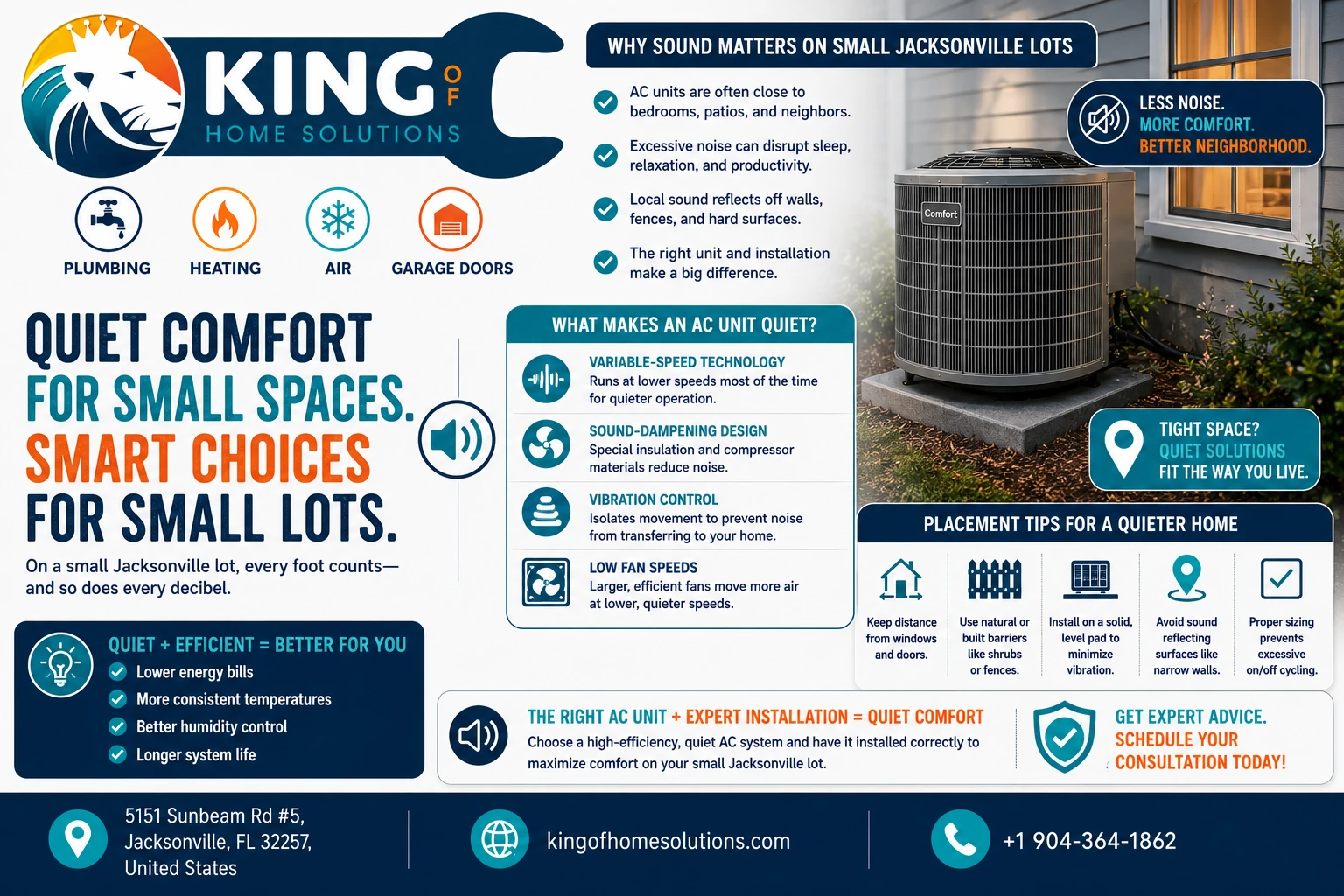
Best “Quiet” AC Units for Small Jacksonville Lots

Best “Quiet” AC Units for Small Jacksonville Lots
On a large suburban property, the sound of an outdoor AC unit may disappear into the background.
On a small Jacksonville lot, it can feel as though the condenser is running inside the neighbor’s bedroom.
The outdoor unit may sit only a few feet from:
- A bedroom window
- A screened porch
- A neighboring patio
- A home office
- A narrow side-yard walkway
- A property line
That makes the sound level more than a comfort feature. It becomes part of choosing the right HVAC system for the property.
For homes with limited outdoor space, the best quiet systems are usually variable-speed or inverter-driven units. Instead of switching abruptly between fully on and fully off, they can operate at reduced capacity for long periods.
That typically means:
- Softer startups
- Lower operating sound
- Fewer disruptive cycles
- More consistent indoor temperatures
- Better humidity control
- Less vibration at the equipment pad
However, the quietest model on paper can still become an irritating installation if it is oversized, placed beside a window, mounted on a vibrating platform, or surrounded by surfaces that reflect sound.
The model matters. The installation matters just as much.
Ready for a Quieter AC System?
Get professional help choosing a quiet, efficient AC unit for your Jacksonville home. Call today.
What Is Considered a Quiet AC Unit?
Outdoor HVAC sound is commonly measured in decibels, written as dB or dBA.
As a general comparison:
- A quiet library may be around 40 dB.
- Normal conversation is commonly around 50 to 60 dB.
- A vacuum cleaner may be around 70 dB.
Because the decibel scale is logarithmic, a difference of several decibels can be more noticeable than the numbers initially suggest. Lennox describes normal conversation as approximately 50 to 60 dB, while Trane compares 70 dB with the sound of a vacuum cleaner.
For a tight residential lot, look for an outdoor unit with a published minimum sound rating in approximately the 45-to-60 dBA range.
That does not mean the equipment will always operate at its minimum rating. Sound can rise when the system is:
- Running near full capacity
- Operating during extreme heat
- Entering a heat-pump defrost cycle
- Installed close to reflective walls
- Working with restricted airflow
- Mechanically worn or poorly maintained
Published sound ratings are useful for comparison, but they are not a guarantee of the exact sound measured at the neighboring property.
Why Variable-Speed Equipment Is Usually Quieter
A conventional single-stage air conditioner has two basic settings:
- Off
- Full capacity
When cooling begins, the compressor and fan start at full output. That can create a noticeable startup sound, followed by a steady mechanical hum.
A variable-speed or inverter-driven unit can adjust its output to match the home’s cooling demand. During mild or moderate conditions, it may operate at a much lower speed.
That reduces noise because:
- The compressor is not always running at maximum output.
- The condenser fan can rotate more slowly.
- Startups are smoother.
- The system cycles off less frequently.
- Vibration is reduced during low-load operation.
This is especially valuable in Jacksonville, where an AC system may run for long periods to control both temperature and humidity.
A properly sized variable-speed unit can provide a quieter background sound instead of repeatedly announcing every cooling cycle.
Best Overall for Tight Side Yards: Daikin FIT
The Daikin FIT is one of the strongest options for small Jacksonville lots because it combines inverter operation with a narrow, side-discharge cabinet.
Traditional condensers are usually square or round and discharge air upward. Side-discharge systems use a slim, rectangular design that can fit more naturally along a side wall.
Daikin states that the FIT can operate in selectable quiet modes as low as approximately 45 dBA. The company also highlights its compact footprint, inverter-driven compressor, low operating sound, and Blue Fin coil coating for corrosion resistance.
Why it works well on a small lot
- Slim side-discharge design
- Very low published quiet-mode rating
- Variable-speed operation
- Reduced startup noise
- Good fit where setback space is limited
- Available as a heat pump for year-round operation
Potential drawbacks
The system uses communicating controls and should be installed by a contractor experienced with Daikin inverter equipment.
Service access must still be maintained. A narrow cabinet does not mean the unit can be pressed tightly against a wall, fence, or hedge.
The installer must follow the manufacturer’s clearance requirements for airflow and maintenance.
Best for
Homeowners whose outdoor unit must sit in a narrow side yard close to a window, patio, or neighboring home.
Quietest Flexible Ducted or Ductless Option: Mitsubishi Electric SUZ
The Mitsubishi Electric SUZ Universal Heat Pump is another strong choice for constrained properties.
Depending on the system configuration, it can be connected to several indoor-unit types, including:
- A conventional-style air handler
- A concealed ducted unit
- A ceiling cassette
- A wall-mounted unit
Mitsubishi lists SUZ systems with sound ratings down to approximately 48 dBA, capacities from 9,000 to 60,000 BTU per hour, and efficiency up to 21.7 SEER2.
Why it works well on a small lot
- Slim outdoor cabinet
- Low published sound level
- Inverter-driven compressor
- Multiple indoor-unit options
- Suitable for additions and whole-home applications
- Can work with ducts or without traditional ductwork
Potential drawbacks
The correct equipment combination is essential. A contractor must verify that the selected outdoor unit, indoor unit, controls, and duct arrangement form an approved match.
Some Jacksonville homes also need duct modifications before a compact inverter system can deliver its expected airflow and humidity performance.
Best for
Homeowners who want a quiet side-discharge system and need flexibility in how conditioned air is delivered inside the home.
Best Traditional Central-Air Premium Option: Trane XV20i
For homeowners who prefer a more traditional top-discharge central AC unit, the Trane XV20i remains a strong low-noise choice.
Trane publishes overall sound levels for its premium variable-speed air conditioners in approximately the 57-to-75 dBA range, depending on model, capacity, and operating conditions. Trane literature also identifies 55 dB as a low-speed sound level for certain TruComfort air-conditioning systems.
The system uses variable-speed compressor technology and sound-insulating components to reduce operating noise.
Why it works well
- Variable-speed cooling
- Soft, gradual operation
- Compressor sound insulation
- Strong humidity-control potential
- Traditional central-system configuration
- Widely recognized dealer network
Potential drawbacks
The cabinet is larger than many side-discharge systems.
On a very narrow lot, the footprint and required service clearances may make placement difficult. The system also requires compatible communicating controls and matched indoor equipment.
Best for
Homeowners with enough outdoor clearance for a traditional condenser who want premium comfort, low-speed operation, and reduced sound.
Best Premium Straight-Cool Option: Lennox SL28XCV
The Lennox SL28XCV is a variable-capacity central air conditioner with a published sound rating as low as approximately 59 dB.
Lennox attributes its quieter operation to the variable-capacity compressor and a sound-dampening system that allows the equipment to spend much of its operating time at reduced speed.
Why it works well
- Variable-capacity operation
- Published rating as low as 59 dB
- Sound-dampening compressor treatment
- High cooling efficiency
- Gradual temperature and humidity control
Potential drawbacks
This is a premium system, and the complete installation may require Lennox communicating controls and matched indoor components.
Its traditional outdoor cabinet may also require more side-yard space than a compact side-discharge unit.
Best for
Homeowners who want a premium, high-efficiency straight-cool system and have adequate room for a conventional outdoor cabinet.
Best Value-Oriented Inverter Option: Bosch IDS Plus
The Bosch IDS Plus is worth considering when a homeowner wants inverter operation without automatically choosing the highest-priced flagship system.
Bosch currently lists its IDS Plus heat-pump systems with fully modulating inverter operation and sound levels as low as approximately 56 dBA, depending on the model and equipment match.
The outdoor unit adjusts compressor operation according to system pressure and demand, allowing it to run more quietly during lower-load conditions.
Why it works well
- Inverter-driven compressor
- Published sound rating as low as 56 dBA
- Compatible with ducted central systems
- Reduced cycling compared with basic single-stage equipment
- Available in several efficiency levels
Potential drawbacks
Some Bosch outdoor units use a more traditional cabinet rather than the narrowest side-discharge format.
The installer must confirm the sound rating and dimensions for the exact model being proposed. Do not assume every product in the IDS family has the same acoustic performance.
Best for
Homeowners who want quieter inverter technology in a conventional ducted system without necessarily buying the most expensive premium model.
What About Carrier?
Carrier’s current premium Infinity systems use variable-speed operation and are designed for quieter, more gradual performance.
The current Infinity 21 Air Conditioner and Infinity 23 Heat Pump are marketed with variable-speed operation, high efficiency, humidity control, and reduced operating sound.
Carrier can be a strong choice when:
- A trusted local dealer supports the equipment.
- The full Infinity communicating system is being installed.
- Humidity control is a priority.
- The contractor provides exact model-specific sound data.
Because model lines and equipment platforms are changing, ask for the sound rating of the precise outdoor-unit model and capacity not simply a general claim that the Infinity line is quiet.
Why Side-Discharge Units Work Well on Small Lots
A side-discharge condenser resembles a large suitcase or narrow rectangular cabinet.
This design can be useful when a property has:
- A narrow side yard
- A small equipment pad
- Limited clearance between houses
- A fence close to the equipment area
- Multiple outdoor units
- A patio or walkway near the condenser
Potential benefits include:
- Smaller footprint
- Lower cabinet height in some cases
- Inverter operation
- Reduced low-speed sound
- More flexible placement
- Less visually dominant equipment
However, discharge direction matters.
A side-discharge fan should not blow directly toward:
- A neighboring patio
- An open window
- A solid fence at close range
- Another condenser
- A narrow dead-end space
- A wall that causes hot air to recirculate
A compact unit still needs a properly planned location.
Jacksonville Noise Rules Still Matter
Jacksonville regulates noise under Chapter 368 and the Environmental Protection Board’s noise-control rules.
The city’s current rule establishes noise measurements at the complainant’s property line, public right-of-way, or public land, with the measurement point generally no closer than 10 feet from the source.
A code-compliant installation involves more than selecting a unit with a low brochure number.
Sound reaching the property line can be affected by:
- Equipment placement
- Distance from the neighbor
- Walls and fences
- Installation height
- Mechanical vibration
- Compressor speed
- Multiple units operating together
- The time of day
- Background sound levels
The contractor should consider the property layout before placing the new condenser in the same location simply because electrical and refrigerant lines are already there.
The Quietest Unit Can Still Sound Loud in the Wrong Location
Sound reflects from hard surfaces.
A condenser installed between two parallel walls may sound louder than the same unit installed in an open area. The walls can create a channel that directs sound toward a window or neighboring property.
Problem locations include:
- Between two houses
- Inside a narrow fenced enclosure
- Under a bedroom window
- In a masonry corner
- Beside a screened porch
- Near a metal fence
- On a roof or platform that transmits vibration
Moving the unit a few feet or rotating a side-discharge cabinet may produce a bigger improvement than choosing a model that is only one or two decibels quieter.
Ask for Sound Data at Full Speed
“As low as 45 dB” does not mean the system is always 45 dB.
The minimum figure usually describes favorable low-speed operation under defined test conditions.
On a 95-degree Jacksonville afternoon, the system may operate at a higher capacity and produce more sound.
Ask the contractor for:
- Minimum sound rating
- Maximum or rated sound level
- Sound-power data for the exact capacity
- Quiet-mode limitations
- Whether quiet mode reduces output
- Heating and defrost sound levels for a heat pump
The model number and tonnage matter. A 2-ton unit and a 5-ton unit within the same product family may not have identical sound ratings.

Why JAX Beach Homes Need HVAC Maintenance Twice a Year (The Salt Factor)
Most HVAC manufacturers recommend annual maintenance. For homeowners in Jacksonville Beach, Neptune Beach, Atlantic Beach, and Ponte Vedra? Once a…
Read The BlogDo Not Oversize the System to Make It “Work Less”
Some homeowners assume a larger AC will run less and therefore be quieter.
That approach often backfires.
An oversized unit may:
- Start and stop more frequently
- Produce more noticeable startup sound
- Run at higher airflow
- Remove less indoor humidity
- Create uneven temperatures
- Increase duct noise
- Wear components more quickly
A correctly sized variable-speed unit is usually quieter because it can run steadily at reduced output.
The contractor should perform a residential load calculation rather than selecting equipment only from the size of the old unit.
Indoor Noise Matters Too
A quiet outdoor condenser does not guarantee a quiet home.
Indoor sound may come from:
- An oversized air handler
- High blower speed
- Undersized return ducts
- Restrictive filters
- Small supply registers
- Poorly designed transitions
- Flexible ducts that are crushed or kinked
- Air-handler vibration
- Refrigerant-line resonance
Homeowners often blame the outdoor unit when the most disruptive sound is actually air rushing through the return grille.
Ask the contractor to measure or evaluate:
- Total external static pressure
- Return-air capacity
- Supply-air velocity
- Register sizing
- Blower settings
- Air-handler mounting
- Duct leakage
A quieter HVAC system requires both the refrigeration equipment and the air-delivery system to be designed correctly.
Ways to Make Any AC Installation Quieter
Use a stable equipment base
The condenser should sit level on a stable pad or approved mounting system.
A cracked, uneven, or poorly supported pad can increase vibration.
Add appropriate vibration isolation
Approved isolation pads or mounts may reduce vibration transfer.
They should be selected for the equipment rather than improvised from household rubber or foam.
Keep the refrigerant lines secure
Poorly supported copper lines can vibrate against framing, siding, or conduit.
The technician should secure and isolate the lines without damaging them.
Maintain proper clearances
Do not build a tight box around the unit.
Restricting airflow can increase compressor workload, raise sound, reduce efficiency, and shorten equipment life.
Avoid solid sound barriers too close to the condenser
A properly designed acoustic barrier may help in some situations. A random fence panel placed beside the fan can reflect sound or restrict discharge air.
Any barrier should preserve manufacturer-required clearances and allow hot air to escape.
Maintain the equipment
A previously quiet system may become loud because of:
- Loose panels
- Debris in the fan
- Worn bearings
- Compressor problems
- Refrigerant issues
- Bent fan blades
- Contactor chatter
- Unbalanced equipment
- Restricted coils
A new or worsening sound should be inspected rather than hidden with a barrier.
Heat Pump or Straight Cool?
For most all-electric Jacksonville homes, a heat pump is usually the more practical year-round choice.
A heat pump provides both cooling and efficient heating. A straight-cool condenser provides cooling only and must be paired with another heat source.
When comparing noise, remember that a heat pump also operates outdoors during winter. It may produce additional sounds during:
- Heating operation
- Reversing-valve changes
- Defrost cycles
- Outdoor-fan speed changes
Ask to compare both cooling-mode and heating-mode sound performance.
A quiet summer rating does not tell the entire story for a heat pump.
Questions to Ask Before Buying
Before approving a proposal, ask:
- What is the exact outdoor-unit model number?
- What is its minimum published sound rating?
- What is its rated or maximum sound level?
- Is the compressor single-stage, two-stage, or variable-speed?
- Is the cabinet top-discharge or side-discharge?
- How much service and airflow clearance is required?
- Where will the discharge air go?
- How close is the unit to the property line?
- Is it near a bedroom or neighboring patio?
- Was a load calculation performed?
- Will the existing ductwork support the required airflow?
- What controls are required?
- Is quiet mode included and properly configured?
- Will the installer use vibration isolation?
- Does the exact equipment match have an AHRI certificate?
Do not accept a proposal that lists only the brand and tonnage.
Two units carrying the same brand name can have very different sound levels.
The Best Choice for Most Small Jacksonville Lots
For the tightest side yards, the strongest options are typically:
- Daikin FIT for a compact cabinet and very low quiet-mode sound
- Mitsubishi Electric SUZ for flexible ducted or ductless configurations
- Bosch IDS Plus for inverter operation in a more conventional central system
- Trane XV20i for premium variable-speed comfort where a traditional cabinet fits
- Lennox SL28XCV for a premium quiet straight-cool application
- Carrier Infinity variable-speed systems when supported by a strong local communicating-system installer
There is no universal winner.
The quietest choice depends on:
- Available side-yard width
- Required system capacity
- Heat-pump or straight-cool configuration
- Neighboring windows and patios
- Duct condition
- Installation quality
- Service support
- Budget
The Bottom Line
For a small Jacksonville lot, choose an AC or heat pump with a variable-speed inverter compressor and a published low-speed rating near or below 60 dBA.
When space is especially tight, a slim side-discharge system such as the Daikin FIT or Mitsubishi Electric SUZ may offer the best combination of low sound and placement flexibility.
But do not buy based on the decibel number alone.
A quiet system can become noisy when it is:
- Oversized
- Installed beside a bedroom
- Surrounded by reflective walls
- Mounted on an unstable pad
- Starved for airflow
- Connected to noisy ductwork
The best result comes from combining quiet equipment with thoughtful placement, correct sizing, stable mounting, proper clearances, and a contractor who understands how sound travels across a small residential property.
On a tight Jacksonville lot, the right AC should cool the house not remind the entire block that it is running.
Enjoy Cooler Comfort Without the Noise
Upgrade to a quiet AC system built for small Jacksonville lots. Call now to explore your best options.