Serving The Jacksonville Area



Manual vs. Automatic Garage Hurricane Braces: Which Is Better?
Manual vs. Automatic Garage Hurricane Braces: Which Is Better?
The hurricane watch goes up.
You bring in the patio furniture, charge the flashlights, check the generator and then remember the garage door.
Some homeowners have another storm-prep job waiting for them:
Installing the garage door hurricane braces.
Depending on the system, that might mean carrying heavy steel posts out of storage, positioning them behind the garage door, securing them to floor and header anchors, and double-checking every connection before the wind arrives.
Other garage doors require virtually no additional storm preparation because their wind reinforcement is permanently built into the door.
That creates an obvious question for Florida homeowners:
Are manual hurricane braces worth the hassle, or should you invest in a permanently reinforced or “automatic” garage door system?
Both approaches can provide meaningful wind resistance when they are properly engineered and installed.
The bigger difference is convenience, cost, maintenance, and whether the homeowner must remember to activate the protection before every storm.
First: What Is a Manual Garage Hurricane Brace?
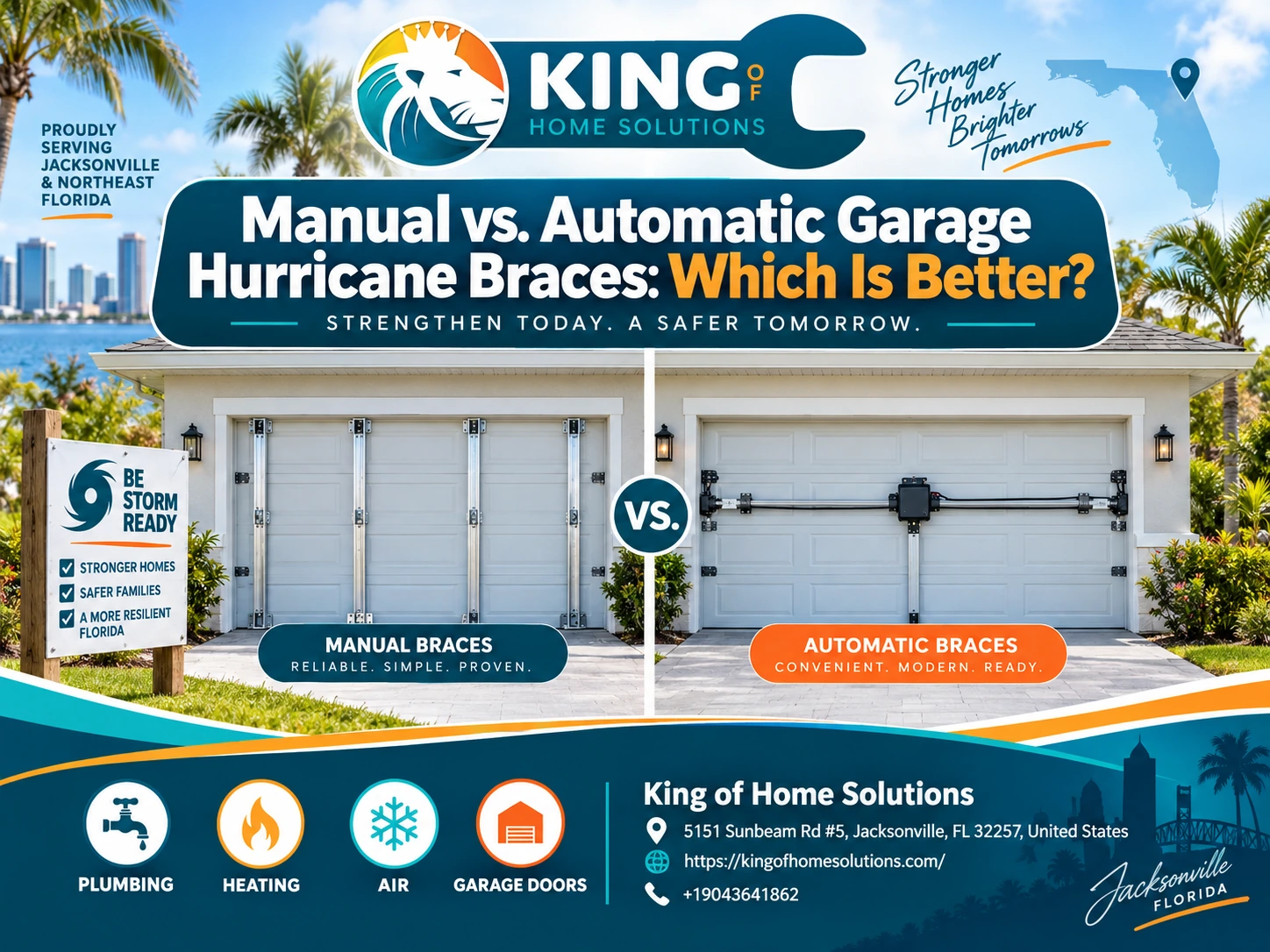
A manual hurricane-bracing system usually uses removable vertical posts or similar reinforcing components installed behind the garage door before severe weather.
The posts typically connect between structural attachment points near the garage floor and header.
Their purpose is to help prevent a large garage door from bending excessively under wind pressure.
A wide garage door is particularly vulnerable because it presents a large surface to the wind.
Manual braces add support across that opening.
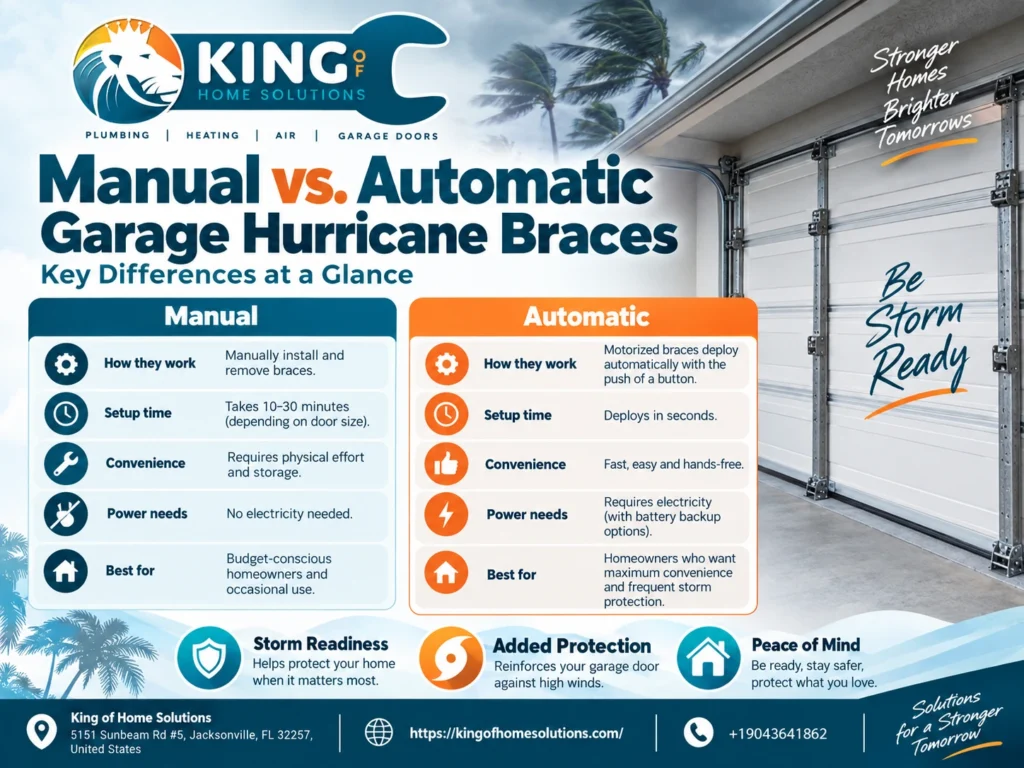
When the storm passes, the homeowner removes the braces so the garage door can operate normally.
Depending on the system, the braces may then be stored against a garage wall or elsewhere until the next storm.
The biggest advantage is simple:
You may be able to strengthen an existing garage door without replacing the entire door.
What Is an “Automatic” Hurricane Brace?
This term can be confusing.
In residential garage-door conversations, “automatic hurricane bracing” often does not mean a brace detects a hurricane and deploys electronically.
It usually refers to a door whose wind-load reinforcement is permanently incorporated into the assembly.
That may include:
- Permanent horizontal steel reinforcement
- Heavier tracks
- Upgraded hinges
- Reinforced jamb attachments
- Stronger brackets and fasteners
- Wind-rated rollers and hardware
- Additional structural reinforcement within the door
For example, current Florida product-approval documentation for some wind-rated garage doors specifies horizontal steel U-bar reinforcement, with the number and gauge of braces varying according to the required wind-load resistance and door height.
Because the reinforcement remains on the door, there is no separate storm-deployment process.
Close the garage door normally, and the engineered reinforcement is already there.
For homeowners who travel frequently or simply do not want another hurricane-preparation task that convenience can be a major advantage.
Manual Braces: The Biggest Advantage Is Cost
If your existing garage door is structurally sound but lacks enough wind reinforcement, a retrofit bracing system may cost considerably less than installing an entirely new wind-rated door.
That makes manual bracing particularly attractive when:
- The existing door is relatively new
- The panels are in good condition
- The tracks and framing are sound
- You don’t want to replace the entire door
- Storm preparation is manageable for your household
Instead of discarding a functional garage door, you are adding support where it is needed.
But the savings come with a responsibility.
Someone has to install the braces before the storm.
And that requirement is more important than it sounds.
The Biggest Weakness of Manual Bracing: Human Behavior
Imagine a hurricane is approaching Jacksonville.
You have shutters to install.
Fuel to buy.
Outdoor furniture to move.
Medications to pick up.
Children or pets to prepare.
Possibly an evacuation plan to make.
Now add several steel garage braces to the list.
The best manual reinforcement system in the world cannot protect the garage if the braces are still hanging on the wall when the strongest winds arrive.
That is the fundamental disadvantage.
Protection depends on someone:
- Being home.
- Remembering the braces.
- Knowing how to install them.
- Installing every component correctly.
- Doing it early enough to avoid dangerous storm conditions.
For a healthy homeowner who plans carefully, that may be completely reasonable.
For an elderly homeowner, rental property, vacation home, or household that travels frequently, it may be a serious limitation.
Permanently Reinforced Doors Win on Convenience
A properly installed wind-rated garage door with permanent reinforcement removes much of that preparation.
There are no posts to carry.
No braces to find.
No floor connections to install at the last minute.
The structural components remain part of the door.
That is particularly valuable when a storm intensifies unexpectedly.
Florida’s garage-door requirements treat the door as a complete engineered assembly rather than simply a panel. Current requirements involve the door’s design pressure, tracks, reinforcement, fasteners, jamb attachments, and other specified components.
That leads to an important point:
Permanent reinforcement only provides its rated performance when the complete system is installed according to its approved design.
Adding a random piece of steel to the back of a garage door does not automatically make it hurricane-rated.
Manual Braces Can Interfere With Garage Access
There is another practical issue homeowners sometimes overlook.
Once manual vertical braces are installed, the garage door may no longer be usable normally.
That means you need to think carefully about when you install them.
Install too early and you may trap a vehicle inside.
Or you may need to remove and reinstall the braces because you forgot something.
Wait too long and you could find yourself working in deteriorating weather.
A permanently reinforced wind-rated door avoids that tradeoff.
You can typically continue normal operation until the point when storm conditions dictate that the door remain closed.
For households using the garage as the main entrance to the home, that difference can matter.
Which System Takes Up More Garage Space?
Manual braces require storage.
Usually not enormous amounts of it but they have to go somewhere.
Long steel posts leaning in the corner of a crowded garage can become:
- Difficult to find
- Buried behind storage
- Damaged
- Missing hardware
- Accidentally discarded during a move
The mounting hardware also needs to remain usable.
If floor anchors fill with dirt, concrete coating, or debris, installing the braces during an emergency may become frustrating.
Permanent reinforcement eliminates most of those storage concerns because the structural components remain attached to the garage door.
The tradeoff is that permanent struts add weight.
That can affect the spring system and must be accounted for as part of the door’s engineering.
Don’t Add Heavy Braces Without Checking the Springs
Garage door springs are designed to counterbalance the weight of the door.
If permanent reinforcement adds significant weight, the spring system must be matched appropriately.
Otherwise, the door may become difficult to lift and the opener may have to work harder.
That can contribute to:
- Premature opener wear
- Poor door balance
- Noisy operation
- Increased stress on hardware
This is why hurricane reinforcement should be treated as a complete garage-door system, not a DIY metalworking project.
The door, springs, tracks, reinforcement, rollers, anchors, and opener all have to work together.
Which Is Stronger?
This is where homeowners should avoid a misleading comparison.
You cannot automatically say:
“Permanent braces are stronger.”
Or:
“Manual posts are stronger.”
Strength depends on the specific tested or engineered system and its design-pressure rating.
A properly engineered manual-brace retrofit could outperform a poorly selected permanent system.
Likewise, a modern wind-rated door designed for your home’s required pressures could provide substantially more protection than an improvised retrofit.
Florida garage doors are evaluated for positive and negative wind pressures, and current labeling requirements identify items such as manufacturer, model, design-pressure ratings, applicable approval numbers, and whether the door is impact-rated when applicable.
Compare those ratings not the number of visible metal braces.
Wind-Rated Does Not Always Mean Impact-Rated
Another mistake is assuming hurricane bracing protects against everything a hurricane can throw at the garage.
Wind pressure and debris impact are different performance issues.
A garage door may be reinforced to resist pressure without necessarily having an impact rating for windborne debris.
Some products address both.
Others do not.
If impact protection is required for your property, verify that the specific door or protection system satisfies that requirement.
Don’t rely only on marketing terms such as:
“hurricane door,” “storm ready,” or “hurricane proof.”
Look for the actual approved performance documentation.
Manual Bracing May Be Best When…
Manual hurricane braces can make sense when:
- Your existing garage door is still in good condition
- A compatible engineered retrofit is available
- You want to minimize upfront cost
- Someone will reliably install the system before storms
- Storage space is not a problem
- You don’t mind losing normal garage operation once braces are deployed
For the right homeowner, the extra preparation may be a perfectly acceptable tradeoff for lower cost.
Permanent Reinforcement May Be Best When…
A permanently reinforced wind-rated door may make more sense when:
- Your existing garage door is already old
- You are replacing the door anyway
- You don’t want storm-specific installation work
- The property is frequently vacant
- Physical installation of manual braces would be difficult
- You want the protection integrated into everyday operation
- You prefer fewer removable components to store and maintain
You generally pay more upfront because you’re buying an engineered door assembly rather than a retrofit accessory.
What you’re purchasing, however, is not simply more steel.
You’re buying convenience and fewer opportunities for storm-preparation mistakes.
The Bottom Line
Manual and permanently integrated hurricane reinforcement can both be effective.
Manual braces usually win when the goal is to strengthen a suitable existing garage door without paying for complete replacement.
Permanent reinforcement wins when convenience and readiness matter most.
The key question is not simply:
“Which brace is stronger?”
Ask:
“Which approved system provides the wind resistance my house requires and will it actually be ready when the storm arrives?”
If you’re comfortable installing manual braces before every hurricane, a retrofit may provide excellent value.
If you don’t want your garage door’s storm protection to depend on whether someone remembered to retrieve four steel posts from behind the Christmas decorations, permanent reinforcement may be worth paying more for.
Because during hurricane preparation, the best protective equipment is not merely the equipment you own.
It’s the equipment that is correctly installed and ready before the wind starts.