Serving The Jacksonville Area


Top 5 HVAC “Scams” Jacksonville Homeowners Should Watch For
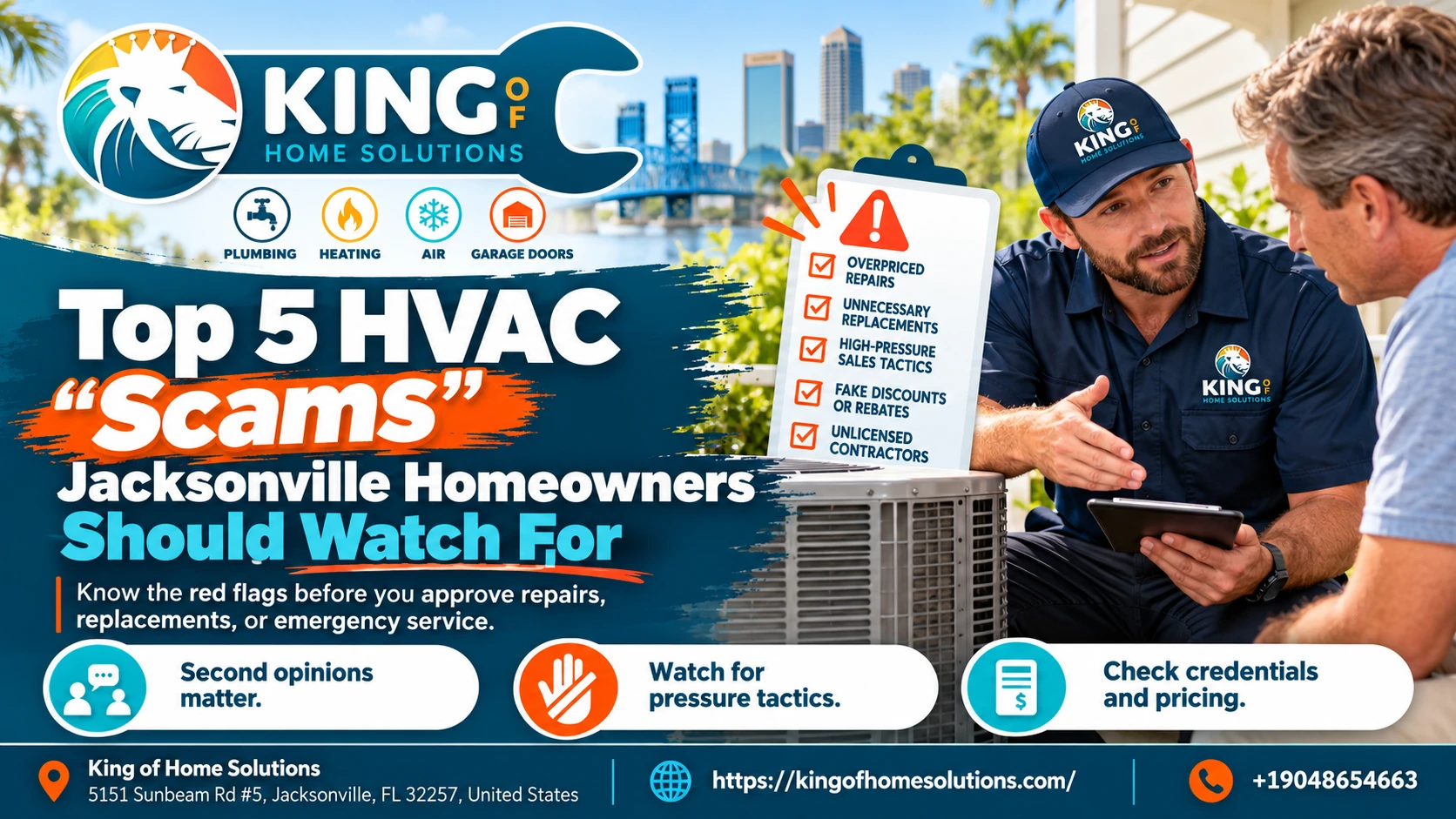
Top 5 HVAC “Scams” Jacksonville Homeowners Should Watch For
Your air conditioner stops cooling on a 94-degree Jacksonville afternoon.
The house is getting hotter by the minute. The humidity is climbing. Your family is uncomfortable.
Then the technician gives you the news:
“You need a whole new system. We can install it today, but you have to decide now.”
Maybe they’re right.
But when you’re standing inside a hot Florida house in July, you’re also in one of the worst possible positions to make a several-thousand-dollar decision under pressure.
Jacksonville homeowners depend heavily on their air conditioners for much of the year, and most HVAC companies are legitimate businesses trying to solve real problems. Unfortunately, urgency also creates opportunities for aggressive sales tactics, unnecessary upgrades, and in some cases actual fraud.
Here are five HVAC red flags Jacksonville homeowners should recognize before signing a contract.
Red Flag #1: “Your Entire AC Is Dead Replace It Today”
A failed air conditioner does not automatically mean a failed air-conditioning system.
Sometimes an AC that appears completely dead has a much smaller problem.
The issue could involve a capacitor, contactor, clogged condensate drain, thermostat, electrical connection, fan motor, or another repairable component.
Other times, replacement genuinely is the best financial decision particularly when an older system has a failed compressor, leaking coil, repeated breakdowns, or poor efficiency.
The red flag is not being offered replacement.
It is being offered only replacement without a clear diagnosis.
Be cautious when a technician cannot explain what failed, what measurements were taken, what repairing the problem would cost, and why repair is not recommended.
If a system replacement will cost thousands of dollars and the situation is not immediately dangerous, a second opinion can be money well spent.
The Federal Trade Commission recommends getting multiple written estimates for major home-improvement projects and asking questions when estimates differ substantially.
Pressure phrases such as “this price disappears when I leave” should make you slow down rather than speed up.
A legitimate replacement recommendation should still make sense tomorrow morning.
Red Flag #2: The Never-Ending “Freon Top-Off”
Your AC is not supposed to need a little refrigerant every summer.
This is one of the most important HVAC facts homeowners can know.
Residential air conditioners operate with refrigerants inside a closed system. Refrigerant circulates through the equipment; it is not consumed like gasoline.
If the system repeatedly becomes low, there is usually a leak somewhere.
Carrier’s current homeowner guidance states that refrigerant does not get “used up”; low refrigerant indicates a leak that requires diagnosis and repair.
That means you should be cautious if the proposed long-term maintenance plan sounds like:
“We’ll just add another couple pounds every summer.”
Adding refrigerant may temporarily restore cooling, and there can be circumstances where a homeowner knowingly chooses a temporary recharge on an older system.
But it doesn’t fix the leak.
Ask where the refrigerant is escaping.
Ask whether leak detection was performed.
Ask how much refrigerant is being added.
Ask whether repairing the leak makes financial sense compared with continuing to recharge an aging system.
Otherwise, you may find yourself repeatedly paying to replace refrigerant that keeps escaping from the same unresolved problem.
Red Flag #3: “You Have Toxic Mold Everywhere—Buy This Duct Cleaning Today”
Jacksonville’s humidity makes mold a believable and frightening sales pitch.
A technician opens a vent, points to a dark substance, and announces:
“Your whole duct system is contaminated.”
Then comes a large quote for duct cleaning, sanitizing chemicals, fogging, UV lights, purification equipment, or complete duct replacement.
Real HVAC mold problems absolutely exist.
Moisture problems around air handlers, drain pans, insulation, and ductwork should not be ignored.
But a photograph of dust or discoloration is not automatically proof that your entire duct system needs an expensive treatment.
EPA guidance specifically recommends asking a service provider to show you the alleged mold contamination. EPA also notes that substances resembling mold may require expert identification to confirm what they actually are.
More importantly, EPA does not recommend routine air-duct cleaning simply because ducts contain some normal household dust. Research has not demonstrated that ordinary duct cleaning prevents health problems, and EPA specifically warns consumers about providers making broad health claims.
If there really is mold, ask the question the sales pitch sometimes skips:
Where is the moisture coming from?
Cleaning mold without fixing the condensate leak, humidity problem, wet insulation, duct leakage, or other source of moisture can allow the problem to return.
Solve the cause not just the frightening photograph.
Red Flag #4: The $79 Tune-Up That Somehow Finds $2,500 of “Emergency” Repairs
Discount maintenance offers aren’t inherently suspicious.
Many reputable HVAC companies use tune-ups as an affordable way to meet new customers.
The warning sign appears when every inexpensive tune-up seems to become an emergency sales appointment.
Suddenly you’re told the capacitor is “almost dead.”
The blower motor is “about to go.”
The compressor is “running dangerously.”
The contactor is “burned.”
And the system supposedly needs thousands of dollars in repairs immediately even though it was cooling normally when the technician arrived.
Any of those components can legitimately fail.
The question is whether the diagnosis can be demonstrated.
For example, electrical components can often be evaluated with actual measurements. Refrigeration performance can be assessed with operating data. Temperature differences, static pressure, amp draw, capacitor readings, refrigerant conditions, and other measurements can help support a diagnosis.
You don’t need to become an HVAC technician.
Just ask:
“Can you show me the reading and explain what the manufacturer’s acceptable range is?”
A good technician should be comfortable explaining the problem in plain language.
Photos can also help when the issue involves corrosion, burned wiring, biological growth, damaged insulation, or another visible condition.
Be especially cautious when several expensive repairs are recommended but the explanation never gets more specific than:
“Trust me, this system is about to die.”
An inspection should produce information—not just anxiety.
Red Flag #5: The Unlicensed “AC Guy” With a Cash Price You Can’t Refuse
This is one of the easiest risks for Jacksonville homeowners to check before work starts.
Florida regulates air-conditioning contracting, and the state’s Department of Business and Professional Regulation provides an online license-verification system where homeowners can search contractors by name, license number, location, or license type.
Florida DBPR identifies several warning signs associated with unlicensed contracting, including unusually low bids, demands for large upfront cash payments, lack of a written contract, refusal to obtain required permits, and asking homeowners to pull permits themselves.
Jacksonville has documented consequences of unlicensed contracting as well. DBPR’s consumer records include a Jacksonville homeowner who hired an unlicensed contractor for fire-damage repairs that included air conditioning work; the homeowner reported shoddy work and missing permits.
Permitting matters, too.
The City of Jacksonville specifically lists replacement of air-conditioning units among work requiring a permit. Jacksonville also requires contractors registering to pull permits to provide their Florida construction license and proof of workers’ compensation coverage or exemption.
If someone says:
“We can save you money if we skip the permit,”
that is not a clever discount strategy.
That is a reason to investigate further.
The Jacksonville “Emergency” Advantage
HVAC sales pressure works especially well in Northeast Florida because homeowners genuinely need cooling.
When the heat index is brutal and the house feels like a sauna, waiting for another estimate sounds unbearable.
Dishonest operators understand that.
So do aggressive salespeople.
The best protection is having a plan before the AC fails.
Know the approximate age of your equipment.
Keep maintenance records.
Know what refrigerant the system uses.
Know whether major components are still under warranty.
Have the contact information for an HVAC company you trust before July arrives.
And if you’re facing a replacement costing thousands of dollars, remember that urgency does not eliminate your right to understand exactly what you’re buying.
The Questions That Can Save You Thousands
Before approving a major HVAC repair or replacement, get clear answers to these questions:
- What exactly failed, and can you show me?
- What does repairing it cost compared with replacing the system?
- What measurements support the diagnosis?
- Is any part still under manufacturer warranty?
- What is your Florida contractor license number, and will the required Jacksonville permit be pulled?
If those questions produce irritation instead of answers, that tells you something.
The Bottom Line
Most Jacksonville HVAC technicians are not trying to scam homeowners.
Expensive repairs are sometimes legitimate.
Compressors really fail.
Coils really leak.
Duct systems really develop problems.
And sometimes replacing an old AC truly is smarter than repairing it again.
What homeowners need to watch for is pressure without evidence.
“You need a new system” should come with a diagnosis.
“You’re low on refrigerant” should lead to a discussion about why.
“You have mold” should come with evidence and a plan to correct the moisture source.
“This part is failing” should be supported by measurements whenever possible.
And “we don’t need a permit” should send up an immediate red flag.
Jacksonville summers already put enough pressure on homeowners.
Your HVAC contractor shouldn’t add another kind.
When the AC stops working, don’t make your decision based entirely on how hot the house feels at that moment.
Make it based on evidence, licensing, documentation, and a diagnosis you actually understand.