Serving The Jacksonville Area


Smart Thermostats: Nest vs. Ecobee for Florida Humidity Control
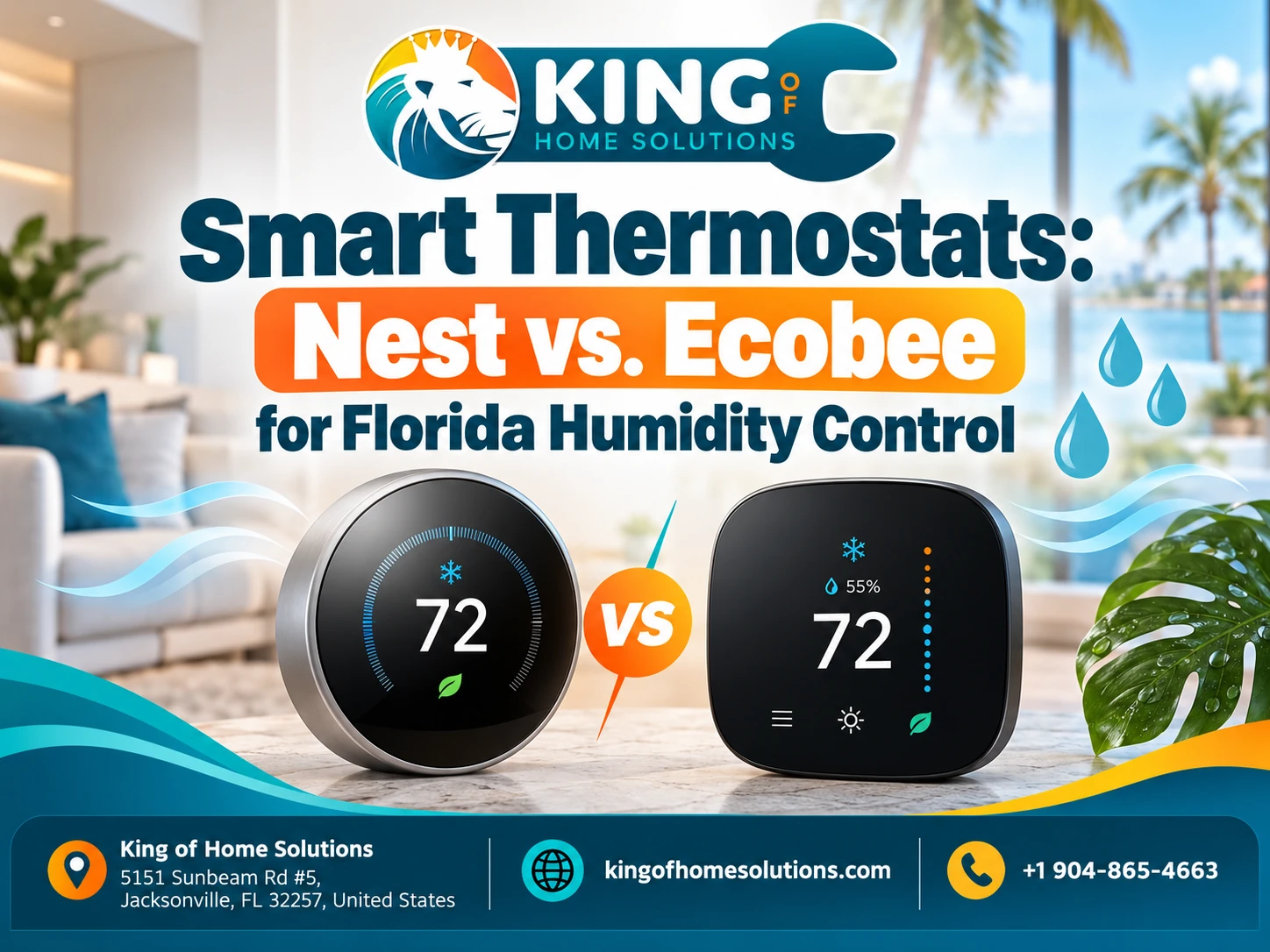
Smart Thermostats: Nest vs. Ecobee for Florida Humidity Control
Your thermostat says 74°F.
But the house still feels sticky.
The sheets feel damp. The tile feels cool but clammy. You find yourself lowering the thermostat another degree not because the house is hot, but because it doesn’t feel comfortable.
That is a very Florida problem.
In a hot, humid climate, controlling temperature is only half of what your air-conditioning system needs to accomplish. It also has to remove moisture.
That makes the Nest vs. ecobee thermostat decision a little different for Florida homeowners than it is for someone living in a dry climate.
Both thermostats can monitor humidity.
Both can use your air conditioner to help remove excess moisture.
Both can work with certain whole-home dehumidification equipment.
But if humidity control is your highest priority, ecobee currently has a slight advantage in HVAC configuration flexibility, while Google’s latest Nest Learning Thermostat has become much more competitive.
The real winner, however, depends on the AC system behind the thermostat.
Why Humidity Matters So Much in Florida
An air conditioner does two jobs simultaneously.
It removes heat from the house.
And as warm indoor air passes over the cold evaporator coil, moisture condenses on that coil and drains away.
That moisture removal is what makes 75°F feel comfortable instead of swampy.
EPA recommends keeping indoor relative humidity below 60%, with approximately 30% to 50% considered ideal when practical. Excess moisture can encourage mold growth and other indoor-air-quality problems.
Florida presents an additional challenge because outdoor air carries so much moisture for much of the year.
University of Florida guidance notes that oversized air-conditioning systems can cool a house too quickly to remove enough humidity, leaving homeowners with the classic “cool but clammy” feeling.
A smart thermostat can help manage that problem.
But it cannot completely correct badly sized HVAC equipment.
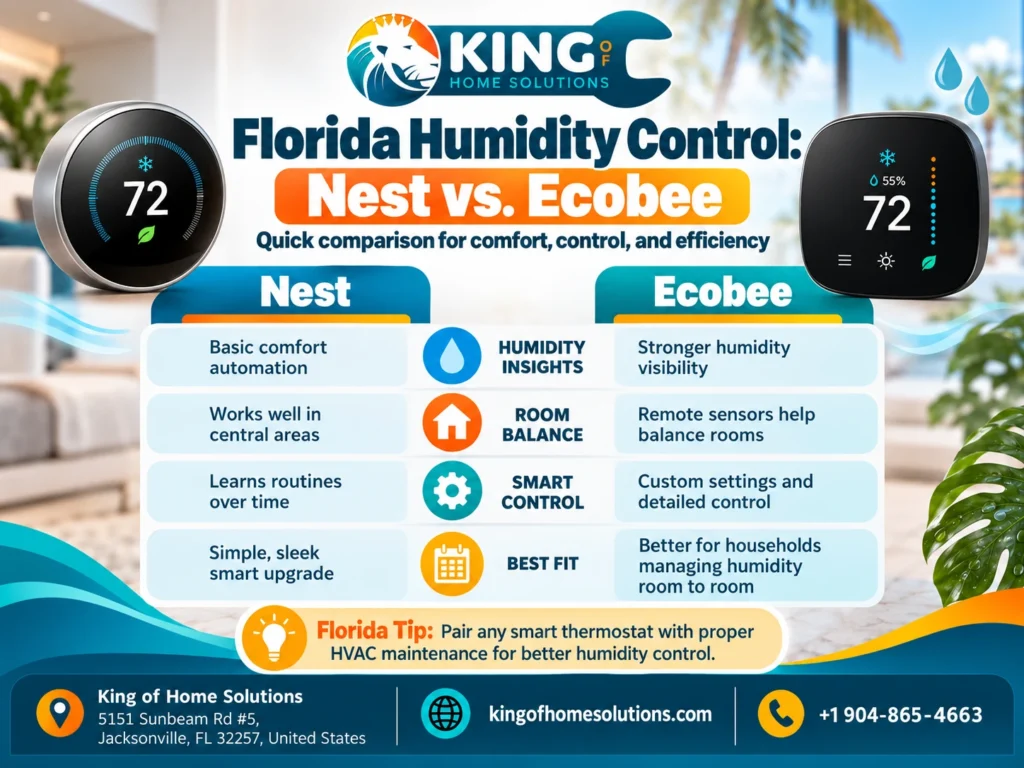
Nest vs. Ecobee: The Quick Comparison
| Feature | Nest Learning Thermostat (4th Gen) | Ecobee Smart Thermostat Premium |
| Built-in humidity sensor | Yes | Yes |
| Uses AC for extra dehumidification | Yes — Cool to Dry | Yes — AC Overcool to Dehumidify |
| Controls whole-home dehumidifier | Yes, compatible systems | Yes, compatible systems |
| Dedicated accessory terminals | Yes | Yes |
| Humidity-based comfort adjustment | Adaptive Comfort | Adjust Temperature for Humidity / eco+ |
| Remote sensors measure humidity | No | No |
| Best fit | Simple automation and Google Home households | Advanced HVAC control and humidity-focused setups |
The biggest difference isn’t whether either thermostat can respond to humidity.
They both can.
It is how much control you want over the HVAC system doing the dehumidification.
How Nest Handles Florida Humidity
Google’s current Nest Learning Thermostat (4th gen) is considerably more capable for humidity management than homeowners familiar with older Nest models may realize.
Its Cool to Dry feature allows the thermostat to run an air conditioner or heat pump to reduce excessive indoor humidity.
Google says the feature can work even when the AC does not have a dedicated dehumidification mode. On the 4th-generation thermostat, homeowners can also configure advanced settings including an overcooling limit, humidity threshold, and minimum indoor temperature.
That matters in Florida.
Suppose your thermostat is set to 75°F.
The house reaches 75°F, but indoor humidity remains uncomfortably high.
Instead of immediately stopping cooling, Cool to Dry may allow additional AC operation to remove more moisture, within configured limits.
In other words:
Nest can intentionally make the house slightly cooler to make it considerably less humid.
That can improve comfort without requiring a separate dehumidifier in every situation.
Nest’s New Adaptive Comfort Feature
The 4th-generation Nest also includes Adaptive Comfort.
This feature uses indoor humidity, weather forecasts, and information Nest learns about the home to adjust how the temperature feels.
Google gives the example of a particularly humid day causing the thermostat to lower the temperature slightly to maintain comfort.
That is particularly relevant in Florida because 75°F at 45% humidity feels very different from 75°F at 65% humidity.
Nest is essentially acknowledging something homeowners already know intuitively:
Temperature alone does not determine comfort.
For someone who wants the thermostat to handle these adjustments automatically rather than constantly changing settings, Nest’s approach is attractive.
Nest Can Also Control a Whole-Home Dehumidifier
If your Florida home has or is getting a dedicated whole-home dehumidifier, the Nest Learning Thermostat 4th gen can control compatible equipment.
Google says the thermostat includes additional terminals that allow it to support humidification and dehumidification accessories, and homeowners can set a desired humidity level through the Google Home app.
It can also be configured for standalone or AC-integrated dehumidification depending on the equipment.
That makes the current Nest a serious option even for more sophisticated Florida HVAC systems.
Compatibility still needs to be verified before installation, particularly when multi-stage equipment, variable-speed systems, heat pumps, ventilation equipment, or dedicated dehumidifiers are involved.
Where Ecobee Has the Advantage
Ecobee has long approached its thermostats more like HVAC control systems than lifestyle gadgets.
That philosophy works well in humid climates.
The ecobee Smart Thermostat Premium includes a built-in humidity sensor and a feature called AC Overcool to Dehumidify.
Like Nest’s Cool to Dry, it can allow the air conditioner to cool below the normal temperature setpoint when additional moisture removal is needed.
So imagine the house has reached 75°F but humidity remains elevated.
Ecobee can continue operating the cooling system within its configured limits in an attempt to pull additional moisture from the air.
For a Florida homeowner who constantly finds themselves lowering the thermostat simply because the house feels humid, this can be extremely useful.
Ecobee Works Well With Dedicated Dehumidifiers
This is where I would give ecobee the slight edge for a humidity-focused Florida HVAC system.
The Smart Thermostat Premium provides accessory terminals and supports compatible humidifiers, dehumidifiers, and ventilation equipment. Ecobee specifies support for either a one-wire or two-wire HVAC accessory on the Premium model.
The Smart Thermostat Enhanced also supports compatible HVAC accessories, although its wiring capabilities differ from the Premium model.
For a straightforward single-stage AC, those differences may not matter.
For a home with:
- A whole-home dehumidifier
- Multi-stage cooling
- Heat-pump equipment
- Ventilation equipment
- More complicated accessory wiring
the exact thermostat model and terminal configuration become much more important.
That is why an HVAC contractor should verify compatibility rather than selecting the thermostat based only on the app or touchscreen.
Don’t Buy Either Thermostat Just for the Remote Sensors
Both companies offer remote room sensors.
They’re useful.
But there is an important limitation for humidity-focused homeowners:
The remote sensors do not provide room-by-room humidity control.
Ecobee’s current SmartSensor detects temperature and occupancy, not humidity.
Google’s second-generation Nest Temperature Sensor measures temperature, not humidity.
The thermostat itself contains the humidity sensor.
That means thermostat location matters.
If the thermostat is installed beside a bathroom, near a supply vent, on an unusually warm wall, or somewhere that does not represent normal living conditions, its humidity reading may not perfectly describe the entire house.
Remote sensors can help balance temperature.
They do not give either system multiple humidity measurement zones.
Which Thermostat Is Better for an Oversized Florida AC?
Neither one fixes the underlying problem.
This is critical.
An oversized air conditioner can drop indoor temperature very quickly.
The thermostat becomes satisfied.
The compressor shuts down.
But the system may not have operated long enough for sufficient moisture to condense on the evaporator coil and drain away.
DOE research on hot-humid climates specifically notes the challenge: modern AC equipment can reduce temperature effectively while still struggling with moisture removal under certain conditions.
Nest’s Cool to Dry and ecobee’s AC Overcool can help by extending cooling for humidity purposes.
But there is a limit.
You cannot keep cooling the house indefinitely just to remove moisture.
Eventually the house becomes uncomfortably cold.
If indoor humidity repeatedly stays above 60% even though the AC is operating properly, the solution may involve HVAC sizing, airflow adjustments, duct leakage, ventilation problems, or a dedicated dehumidifier.
A $250 thermostat cannot overcome every mechanical problem.
Which One Would I Choose for Florida?
For a simple AC system where you want strong automation and minimal adjustment:
Nest Learning Thermostat 4th gen is an excellent choice.
Cool to Dry, Adaptive Comfort, humidity sensing, and dedicated dehumidifier support make the current model far more capable for Florida conditions than Nest’s simpler reputation might suggest.
For a homeowner who wants more HVAC-focused configuration or expects to integrate a dedicated whole-home dehumidifier:
I would lean toward ecobee Smart Thermostat Premium.
Its AC Overcool to Dehumidify feature, accessory support, humidity sensing, staging capabilities, and deeper HVAC configuration make it particularly well suited to hot-humid homes.
But the difference is no longer enormous.
The latest Nest is genuinely competitive.
The Thermostat Isn’t Always the Problem
Before replacing your thermostat because the house feels humid, look at the entire HVAC system.
A Florida home with persistent humidity problems could have:
an oversized AC, short cycling, poor airflow, a dirty evaporator coil, leaking ducts, excessive outdoor-air infiltration, condensate problems, or inadequate dehumidification capacity.
Changing from Nest to ecobee will not magically repair those conditions.
The thermostat can tell the HVAC equipment what to do.
The equipment still needs to be capable of doing it.
The Bottom Line
For Florida humidity control, ecobee gets a slight overall advantage, especially for homeowners who want detailed HVAC control or integration with a whole-home dehumidifier.
But Google’s Nest Learning Thermostat 4th gen has closed much of the gap with Cool to Dry, Adaptive Comfort, advanced overcool settings, humidity sensing, and dehumidifier support.
So don’t choose based only on which thermostat has the prettier display.
Ask what your home actually needs.
If indoor humidity already stays near 45% to 50%, either thermostat can provide excellent everyday comfort.
If humidity regularly climbs toward or above 60%, don’t simply keep lowering the temperature.
Find out why.
Because in a Florida home, the smartest thermostat isn’t necessarily the one that learns your schedule best.
It’s the one that works with your HVAC system to make 75°F actually feel like 75°F.