Serving The Jacksonville Area


Electrolysis: The Teal-Green Growth “Eating” Your Jacksonville Copper Pipes

Electrolysis: The Teal-Green Growth “Eating” Your Jacksonville Copper Pipes
You open the cabinet beneath the sink and notice something strange around a copper pipe.
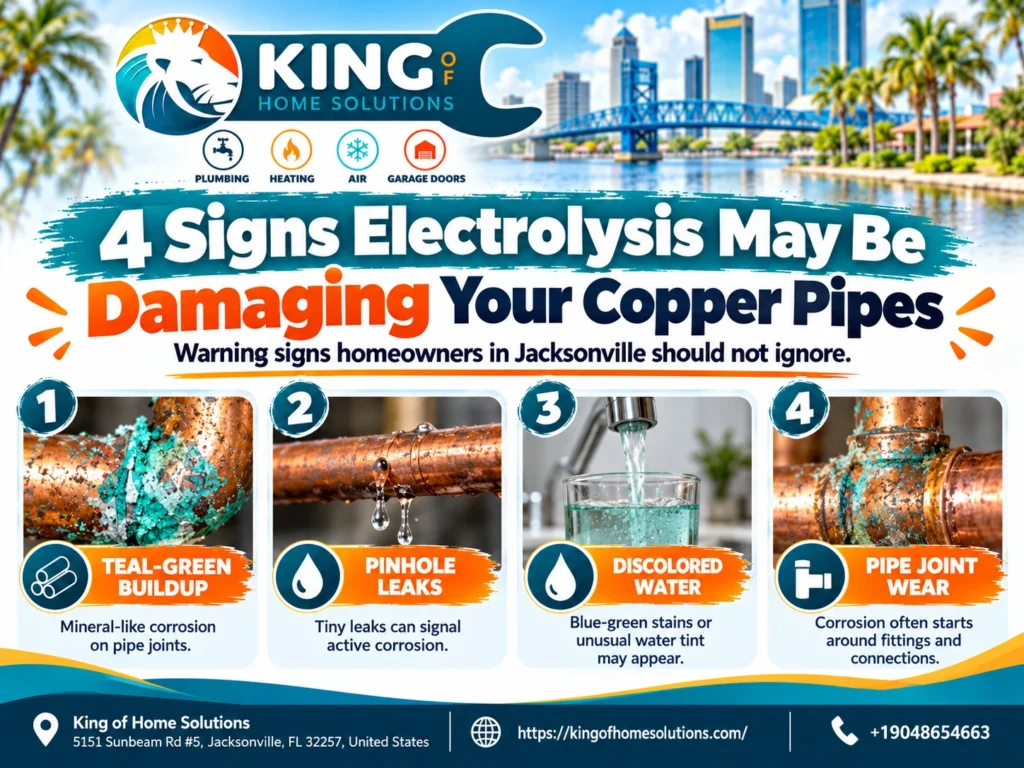
A joint that used to be shiny now has blue-green or teal crust around it.
Maybe the same material is appearing on copper lines near the water heater. Perhaps there is a tiny green spot on a pipe in the garage, followed by a barely noticeable bead of moisture.
A common explanation homeowners hear is:
“That’s electrolysis eating the copper.”
Sometimes an electrical or galvanic corrosion issue is involved.
But that teal-green material does not automatically mean electrolysis.
In fact, the Copper Development Association specifically warns that “electrolysis” is frequently misused when describing copper plumbing failures. True electrolytic corrosion requires an externally imposed stray direct electrical current. What homeowners and even contractors often call electrolysis may actually be ordinary copper corrosion, galvanic corrosion, water-chemistry problems, erosion-corrosion, residual soldering flux, or a small leak leaving corrosion products behind.
For Jacksonville homeowners, the color is a warning worth investigating.
The diagnosis, however, matters more than the color.
What Is That Teal-Green Material?
Copper changes chemically when it reacts with its environment.
Those reactions can create blue, green, or turquoise-colored copper compounds.
EPA guidance notes that corrosion of copper plumbing can produce blue-green discoloration and staining, while copper exposed to air can develop green copper compounds on its surface.
That means a little green discoloration on an old copper pipe does not automatically mean the pipe is about to burst.
But location matters.
A dry, stable patina on exposed copper is different from a growing mound of crust around a soldered fitting that feels damp.
If the green area is accompanied by:
- Moisture
- White mineral deposits
- Dripping
- A pin-sized wet spot
- Ceiling staining below the pipe
- Repeated corrosion around multiple fittings
you may be looking at an active plumbing problem rather than harmless surface oxidation.
Is It Really Electrolysis?
Usually, that word deserves a closer look.
True electrolytic or stray-current corrosion occurs when an outside electrical current passes through the metal and causes corrosion.
According to the Copper Development Association, this form of corrosion requires an imposed stray DC electrical current and is relatively uncommon in ordinary residential copper plumbing.
A different phenomenon is galvanic corrosion.
Galvanic corrosion occurs when two dissimilar metals are electrically connected while exposed to an electrolyte.
For example, copper and certain other metals joined improperly in the presence of conductive water can create an electrochemical reaction.
That is closer to what many people mean when they casually say “electrolysis.”
But even galvanic corrosion should not be diagnosed just because a pipe has turned green.
The actual materials, fittings, water chemistry, and location of the deterioration need to be examined.
Jacksonville Water Doesn’t Automatically Mean Your Copper Is Being Destroyed
This is another important distinction.
Seeing copper corrosion in a Jacksonville house does not mean Jacksonville’s municipal water is inherently unsafe or corrosive.
JEA’s 2025 Water Quality Report states that the utility performs tens of thousands of water-quality tests and reports compliance monitoring for copper and other regulated parameters. Its report lists corrosion of household plumbing as one potential source of copper detected at the tap.
That’s important because water arriving at the property and water coming from your faucet are not necessarily chemically identical.
Water can interact with:
- Copper pipes
- Brass fittings
- Water heaters
- Faucets
- Soldered joints
- Private treatment equipment
after it enters the home.
This is why two houses receiving water from the same utility can experience different plumbing conditions.
Age, workmanship, pipe sizing, water temperature, and the home’s individual piping system all matter.
Cause #1: A Tiny Leak Can Create a Big Green Clue
Sometimes the green buildup isn’t causing the leak.
The leak is causing the green buildup.
Imagine a soldered copper joint allowing an extremely small amount of water to escape.
The leak may be too slow to create a visible drip.
Instead, the moisture evaporates.
Minerals and copper corrosion products remain behind.
That process repeats hundreds of times.
Eventually, you see a crusty blue-green deposit around the joint.
This is why wiping green material away without investigating the pipe can be misleading.
If it grows back, or the copper underneath remains damp, there may be an active leak.
A plumber can pressure-test or inspect the joint rather than guessing based on appearance.
Cause #2: Old Soldering Flux Can Contribute to Corrosion
Copper plumbing joints traditionally use flux during soldering.
Flux helps prepare the metal so solder can form a proper connection.
But too much aggressive flux—or improperly handled flux residue—can contribute to corrosion.
The Copper Development Association identifies excessive or aggressive flux and poor workmanship among recognized causes of copper pipe corrosion. Its technical guidance also describes green corrosion deposits associated with flux-induced pitting.
This is particularly interesting when corrosion appears repeatedly near soldered fittings rather than evenly across long straight sections of pipe.
The copper itself may not be inherently defective.
The problem may trace back to how certain connections were made years earlier.
Cause #3: Water Chemistry Can Attack Copper From the Inside
The corrosion you see outside the pipe may be the final stage of a process that began inside it.
Water chemistry can influence whether copper develops a protective interior film or begins corroding.
Factors can include:
- pH
- Dissolved oxygen
- Carbon dioxide
- Chloride
- Sulfate
- Hardness
- Temperature
- Total dissolved solids
EPA guidance notes that copper plumbing can experience general corrosion and localized pitting depending on water characteristics. Copper-industry guidance similarly identifies aggressive water chemistry among the potential causes of pitting failures.
This becomes especially relevant for homeowners using private wells or water-treatment equipment that substantially changes the home’s water chemistry.
If several copper pipes are developing pinhole leaks, testing the water can provide information that replacing one damaged section cannot.
Cause #4: Water Moving Too Fast Can Wear Copper Away
Water itself can physically contribute to copper deterioration when velocity or turbulence becomes excessive.
This is called erosion-corrosion.
It may occur when:
- Pipes are undersized
- Water velocity is excessive
- Hot-water recirculation pumps are oversized
- Pipe ends were not properly reamed
- Fittings create excessive turbulence
- Water temperatures are unusually high
The Copper Development Association recommends keeping water velocities within appropriate limits specifically to reduce erosion-corrosion risk.
This type of failure is very different from galvanic corrosion.
Yet after the pipe develops a pinhole and green corrosion appears outside, both problems may look similar to the homeowner.
That is why the visible stain alone cannot diagnose the mechanism.
Cause #5: Florida Humidity Can Make External Corrosion Easier to Notice
Jacksonville homeowners also deal with a climate ingredient that isn’t present everywhere:
persistent humidity.
Copper piping in garages, crawlspaces, utility rooms, and other humid areas may develop surface oxidation.
Cold-water lines can also sweat when warm humid air contacts the cooler pipe surface.
Condensation does not automatically mean the pipe itself is leaking.
But repeated moisture can create exterior discoloration and make it harder for homeowners to distinguish condensation from an actual pinhole leak.
Try drying the area completely.
If water quickly reforms at one precise point while the surrounding pipe remains dry, a plumbing leak becomes more suspicious.
If the entire cold pipe becomes uniformly damp during humid conditions, condensation may be playing a larger role.
Should You Clean the Green Material Off?
You can gently inspect accessible piping, but don’t aggressively scrape, sand, or pick at a badly corroded spot.
That green crust may be sitting over extremely thin copper.
A pipe that has been slowly deteriorating can sometimes begin leaking when corrosion products are disturbed.
This is especially true when you see:
- A raised green mound
- Heavy crust concentrated at one point
- Previous water staining
- Visible deformation
- A tiny dark or wet center
If the pipe looks seriously compromised, treat the discoloration as evidence—not dirt that needs cleaning.
One Pinhole Leak or a Whole-House Problem?
This is the expensive question.
One failed solder joint does not automatically mean your entire Jacksonville home needs to be repiped.
A plumber may simply cut out the damaged section and replace it.
But the situation changes when you’re seeing:
Leak #1.
Then another six months later.
Then another behind drywall.
Then green corrosion appeared across multiple unrelated sections of the house.
At that point, repeatedly repairing individual holes may no longer address the underlying condition.
A more complete investigation could include:
- Inspecting exposed copper
- Checking plumbing pressure
- Reviewing pipe sizes
- Testing water chemistry when appropriate
- Examining failed pipe sections
- Looking for dissimilar-metal connections
- Checking hot-water recirculation
- Identifying repeated solder-joint failures
Only after identifying the pattern should you start discussing whether targeted repairs or repiping makes better financial sense.
When Should You Call a Jacksonville Plumber?
Schedule an inspection if you notice green corrosion accompanied by:
- Active dripping
- Damp drywall
- Multiple pinhole leaks
- Corrosion appearing at numerous joints
- Falling water pressure
- Blue-green staining at fixtures
- Unexplained increases in water use
- Repeated copper plumbing repairs
And if you suspect an actual electrical bonding or stray-current problem, the solution may require both a licensed plumber and a qualified electrician.
Do not disconnect electrical grounding or bonding connections from plumbing based on an internet diagnosis.
That can create a serious electrical safety hazard.
The Bottom Line
That teal-green growth on your Jacksonville copper plumbing deserves attention.
But don’t let someone point at it and automatically say:
“Electrolysis.”
True electrolytic corrosion is a specific electrical phenomenon.
The problem could instead be ordinary oxidation, a tiny leaking joint, galvanic interaction between metals, aggressive water chemistry, excess soldering flux, erosion-corrosion, condensation, or localized pitting.
The color tells you copper is reacting with something.
It doesn’t tell you what that something is.
And that difference matters.
Cleaning away the green material may improve the appearance.
Replacing one leaking fitting may stop today’s drip.
But if corrosion keeps appearing throughout the house, the better question is:
“What is causing my copper to corrode in the first place?”
Answer that before the next little teal-green spot becomes the next pinhole leak behind your wall.