Serving The Jacksonville Area



How to Remove “Hard Water Spots” From Jacksonville Fixtures Permanently
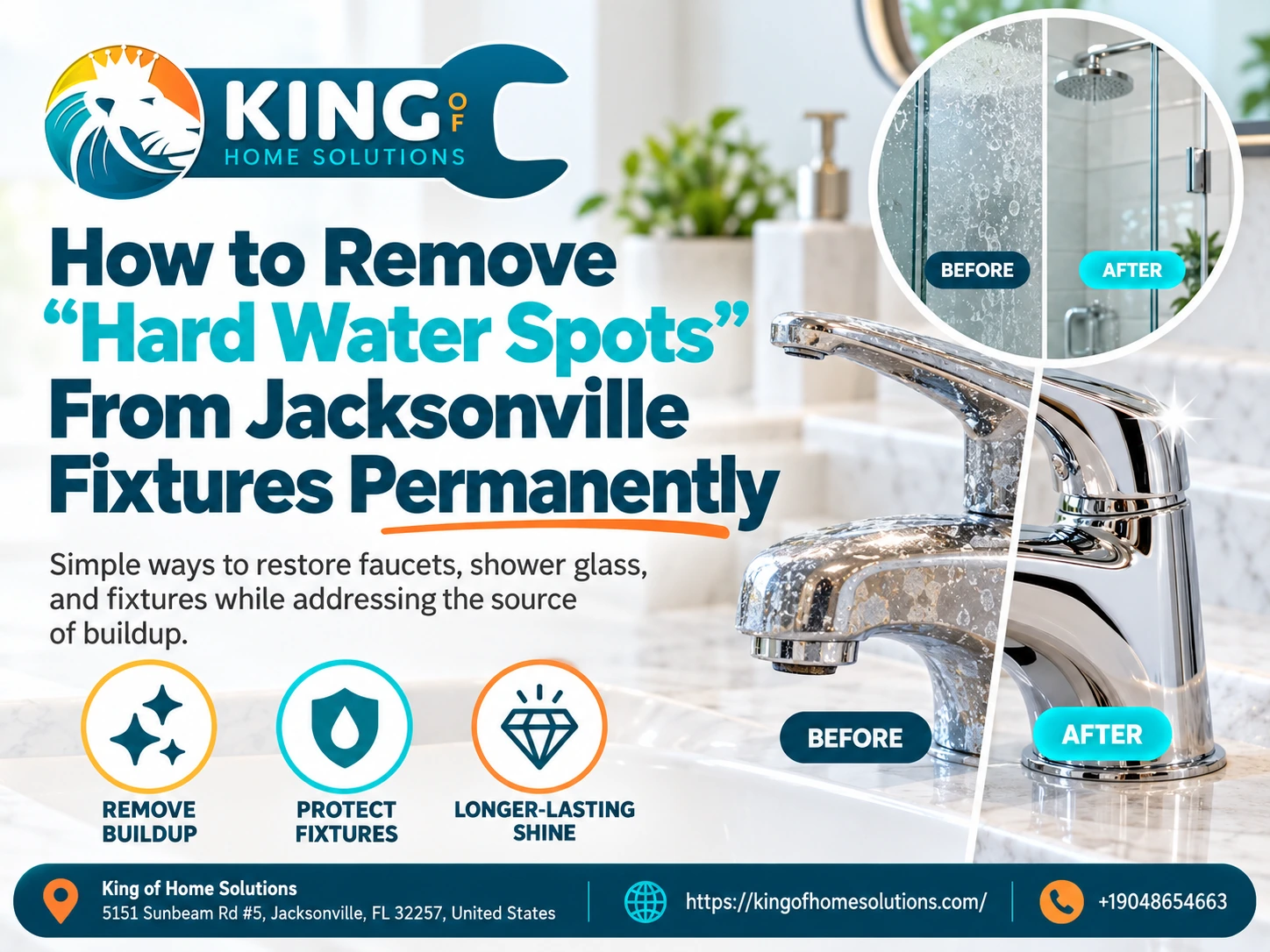
How to Remove “Hard Water Spots” From Jacksonville Fixtures Permanently
You clean the bathroom faucet on Saturday.
By Monday, the white spots are back.
You wipe the showerhead.
They return.
You polish the black fixtures until they look brand new, someone washes their hands once, and suddenly the faucet looks like it has been misted with chalk.
Welcome to Jacksonville hard water.
For many JEA customers, the problem isn’t poor housekeeping. It is the water itself.
JEA’s current hardness data classify most Jacksonville ZIP codes as very hard, with many areas measuring roughly 11–20 grains per gallon and some JEA-served areas reaching even higher levels. The hardness comes primarily from naturally occurring calcium and magnesium in the Floridan Aquifer.
Those minerals are dissolved and invisible while the water is flowing.
Then the droplets dry.
The water evaporates.
The minerals stay behind.
That’s the white crust on your faucet.
And here’s the part homeowners need to understand:
You can remove hard-water spots from a fixture. You cannot permanently stop them from returning unless you change the water or stop allowing mineral-rich water to dry on the surface.
First: Remove the Existing Mineral Deposits
For most ordinary faucet finishes, the safest place to start is much gentler than the bottle of industrial lime remover under the sink.
Use a 50/50 mixture of white vinegar and water.
Both Delta and Kohler recommend diluted white vinegar for removing calcium and hard-water deposits from compatible faucet finishes. Delta also recommends thoroughly rinsing the surface afterward.
For light spots, dampen a soft microfiber cloth with the mixture and wipe the fixture.
For heavier buildup, soak the cloth and wrap it around the affected area for several minutes.
Then gently wipe, rinse with clean water and dry the fixture.
Avoid turning this into a scrubbing competition.
Mineral scale can be stubborn, but scratching a $500 faucet finish to remove a $0.02 calcium deposit is not a victory.
For Showerheads and Aerators, Soaking Works Better
Hard water doesn’t only leave visible spots.
It can restrict flow.
Tiny showerhead nozzles and faucet aerators gradually collect mineral deposits until the spray begins shooting sideways or the kitchen faucet suddenly seems to have “low pressure.”
If the component is removable and the manufacturer permits it, soaking it in diluted vinegar can dissolve the mineral buildup.
Delta specifically recommends vinegar-and-water soaking for mineral deposits in faucet spray components and aerators.
This is why a Jacksonville faucet with weak flow does not automatically need a new cartridge or plumbing repair.
Sometimes the restriction is sitting right at the end of the spout.
Don’t Use Stronger Chemicals Just Because Vinegar Is Slow
This is where expensive finishes get ruined.
Delta specifically warns against harsh abrasives, bleach-based cleaners and products containing aggressive acids such as hydrochloric, hydrofluoric or phosphoric acid on its faucet finishes.
That matters even more with today’s decorative finishes.
Matte black.
Champagne bronze.
Brushed gold.
Oil-rubbed bronze.
Specialty coatings can be far less forgiving than old-school chrome.
Before using any acidic cleaner, check the fixture manufacturer’s care instructions.
And be especially careful around natural stone countertops, marble and grout. Vinegar is acidic and can damage acid-sensitive stones.
The cleaner that is safe for your faucet may not be safe for everything surrounding it.
Why the Spots Keep Coming Back
Suppose you clean the faucet perfectly.
Then somebody washes their hands.
A dozen droplets remain on the spout.
Jacksonville water contains dissolved calcium and magnesium.
The droplets evaporate.
The minerals do not.
Now the spots are back.
JEA itself identifies spotting on dishes and windows and scale on plumbing fixtures as normal consequences of hard water and recommends white vinegar for dissolving the deposits.
So cleaning solves yesterday’s deposits.
It does nothing about tomorrow’s water chemistry.
That leaves you with two long-term strategies.
Option #1: Dry the Fixtures
This is the cheapest solution.
Keep a microfiber cloth near heavily used fixtures and wipe the faucet after use.
Delta specifically recommends blotting water from faucet surfaces rather than allowing it to evaporate because evaporation encourages mineral deposits.
Will most families wipe every faucet after every use?
Probably not.
But it works extremely well in areas where appearance matters most.
A guest bathroom.
A glass shower.
A matte-black kitchen faucet.
If you can remove the water before it evaporates, the calcium never gets a chance to become a visible spot.
Option #2: Actually Soften the Water
If you want the closest thing to a permanent solution, this is it.
A conventional whole-house ion-exchange water softener removes much of the calcium and magnesium responsible for hardness before the water reaches your faucets.
JEA specifically identifies water softeners and ion-exchange treatment as options for dealing with hard water.
This doesn’t mean the water becomes chemically pure.
And a softener is not the same thing as a drinking-water filter.
But it attacks the actual source of the spotting problem instead of repeatedly cleaning the evidence.
For a Jacksonville home dealing with:
- White faucet scale
- Spotted shower doors
- Crusty showerheads
- Scale around valves
- Mineral buildup in appliances
a properly sized softener can make a dramatic difference.
A Carbon Filter Will Not Fix Hard-Water Spots
This is a common sales misunderstanding.
A whole-house carbon filter can be useful for reducing chlorine taste and odor.
But carbon does not normally remove the calcium and magnesium that make Jacksonville water hard.
So you can install a beautiful whole-home carbon system and still have white spots all over your black faucets.
If hardness is your problem, ask specifically whether the equipment softens the water.
Don’t settle for vague phrases like:
“conditions the water.”
“improves water quality.”
“reduces contaminants.”
Ask for the before-and-after hardness measurement in grains per gallon.

What About Salt-Free Water Conditioners?
This is where marketing gets messy.
Some salt-free systems are designed to alter how hardness minerals behave rather than physically removing them the way conventional ion-exchange softeners do.
That may have benefits for scale management in certain applications.
But if your specific goal is:
“I don’t want visible calcium spots on my fixtures,”
understand that hardness minerals can still remain in the water.
If the minerals remain and water evaporates from a dark faucet, residue can still remain too.
For homeowners obsessed with spotless chrome or matte-black fixtures, conventional softening is generally the more straightforward solution.
Reverse Osmosis Won’t Solve the Whole Bathroom Either
An under-sink RO system can remove a substantial amount of dissolved material from drinking water.
That’s great for drinking and cooking.
It does nothing for the master shower, bathroom faucet or washing machine if the RO system only serves the kitchen sink.
Whole-house reverse osmosis exists, but it is a much more complex and expensive treatment strategy and is rarely necessary simply because your showerhead has calcium spots.
Don’t install a $10,000 solution to a problem a properly sized softener may address far more simply.
Why Black Fixtures Make Jacksonville Hard Water Look Worse
Black faucets did not create the mineral problem.
They exposed it.
White calcium deposits have enormous visual contrast against matte-black finishes.
Chrome may hide minor spotting better because it reflects light.
Brushed nickel can disguise it somewhat.
Black shows everything.
If you love the look, keep it.
But in a very-hard-water Jacksonville home, either prepare to wipe the fixture frequently or address the water itself.
The same is true for clear glass shower enclosures.
They’re beautiful.
They’re also excellent mineral-deposit billboards.
The Best Jacksonville Strategy
If your fixtures already have deposits:
Clean them gently with a manufacturer-approved vinegar solution.
If the deposits return quickly:
Confirm your actual water hardness.
JEA publishes average hardness by ZIP code, but your home’s exact result can be tested directly.
If you’re around 15–20 grains per gallon and tired of constantly descaling faucets, showerheads and glass:
Get quotes for a properly sized ion-exchange softener.
And if you don’t want a softener?
Keep a microfiber cloth handy and dry the surfaces before the droplets evaporate.
Those are the two approaches that address the actual physics.
The Bottom Line
There is no miracle spray that permanently eliminates hard-water spots from Jacksonville fixtures.
Vinegar removes the deposits.
A microfiber towel prevents droplets from drying.
But only changing the hardness of the water addresses the source of the problem throughout the house.
That’s why the permanent solution isn’t a stronger bathroom cleaner.
It’s deciding whether Jacksonville’s mineral-heavy water is annoying enough to justify whole-house treatment.
If you have one spotted faucet, clean it.
If you have spotted faucets, crusty showerheads, cloudy glass and mineral deposits throughout the entire house every week, stop fighting every fixture individually.
At that point, you’re not dealing with a cleaning problem anymore. You’re dealing with a water problem.