Serving The Jacksonville Area



The Danger of DIY Garage Door Spring Repair: The “Hospital Trip” Warning
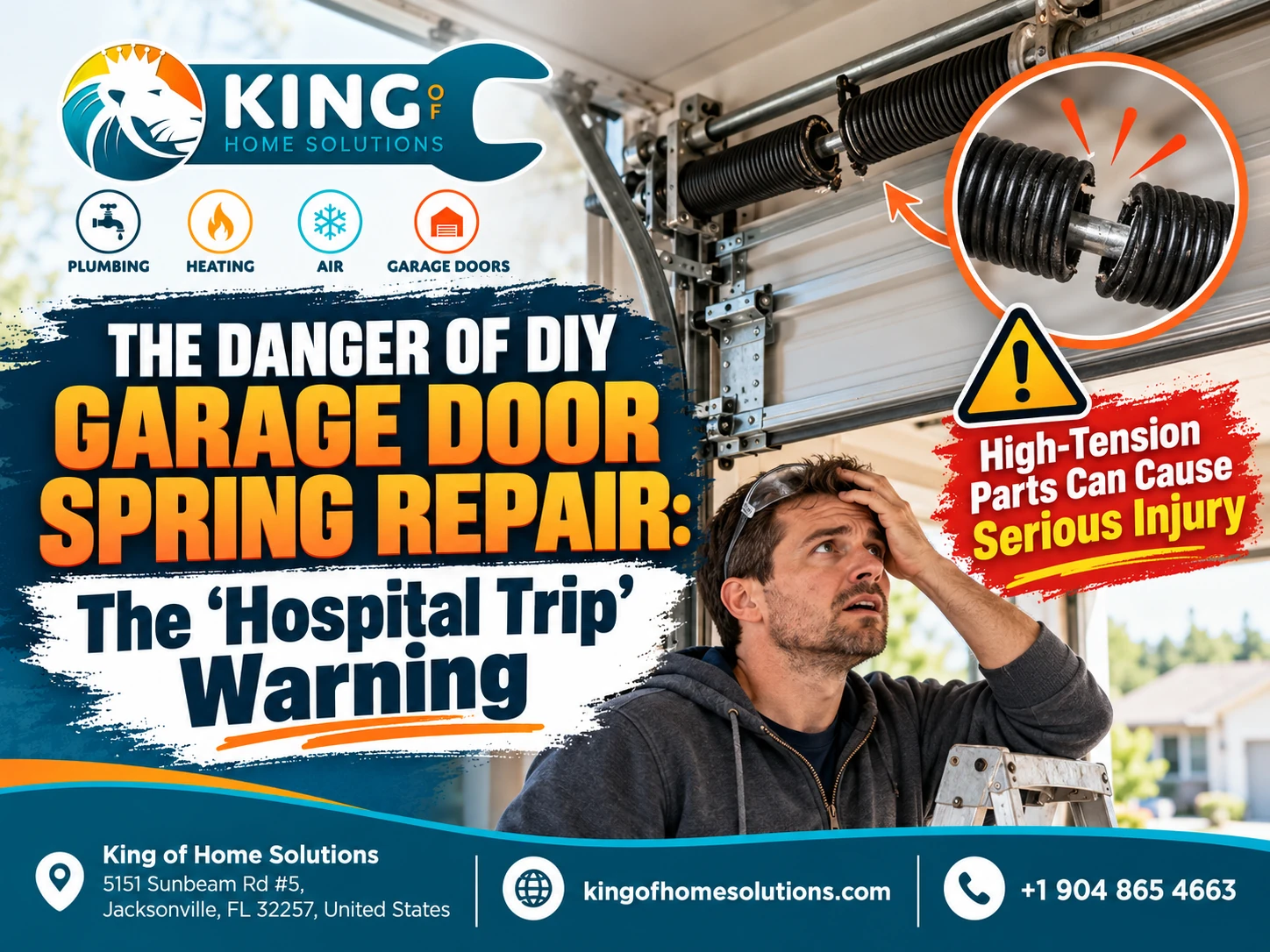
The Danger of DIY Garage Door Spring Repair: The “Hospital Trip” Warning
The garage door won’t open.
You look up and notice the spring above the door has snapped.
Then comes the tempting thought:
“How hard can it be to replace?”
A quick search makes the job look simple enough. Buy a replacement spring. Grab a few tools. Follow a video. Save the service call.
But garage door spring repair is one of those home projects where the difference between “DIY savings” and “emergency room visit” can be a few inches, one slipped tool, or one incorrect adjustment.
That isn’t an exaggeration designed to scare homeowners.
Garage door springs are part of a high-tension counterbalance system designed to help lift a door that may weigh hundreds of pounds. When that stored energy is released unexpectedly, metal components can move violently and with very little warning.
This is why garage door spring repair deserves a simple rule:
If the repair involves removing, winding, unwinding, or adjusting a high-tension spring, leave it to a trained garage door technician.
Why Garage Door Springs Are So Dangerous
Most homeowners don’t think about the weight of their garage door because the opener makes everything look easy.
Press a button.
The door rises.
Press it again.
The door closes.
But the opener is not supposed to carry the full weight of the door by itself.
The spring system does much of the heavy lifting.
Depending on the design, your garage may use torsion springs mounted above the door or extension springs positioned along the sides.
Both systems store mechanical energy.
When everything is installed and adjusted correctly, that energy helps counterbalance the door.
When something is handled incorrectly, that same energy can become dangerous.
A torsion spring that is being wound or unwound incorrectly can rotate suddenly.
A tool can slip.
A winding bar can be thrown.
A bracket can move.
A cable can release.
And if part of the system fails while your hands, face, or body are in the wrong place, the injury can be immediate.
That’s where the “hospital trip” warning comes from.
The Door Itself Is Also a Hazard
The spring isn’t the only dangerous part of the job.
The garage door can become dangerous the moment its counterbalance system stops working correctly.
A typical residential garage door is heavy.
When a spring breaks, the door may suddenly become difficult or impossible to lift manually.
If someone disconnects the opener and tries to raise the door without realizing how much weight the spring was carrying, the door can fall.
That can cause:
- Crushed fingers
- Hand injuries
- Foot injuries
- Head injuries
- Damage to vehicles
- Damaged tracks and rollers
- Additional door damage
This becomes even more serious with large double-wide, insulated, or reinforced garage doors.
A door that normally feels easy to move can become extremely heavy after a spring failure.
Why Online Videos Can Make the Repair Look Easier Than It Is
One reason DIY spring replacement is tempting is that videos often show an experienced person completing the repair smoothly.
What you don’t necessarily see is the years of experience behind those movements.
A trained technician knows how to recognize:
- The correct spring size
- The correct spring orientation
- Proper winding direction
- Appropriate spring tension
- Cable routing
- Bearing condition
- Drum alignment
- Track condition
- Whether other hardware is damaged
- Whether the door is actually balanced afterward
That last point matters.
A spring can be installed and the garage door can still be wrong.
Too much tension and the door may rise on its own.
Too little tension and the door may feel heavy.
Uneven spring tension can cause one side to move differently from the other.
A repair that appears successful because “the door opens” may still leave the system improperly balanced.
The Wrong Spring Can Create a New Problem
Garage door springs are not universal.
They are selected based on factors such as:
- Door weight
- Door height
- Spring dimensions
- Wire size
- Inside diameter
- Wind direction
- Number of springs
- Lift system design
Installing a spring that merely “looks about the same” is not good enough.
If the replacement spring is incorrectly matched, the garage door may not balance properly.
Then the opener has to compensate.
That can strain the opener, cables, drums, rollers, and other hardware.
In other words, saving money on one spring can potentially create several new repairs.
A professional technician typically identifies the correct spring for the actual door rather than guessing from appearance alone.
Why Winding Bars Matter
One of the most dangerous DIY mistakes involves using the wrong tools.
Torsion springs are adjusted using proper winding bars designed to fit the winding cone.
Homeowners sometimes substitute screwdrivers, socket extensions, metal rods, or other improvised tools.
That is dangerous.
If an improvised tool doesn’t fit correctly or slips while the spring is under tension, the spring can rotate suddenly.
At that point, the tool itself may become a projectile.
This is not the kind of repair where “close enough” tools are acceptable.
The correct equipment is part of performing the work safely.
What About Extension Springs?
Extension springs may look less intimidating because they’re stretched along the tracks rather than wound around a torsion shaft.
That doesn’t make them harmless.
When extension springs fail, components can move violently.
Older systems may also be missing proper safety cables designed to help contain a broken spring.
If you have an older garage door with extension springs, a professional inspection is worthwhile even if the door currently operates.
A technician can check the springs, safety cables, pulleys, and related hardware for wear.
The “I’ll Just Replace One Spring” Problem
Many two-car garage doors use two torsion springs.
If one breaks, homeowners sometimes want to replace only the failed spring.
That may be reasonable in some cases, but the age and cycle life of the second spring matter.
If both springs were installed at the same time and have completed roughly the same number of cycles, the surviving spring may also be approaching the end of its useful life.
Replacing only one can mean paying for another service call soon afterward.
A technician can evaluate whether replacing both springs makes sense based on the actual system.
The point isn’t that both springs must always be replaced.
It’s that spring replacement should consider the entire counterbalance system, not just the one visibly broken component.
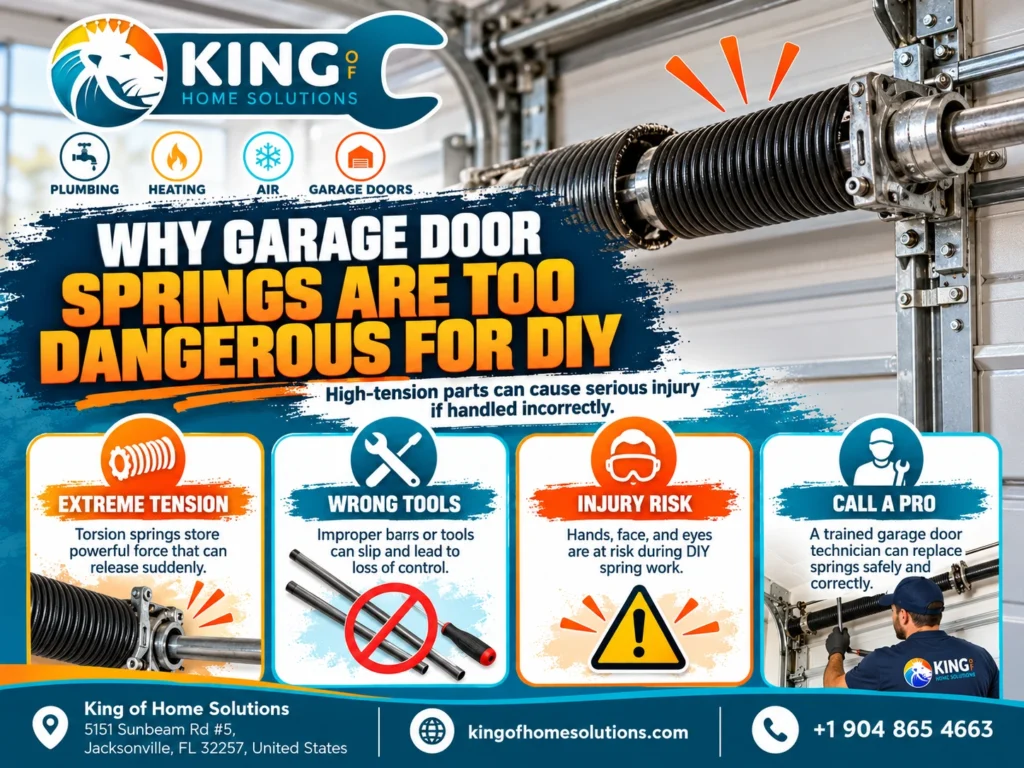
A Broken Spring Can Damage the Garage Door Opener
Some homeowners discover the spring problem only after repeatedly pressing the opener button.
The motor hums.
The door rises a few inches.
Then it stops.
They press the button again.
And again.
This can make the situation worse.
Remember: the opener is not designed to lift the entire dead weight of an unbalanced garage door.
Repeatedly forcing the opener to operate with a broken spring can damage:
- Drive gears
- Belts
- Chains
- Trolleys
- Motor components
- Opener rails
If the garage door suddenly becomes extremely heavy or will not lift normally, stop repeatedly operating the opener.
Have the spring system inspected.
Warning Signs You May Have a Broken Spring
A broken garage door spring isn’t always difficult to recognize.
You may notice:
- A visible gap in a torsion spring
- A loud bang from the garage
- The door only opening a few inches
- The garage door suddenly feeling extremely heavy
- The opener struggling
- A crooked or uneven door
- Loose cables
- The door dropping unusually fast
Do not touch loose cables or attempt to reposition spring-related hardware.
The safest move is to leave the door closed when possible and call a professional.
If the door is stuck open, keep people, pets, and vehicles away from the area beneath it.
What You Can Safely Do Yourself
Calling a professional for spring repair doesn’t mean homeowners should never perform garage door maintenance.
There are several lower-risk tasks you can handle, depending on the manufacturer’s recommendations.
You can:
- Keep the garage area clean
- Remove loose debris from tracks without adjusting them
- Inspect the door visually
- Listen for unusual noises
- Check the weather seal
- Test automatic reversing features
- Lubricate approved components according to manufacturer guidance
- Watch for frayed cables or worn rollers without touching them
The important distinction is between maintenance and high-tension repair.
Wiping dirt from a track is maintenance.
Winding a torsion spring is not.
Why Professional Spring Repair Costs More Than the Part
A homeowner may look online and see a replacement spring for a relatively modest price.
Then a professional quote arrives and seems much higher.
You’re not only paying for the piece of steel.
You’re paying for:
- Correct spring identification
- Specialized tools
- Safe removal of stored tension
- Proper installation
- Accurate winding
- Door balancing
- Inspection of cables and drums
- Testing after repair
- Labor and liability
This is one repair where professional labor isn’t simply about convenience.
It’s largely about managing risk.
The Bottom Line
Garage door spring replacement can look deceptively simple.
A broken spring is visible.
The replacement part is easy to find.
Videos are everywhere.
But none of that changes the fact that you’re working with a heavy moving door and a component designed to store substantial mechanical energy.
A mistake can happen quickly.
And unlike painting a wall badly or installing a shelf crooked, the consequence isn’t simply doing the project twice.
It can be a serious injury.
If your garage door spring breaks, resist the urge to turn it into a weekend DIY project.
Stop using the door when possible.
Keep people away from unstable or hanging components.
Don’t force the opener.
And call a garage door professional.
Because saving a few hundred dollars is never a good trade if the repair ends with a trip to the hospital.