Serving The Jacksonville Area


Air Purifiers vs. Whole-Home Scrubbers for Jacksonville Allergy Seasons
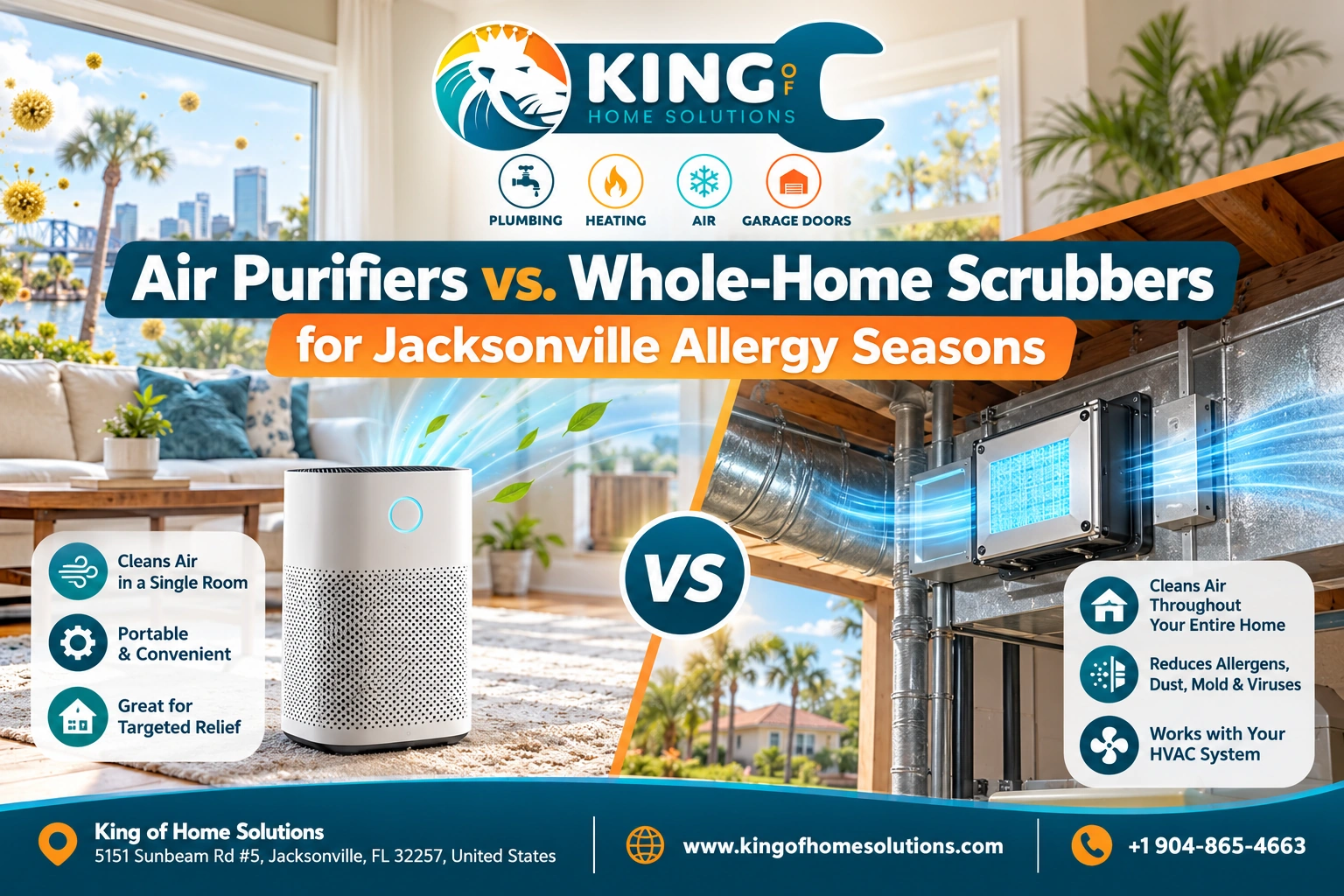
Air Purifiers vs. Whole-Home Scrubbers for Jacksonville Allergy Seasons
If you live in Jacksonville, allergy season can feel less like a season and more like a rotating schedule.
Tree pollen arrives early.
Oak pollen covers patios and cars.
Grass pollen follows.
Then weeds such as ragweed continue the cycle.
Meanwhile, Jacksonville’s warm, humid climate creates favorable conditions for indoor allergens such as dust mites and mold.
So when sneezing, itchy eyes, congestion, and indoor dust become frustrating, homeowners often start looking at two solutions:
A portable HEPA air purifier or a whole-home HVAC “air scrubber.”
The whole-home system sounds more powerful.
After all, why clean one bedroom when you could supposedly “scrub” every cubic foot of air in the house?
But bigger does not automatically mean better.
For airborne allergens such as pollen, pet dander, and fine particles, a properly sized portable HEPA purifier can be extremely effective in the rooms where you spend the most time. A well-designed whole-home filtration system can provide broader coverage—but some products marketed as “scrubbers” rely on ionization, oxidation, UV, or other technologies that do not perform the same job as a physical filter.
For Jacksonville allergy sufferers, understanding that difference can save a lot of money.
Jacksonville Doesn’t Really Have a Short Allergy Season
In many parts of the country, homeowners battle spring pollen for a few weeks and then get a break.
Florida is different.
University of Florida IFAS notes that Florida experiences longer and more frequent pollen seasons. Trees can pollinate during winter and spring, grasses during spring through fall, and weeds can produce pollen across several seasons. Oak is one of Florida’s most important allergenic trees, with peak pollination generally occurring from February through May.
Jacksonville allergy specialists describe an even longer local cycle, with tree pollen potentially starting in December, followed by grass pollen and then weed pollen extending into fall.
That means pollen gets plenty of opportunities to enter your house.
It comes through doors.
It rides in on clothing and pets.
It enters when windows are open.
And once inside, it can settle onto bedding, carpet, furniture, and other surfaces.
Your air-cleaning strategy therefore needs to do more than sound impressive.
It needs to actually capture particles.
How a Portable HEPA Air Purifier Works
A portable air purifier sits in an individual room and continuously pulls surrounding air through a filter.
For allergy control, the most important feature is usually a high-efficiency mechanical filter, commonly HEPA.
Instead of chemically reacting with particles or electrically charging them, the filter physically captures them as air passes through the machine.
EPA says portable air cleaners can help reduce airborne particles and notes that many effective units use HEPA filtration. EPA recommends choosing a purifier with a Clean Air Delivery Rate, or CADR, appropriate for the size of the room.
This sizing requirement is important.
A tiny purifier in a 700-square-foot open living room may technically be running all day without moving enough air to make much difference.
A correctly sized purifier running continuously in a bedroom can filter the same air repeatedly.
For allergy sufferers, that can be particularly useful because you may spend seven or eight hours every night in that one room.
Where Portable Purifiers Win
The biggest advantage is targeted filtration.
Suppose one person in your household has severe pollen allergies.
Instead of spending thousands of dollars modifying the entire HVAC system, you could put a properly sized HEPA purifier in the bedroom and another in the main living space.
EPA notes that multiple well-placed portable air cleaners can sometimes provide filtration comparable to central approaches and may cost less than operating an entire central HVAC fan continuously.
Portable units also work regardless of whether your air conditioner is actively cooling.
That is a major difference.
A standard HVAC filtration system only cleans air when the blower is moving air through the return and filter.
The portable purifier can continue operating even after the thermostat is satisfied.
For someone trying to reduce airborne pollen overnight, that is valuable.
So What Is a “Whole-Home Air Scrubber”?
This is where homeowners need to ask more questions.
There is no single universal technology called an air scrubber in residential HVAC marketing.
One contractor’s “whole-home scrubber” may be an upgraded mechanical media filter.
Another may combine UV light with filtration.
Another may use bipolar ionization.
Another may use photocatalytic oxidation or another electronic technology.
These systems work differently.
So before agreeing to a $1,500 or $3,000 indoor-air-quality upgrade, ask:
“What exactly does this device use to remove pollen from the air?”
If the answer is simply a brand name or a phrase such as “active purification technology,” keep asking.
For allergies, you want to know how effectively the equipment removes airborne particles.
Whole-Home Mechanical Filtration Has a Big Advantage
A properly designed central filtration system can treat air throughout the house.
Instead of placing separate machines in bedrooms and living rooms, return air passes through a high-efficiency filter before conditioned air is redistributed through the ductwork.
EPA recommends a MERV 13 filter or the highest efficiency filter the HVAC system can accommodate when greater particle filtration is desired.
For Jacksonville pollen, this can make excellent sense.
The challenge is airflow.
A high-efficiency filter creates resistance.
If your return ductwork or blower cannot handle that resistance, simply inserting the thickest, highest-MERV filter you can find can reduce airflow through the AC.
In Florida, restricted airflow can potentially contribute to poor cooling performance and even evaporator-coil problems.
So a central filtration upgrade should be matched to the HVAC system.
Sometimes that means installing a larger media cabinet rather than squeezing a restrictive one-inch filter into an existing slot.
Be Careful With Ionizing “Scrubbers”
Some whole-home air-cleaning products use bipolar ionization or related technologies.
These devices release charged ions intended to interact with airborne particles.
Manufacturers may claim that this causes particles to cluster together or become easier for filtration systems to remove.
EPA currently describes bipolar ionization as an emerging technology and says real-world research is less established than it is for conventional mechanical filtration. EPA also warns that some ionization products have the potential to generate ozone or other unwanted by-products.
Ozone matters because it is a lung irritant.
EPA also notes that some ion generators may be relatively ineffective at removing larger particles such as pollen and house-dust allergens.
If you are considering an ionization-based whole-home system, EPA recommends looking for equipment meeting UL 2998 zero-ozone certification.
Do not assume that because something is installed professionally inside your HVAC system, every technology it uses is automatically the best choice for allergies.
What About UV Lights?
UV-C technology can be useful in humid Jacksonville HVAC systems.
But it solves a different problem.
UV light can help inhibit biological growth on surfaces such as a damp evaporator coil or drain-pan area.
What UV does not do particularly well is physically remove pollen, dust, and pet dander from the air.
For those particles, mechanical filtration remains essential.
So if a salesperson points at a UV lamp and tells you it will replace your air filter for allergy control, that should raise questions.
UV and filtration can complement each other.
They are not interchangeable.
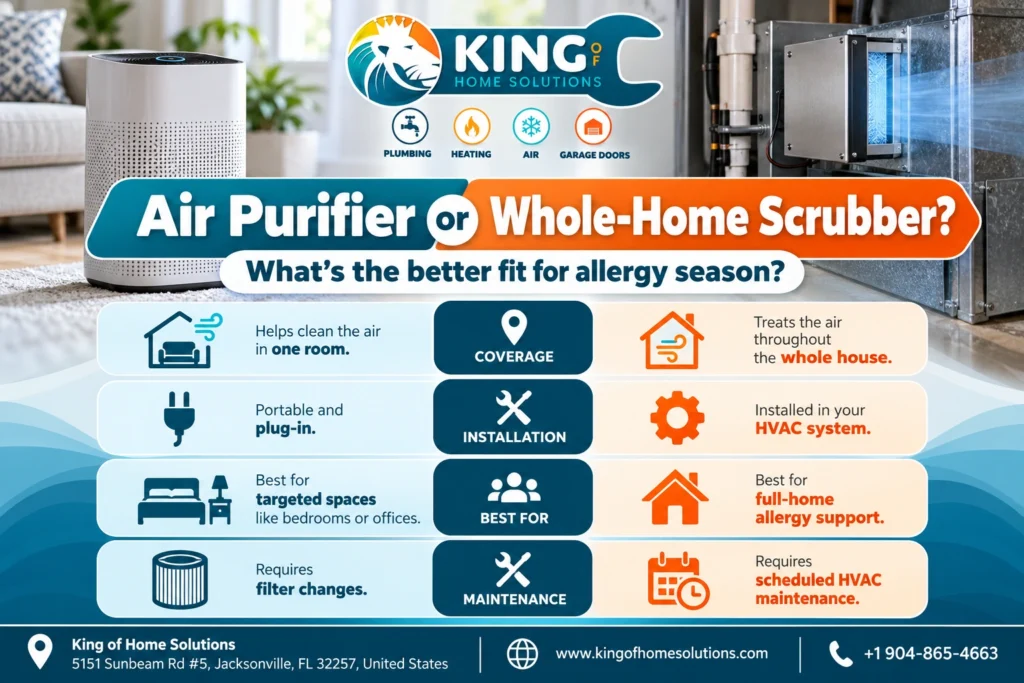
Jacksonville Humidity Changes the Indoor Allergy Problem
Pollen isn’t the only issue.
Jacksonville’s humidity can also support dust mites and mold when indoor moisture is not properly controlled.
EPA recommends keeping indoor relative humidity below 60% and advises using a dedicated dehumidification strategy when humidity remains consistently above that level in a warm, humid climate.
This means neither a $300 HEPA purifier nor a $3,000 whole-home scrubber fixes an underlying moisture problem.
If the indoor humidity sits at 65% all summer because the AC is oversized or the house has excessive outdoor-air leakage, address the moisture.
If mold is growing around an air handler because the drain pan remains wet, fix the drainage.
Air cleaning can remove some airborne particles.
It cannot repair the conditions producing them.
What Does a Whole-Home System Cost?
Whole-home air-cleaning prices vary dramatically because the category includes everything from upgraded media filters to complex electronic purification systems.
Current 2026 estimates put many professionally installed whole-house filtration systems around $419 to $4,962, depending on the filtration technology and installation complexity.
Whole-home purifier projects average around $2,600 in some current national estimates, although premium systems and complicated duct modifications can cost considerably more.
A portable HEPA solution will generally have a much lower entry cost because there is no HVAC modification or installation labor.
However, you may eventually need several units to cover multiple rooms.
And both approaches have recurring filter costs.
Which One Is Better for Jacksonville Allergies?
If your primary concern is pollen in the bedroom, start with a correctly sized portable HEPA purifier.
It is relatively inexpensive, easy to measure using CADR, and concentrates filtration exactly where you sleep.
If you want particle filtration throughout the entire house, investigate an upgraded central media filter or whole-home filtration system that your HVAC equipment can actually support.
If a contractor recommends a “scrubber,” find out exactly what technology is inside it.
Do not buy the word.
Buy the verified performance.
And in many Jacksonville homes, the strongest approach may be a combination:
A correctly sized central HVAC filter for the whole house, plus a HEPA purifier in the bedroom for additional filtration during peak pollen periods.
The Bottom Line
For Jacksonville allergy season, portable HEPA purifiers have one major advantage: we already understand how they remove particles.
Air goes in.
Pollen gets trapped in a filter.
Cleaner air comes out.
Whole-home systems can be extremely useful too particularly when they use effective mechanical filtration and are correctly integrated with the HVAC system.
But “whole-home scrubber” can describe several very different technologies.
Some filter particles.
Some use UV.
Some use ionization.
Some combine multiple approaches.
And more complicated does not automatically mean more effective for pollen.
Start with the allergen you’re trying to control.
Keep Jacksonville pollen outside whenever possible.
Use adequate HVAC filtration.
Control indoor humidity.
Choose a properly sized HEPA purifier where targeted filtration is needed.
Then consider additional whole-home technology only when you understand exactly what it adds.
Because during Jacksonville’s long allergy seasons, the goal isn’t to own the most sophisticated air-cleaning system.
It’s to keep as much pollen as possible out of the air you’re actually breathing.