Serving The Jacksonville Area



Why Your “Hurricane-Proof” Garage Door Is Actually Vibrating
Why Your “Hurricane-Proof” Garage Door Is Actually Vibrating
You paid extra for a reinforced garage door.
It has heavier panels, additional struts, stronger tracks, upgraded hardware, and maybe even a wind-load rating designed for severe storms.
Then a strong gust hits the house and the door starts vibrating.
That can be unsettling.
After all, wasn’t the whole point of buying a “hurricane-proof” garage door to make it feel solid?
The answer is more complicated than most homeowners expect.
First, no residential garage door is literally “hurricane-proof.” The more accurate terms are wind-rated, wind-resistant, or impact-rated, depending on the specific testing and certification.
Second, a reinforced garage door can still flex, hum, rattle, or vibrate when strong pressure is applied to a large surface.
The important question is not:
It is:
“Is the movement within normal limits, or is something loose, misaligned, or structurally compromised?”
That distinction matters.
A Garage Door Is Basically a Giant Sail
Think about the size of a typical double garage door.
A common door may be around 16 feet wide and 7 feet tall.
That is more than 100 square feet of surface area facing the wind.
During a tropical storm or hurricane, wind pressure acts across that entire surface.
Even a heavily reinforced door may experience some deflection.
That does not automatically mean the door is weak.
Engineered systems are often designed to tolerate controlled movement while still resisting the loads they are rated for.
A perfectly rigid door would require dramatically heavier materials and structural support.
So some movement can be normal.
The problem begins when vibration becomes excessive, uneven, or accompanied by other warning signs.
Why Reinforcement Can Make the Vibration Sound Worse
This surprises homeowners.
A reinforced door can sometimes sound louder during vibration than a lighter door.
Why?
Because reinforcement adds more metal.
Wind-rated garage doors may include:
- Horizontal steel struts
- Heavier hinges
- Reinforced tracks
- Additional brackets
- Stronger jamb attachments
- Vertical bracing systems
- Thicker panels
When wind pressure causes the door to move slightly, those components can transmit vibration through the entire system.
The result may be:
- Humming
- Buzzing
- Metallic rattling
- Panel vibration
- Track noise
- Bracket chatter
The door may actually be performing normally while sounding more dramatic than expected.
That said, persistent rattling in calm weather deserves inspection.
Wind Pressure Changes Constantly
Hurricane-force winds are not steady.
They gust.
They drop.
They change direction.
They move around corners and over rooflines.
The pressure on your garage door can change second by second.
That repeated loading can make a large door move inward and outward slightly.
You may see the panels flex.
You may hear the reinforcement struts vibrate.
You may notice the door shake when a particularly strong gust hits.
This does not necessarily mean the door is about to fail.
But excessive panel bowing, track movement, or hardware separation is different.
A wind-rated door should remain connected to its supporting structure.
The tracks, brackets, fasteners, and jamb attachments are just as important as the panels themselves.
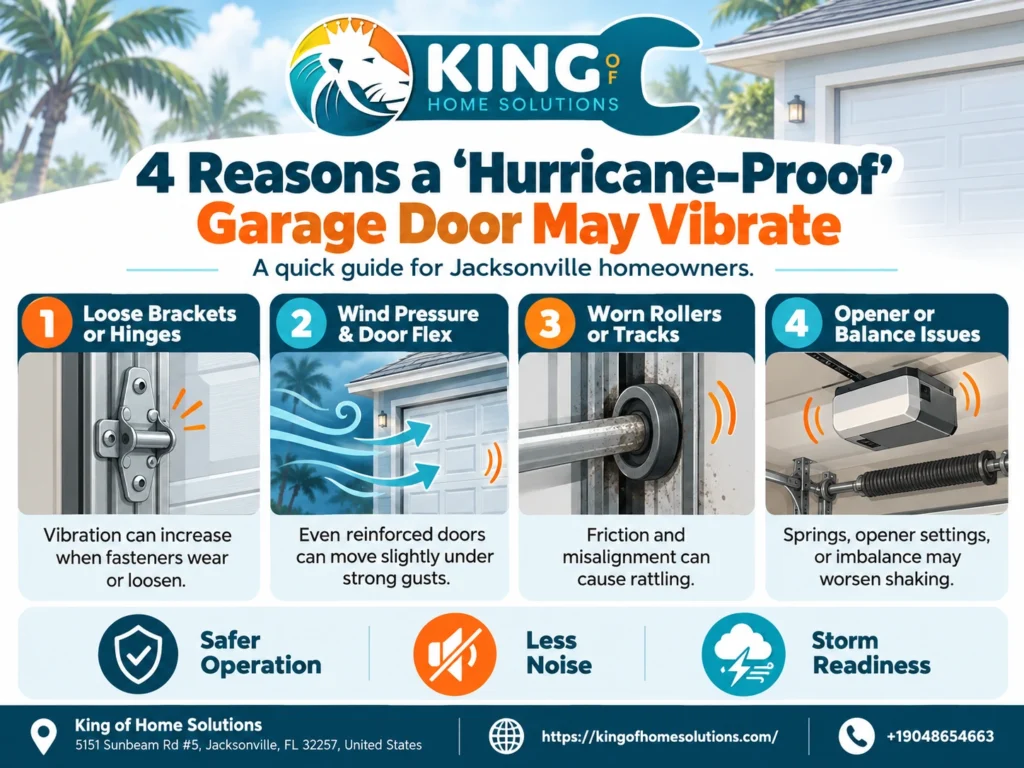
Loose Hardware Is One of the Most Common Causes of Vibration
A garage door contains a surprising number of moving parts.
Every cycle creates vibration.
Over time, bolts and fasteners can loosen.
Now add wind pressure.
A slightly loose bracket that was barely noticeable during normal operation can begin rattling loudly during a storm.
Common vibration points include:
- Track brackets
- Hinges
- Reinforcement struts
- Opener mounting brackets
- Jamb fasteners
- Roller stems
- Header attachments
A loose component does not always mean the entire door is unsafe.
But it should not be ignored.
The problem with repeated vibration is that it can gradually make loose hardware worse.
What begins as a small rattle can eventually become a larger alignment or structural problem.
The Opener May Be Adding to the Shaking
Sometimes the garage door itself gets blamed for vibration that is actually coming from the opener.
Ceiling-mounted garage door openers are attached to framing through metal brackets.
If those brackets are loose, every movement of the opener can transmit vibration into the ceiling.
You may notice:
- Shaking near the opener rail
- Loud humming overhead
- Brackets vibrating
- Ceiling vibration
- Movement when the motor starts
A heavier wind-rated door can make this more noticeable if the opener is poorly mounted or mismatched to the door.
The opener should guide a properly balanced garage door.
It should not be struggling to pull the full weight of the door.
If the door shakes significantly during normal opening and closing, the problem may involve balance, rollers, tracks, or opener installation rather than wind resistance.
Reinforcement Struts Can Rattle
Horizontal struts are commonly added to strengthen wide garage door sections.
They help resist bending and support the panels.
But if a strut is loose or improperly attached, it can vibrate against the door.
This may create a metallic buzzing sound, especially during wind gusts.
You may hear the noise even when the door itself does not appear to move much.
That is why a visual inspection matters.
A technician can check whether the struts are secure, properly placed, and compatible with the door’s engineering.
Do not remove reinforcement simply because it is noisy.
Those components may be part of the door’s wind-load design.
Track Movement Is More Concerning
A little panel vibration is one thing.
Tracks moving away from the wall are another.
The garage door transfers wind loads into:
- Tracks
- Brackets
- Framing
- Header
- Jambs
- Anchor points
If those attachment points are weak, even a strong door panel can fail.
Watch for:
- Track brackets pulling away
- Fasteners backing out
- Cracks around mounting points
- Tracks visibly flexing
- Rollers approaching the edge of the track
- Gaps forming between brackets and framing
Those are not normal vibration noises.
They suggest the supporting structure may be moving.
That deserves professional attention.
Poor Installation Can Undermine a Strong Door
A wind-rated garage door is only as strong as its installation.
The manufacturer may design the door to resist a specific pressure.
But the field installation still matters.
Wrong fasteners.
Improper spacing.
Weak framing.
Missing reinforcement.
Incorrect track hardware.
These mistakes can reduce the real-world performance of the system.
That is why the label on the door is not the entire story.
A “hurricane-rated” door installed incorrectly may perform worse than expected.
If you recently purchased a home and are unsure whether the garage door was installed according to its approved design, having it inspected can provide valuable peace of mind before storm season.
Is the Door Actually Impact-Rated?
Another source of confusion is terminology.
A wind-rated door is not necessarily an impact-rated door.
Wind rating refers to the door’s ability to resist pressure.
Impact rating refers to its ability to withstand specified debris impacts under testing conditions.
Some systems meet both requirements.
Others do not.
A door can be reinforced against wind pressure and still require additional protection in areas where impact resistance is required.
This does not directly cause vibration, but it matters when homeowners assume that every reinforced door provides the same level of storm protection.
Check the product documentation instead of relying on the phrase “hurricane-proof.”
Vibration in Calm Weather Is a Different Problem
If the garage door shakes only during major wind events, pressure loading may be the main explanation.
If it shakes every morning when you open it, you probably have a mechanical issue.
Possible causes include:
- Worn rollers
- Dirty tracks
- Bent tracks
- Loose hinges
- Poor door balance
- Spring problems
- Opener vibration
- Misaligned hardware
A wind-rated label does not eliminate normal garage door maintenance.
The heavier and more reinforced the door, the more important proper balance becomes.
When Should You Be Concerned?
Call a garage door professional if you notice:
- Violent movement
- Panels visibly buckling
- Tracks pulling away
- Broken or loose reinforcement
- Rollers leaving the tracks
- Gaps around mounting brackets
- The door moving unevenly
- Loud popping noises
- Loose cables
- Broken springs
- Shaking during calm weather
Do not attempt to adjust high-tension springs, cables, or structural reinforcement yourself.
Those components can be dangerous.
The Bottom Line
A wind-rated or “hurricane” garage door can still vibrate.
That alone does not mean it is defective.
You are dealing with a very large surface exposed to changing wind pressure.
Some movement, humming, or light rattling may simply be the door absorbing and transferring those forces.
What matters is how the system moves.
Minor panel flex is different from tracks separating from the wall.
A vibrating reinforcement strut is different from a structural bracket pulling out of the framing.
And a door that rattles only during strong gusts is different from one that shakes every time you press the opener.
If your reinforced garage door starts vibrating, do not assume the expensive upgrade failed.
But do not ignore dramatic movement either.
Have the hardware, tracks, reinforcement, balance, and mounting points inspected.
Because the real strength of a hurricane-rated garage door is not just in the panels.
It is in the entire system that keeps those panels attached to your house when the wind starts pushing.