Serving The Jacksonville Area



5 Common Garage Door Spring Failures in Florida’s Salt Air
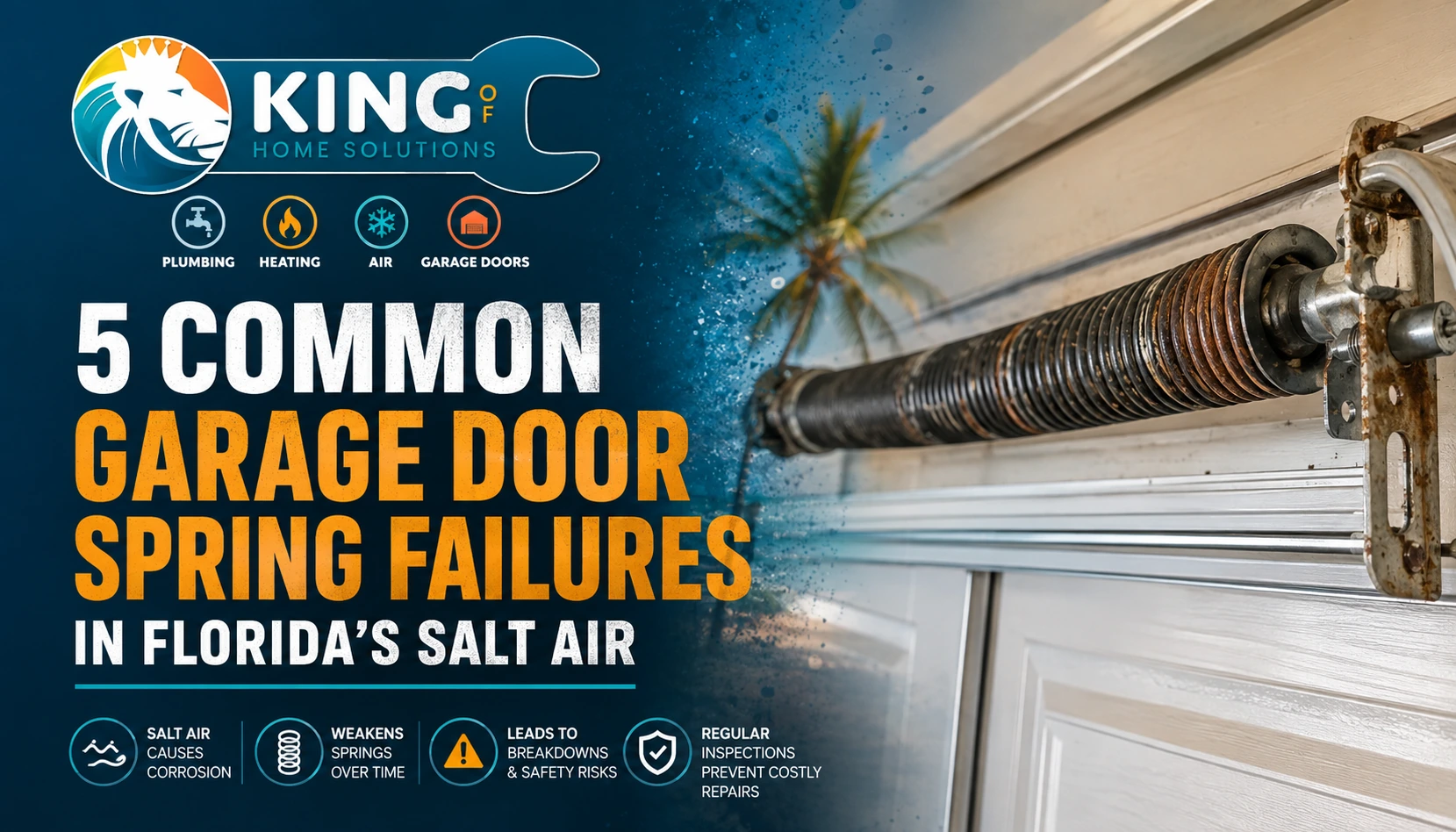
5 Common Garage Door Spring Failures in Florida’s Salt Air
Garage door springs in Florida face a harsher environment than many homeowners realize. Airborne salt, year-round humidity, intense heat, and sudden temperature changes can weaken spring components, accelerate corrosion, and increase the risk of premature failure.
A garage door spring may look like a simple coil of metal, but it performs one of the most demanding jobs in the entire system. Every time the door opens or closes, the spring supports much of the door’s weight.
When rust, moisture, and coastal air begin affecting the metal, the spring can lose strength before the damage becomes obvious.
At King of Home Solutions, we encourage Florida homeowners to pay attention to small changes in how their garage door moves, sounds, and feels. Spring problems rarely improve on their own. Recognizing the warning signs early may help prevent the door from becoming stuck, moving unevenly, or failing unexpectedly.
Stop Spring Failure Before It Gets Worse
Salt air can weaken your garage door springs fast. Call now for professional inspection and repair.
Why Florida Salt Air Is Hard on Garage Door Springs
Florida’s coastal environment contains airborne salt particles that can settle on exposed metal surfaces. Homes near the ocean, Intracoastal Waterway, rivers, and other coastal areas may experience the strongest effects, but salt can also travel inland.
Salt attracts and holds moisture. Once it settles on a garage door spring, it can keep the metal damp for longer periods, creating favorable conditions for oxidation, commonly known as rust.
Humidity adds to the problem. A garage may feel dry compared with the outdoors, but warm, moist air enters whenever the door opens. Garages without climate control can remain humid for hours, especially during rainy periods and summer months.
Garage door springs are also under constant tension. Corrosion is particularly concerning in a tightly wound spring that repeatedly twists, contracts, and supports a heavy door. Even minor surface damage can become a weak point under repeated stress.
The following five spring failures are especially common in Florida’s salt-heavy air.
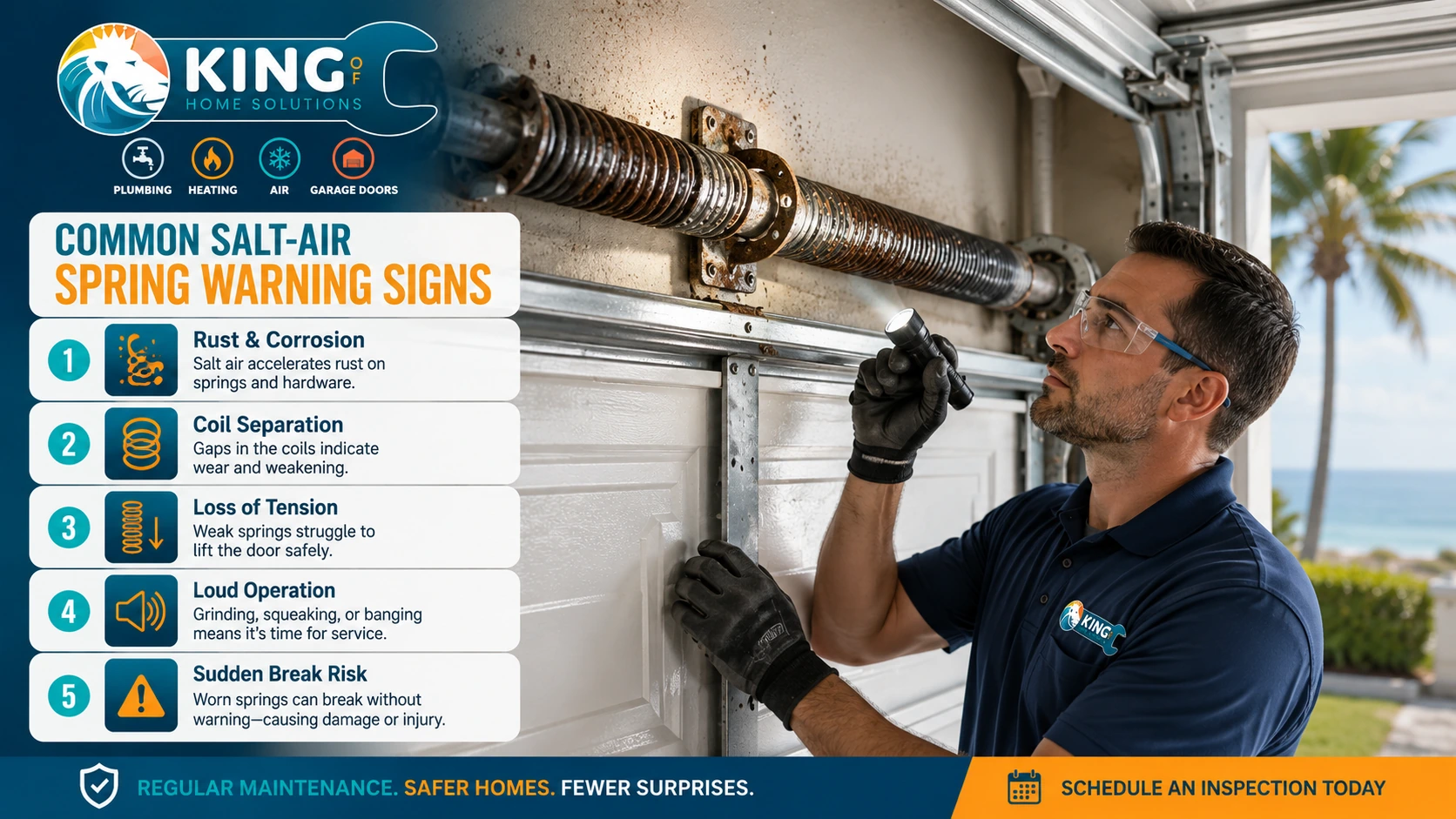
1. Surface Rust That Weakens the Spring
Surface rust is often the first visible sign that salt and moisture are affecting a garage door spring.
At first, the rust may appear as small orange or brown spots along the coils. Homeowners may assume the damage is only cosmetic, but corrosion gradually reduces the metal’s thickness and strength.
A garage door spring depends on consistent strength throughout the coil. When corrosion creates weak areas, the spring may no longer distribute tension evenly. One section can begin carrying more stress than another, increasing the risk of cracking or breaking.
Rust may also create friction between the coils. As the spring moves, rough metal surfaces may rub against one another instead of moving smoothly, creating additional heat and wear.
Common signs of surface corrosion include:
- Orange or brown discoloration
- Flaking metal
- Rough or pitted spring coils
- Squeaking or grinding sounds
- Small piles of rust-colored debris
- A garage door that feels heavier than usual
Rust may develop faster when the garage door remains open for long periods, allowing humid, salt-laden air to circulate around the spring. Water intrusion, roof leaks, and poor ventilation can also worsen corrosion.
Light surface rust does not always mean the spring requires immediate replacement, but it should be inspected. Once corrosion has weakened the metal, lubricant cannot restore the lost strength.
2. Spring Breakage Caused by Corrosion Fatigue
One of the most dramatic garage door spring failures is a complete break.
When a torsion spring snaps, homeowners may hear a loud bang from the garage. The sound can resemble an object striking the door or falling from a shelf. In many cases, it is the sudden release of stored spring tension.
Springs naturally wear out after a certain number of opening and closing cycles. Salt corrosion can shorten that service life by weakening the steel.
Each time the garage door operates, the spring bends and twists. This repeated movement creates normal metal fatigue. When rust is present, small pits may form on the spring’s surface. These pits concentrate stress in specific areas.
Eventually, a crack may form and spread through the coil, causing the spring to break with little warning.
Signs of a broken torsion spring may include:
- A visible gap in the spring
- A garage door that will not open
- An opener that lifts the door only a few inches
- A door that feels extremely heavy
- Loose cables
- The top section of the door bending when the opener runs
- A loud bang heard earlier in the garage
Do not force the door open when a spring has broken. The opener is not designed to lift the full weight of the door without spring assistance.
Continuing to operate the door may damage the motor, rail, belt, chain, cables, panels, or other components.
A broken spring also presents a serious safety risk. Garage door springs are under high tension and should only be handled with the proper tools, training, and procedures.
3. Loss of Spring Tension
A garage door spring does not have to break completely to fail. It may gradually lose tension and become unable to balance the door correctly.
This type of failure can develop as the metal weakens from age, heat, repeated use, and corrosion. Salt air may accelerate the process by reducing the spring’s structural strength.
A properly balanced garage door should remain relatively stable when manually lifted to about halfway. If the door slowly falls, rises on its own, or refuses to stay in position, the spring system may no longer be providing the correct support.
Loss of tension makes the garage door opener work harder. The motor may have to pull more weight during every cycle, increasing wear on opener components.
Homeowners may notice:
- The door opening more slowly
- The door closing faster than usual
- The opener sounding strained
- The door stopping during operation
- The door feeling unusually heavy
- The door drifting downward when partially open
- Increased vibration
In a two-spring system, one spring may lose tension faster than the other. This can create an imbalance even when neither spring has broken.
Adjusting spring tension is not a safe do-it-yourself project. Adding or removing tension requires controlled movement of a spring that stores significant force.
A professional technician can determine whether adjustment is appropriate or whether corrosion and fatigue make replacement the safer option.
4. Uneven Spring Wear and Door Imbalance
Salt exposure is not always uniform. One side of the garage may receive more moisture, wind, or rain than the other. A small leak or opening may also allow humid air to repeatedly reach one spring.
As a result, one spring may corrode or weaken faster than its matching spring.
Uneven spring wear can cause the garage door to lift at an angle. One side may rise faster than the other, placing stress on the tracks, rollers, cables, hinges, and opener.
A crooked door may bind in the tracks or create gaps along the bottom seal. In more severe cases, rollers may leave the track or cables may become tangled around the drums.
Warning signs of uneven spring performance include:
- One side of the door sitting lower than the other
- Shaking during movement
- Uneven gaps beneath the door
- Rollers rubbing against the track
- Scraping sounds on one side
- Cables appearing tighter on one side
- The door becoming stuck partway
Uneven movement should be addressed promptly. Continuing to operate an unbalanced door may damage components that were originally in good condition.
When one spring fails in a two-spring system, homeowners often ask whether only the damaged spring can be replaced. In many cases, replacing both springs may be more practical because they were installed at the same time, completed a similar number of cycles, and experienced the same environmental conditions.
Replacing only one aging spring may lead to another service call if the second spring fails soon afterward.
5. Corroded Spring Connections and Hardware
The spring itself is not the only component vulnerable to Florida salt air. The hardware supporting the spring system can also corrode.
Torsion spring systems may include:
- Winding cones
- Stationary cones
- Anchor brackets
- Center bearings
- Drums
- Shafts
- Set screws
- Mounting hardware
Extension spring systems may include hooks, pulleys, cables, and safety cables.
Salt and moisture can cause these parts to rust, seize, loosen, or weaken.
For example, a corroded winding cone may no longer grip the spring securely. Rusted set screws may become difficult to remove or may fail to hold the shaft properly. A weakened bracket may shift under tension.
Spring hardware problems may cause:
- Loud clicking or popping
- Irregular spring movement
- A shaking torsion shaft
- Loose or slipping cables
- Visible movement in mounting brackets
- Rust around screws and connection points
- Grinding during operation
A spring may still appear intact while the surrounding hardware is close to failure. That is why a complete garage door inspection should include more than a quick look at the coils.
A technician should examine the springs, mounting points, cables, drums, rollers, tracks, hinges, and opener. The entire system works together, and one corroded component can affect the others.
Insulated vs. Non-Insulated Garage Doors: Understanding the “Garage Sweat” Problem
You open the garage on a humid morning and notice water beads across the inside of the door. The panels…
Read The BlogHow Long Do Garage Door Springs Last in Florida?
Garage door spring life is usually measured in cycles rather than years. One cycle includes opening and closing the door once.
Many standard springs are rated for approximately 10,000 cycles. A household that uses the garage door four times per day may reach that number in roughly seven years. Homes that use the garage as the primary entrance may complete far more cycles each day.
Florida conditions may shorten the spring’s practical lifespan.
Salt exposure, humidity, insufficient lubrication, poor spring quality, incorrect sizing, and door imbalance can all accelerate wear. A spring may fail earlier than expected even when it has not reached its advertised cycle rating.
Homeowners should not rely on age alone. A five-year-old spring with heavy corrosion may be in worse condition than an older spring in a cleaner, drier environment.
Regular inspections provide a better picture of the spring’s condition.
Can Lubrication Prevent Salt-Air Damage?
Proper lubrication can help reduce friction and provide some protection against moisture, but it cannot restore a damaged spring.
A garage door lubricant designed for metal moving parts can be applied lightly to torsion springs, hinges, rollers, and other approved components. Thick grease is generally not ideal because it can collect dirt, sand, and debris.
Lubrication may help:
- Reduce coil friction
- Lower operating noise
- Limit moisture exposure
- Support smoother movement
- Slow minor surface oxidation
However, lubricant should not be used on a severely rusted spring as a substitute for inspection. It cannot rebuild weakened metal or prevent a cracked spring from breaking.
Homeowners should also avoid using products that are not intended for garage doors. Some general-purpose sprays may displace moisture or clean surfaces without providing suitable long-term lubrication.
How Florida Homeowners Can Protect Garage Door Springs
Preventive care is especially important in coastal environments.
Homeowners can reduce spring wear by keeping the garage and surrounding area as dry and clean as possible. After heavy storms or strong winds, inspect the garage for moisture intrusion and visible salt residue.
Helpful maintenance steps include:
- Schedule regular garage door inspections
- Keep weather seals in good condition
- Repair roof or wall leaks near the garage
- Avoid leaving the garage door open unnecessarily
- Clean visible salt residue from metal components
- Use an approved garage door lubricant
- Test the door’s balance periodically
- Listen for new noises
- Address uneven movement promptly
- Replace worn rollers, cables, and hardware
Do not touch, loosen, or adjust spring components during an inspection. Visual checks may be helpful, but any work involving spring tension should be left to trained professionals.
When Should You Call for Garage Door Spring Service?
Call for professional service if the door becomes heavy, crooked, noisy, slow, or difficult to operate.
A visible gap in the spring, loose cable, severe corrosion, or loud bang requires prompt attention.
Stop using the opener if the door is not moving normally. Repeated operation can turn a spring problem into more extensive damage involving the opener, panels, tracks, rollers, or cables.
A technician can inspect the system, identify the cause, and determine whether the spring requires adjustment or replacement.
Protect Your Garage Door From Florida’s Coastal Air
Florida’s salt air can damage garage door springs through surface corrosion, metal fatigue, tension loss, uneven wear, and weakened hardware.
These problems may begin gradually, but they can eventually leave the door stuck, unbalanced, or unsafe to operate.
At King of Home Solutions, we help homeowners identify spring problems before they lead to a larger garage door failure. We inspect the springs, cables, tracks, hardware, and opener so the recommendation is based on the condition of the entire system rather than one visible symptom.
If your garage door is making unusual noises, moving unevenly, feeling heavier, or showing signs of rust, contact King of Home Solutions. Our team can evaluate the system, explain the available options, and help restore safe, dependable operation in Florida’s demanding coastal environment.
Garage Door Spring Showing Signs of Rust?
Florida’s salty air can lead to corrosion and sudden spring failure. Get it checked before your door stops working.