Serving The Jacksonville Area


The Homeowner’s Guide to JEA Water Quality Reports
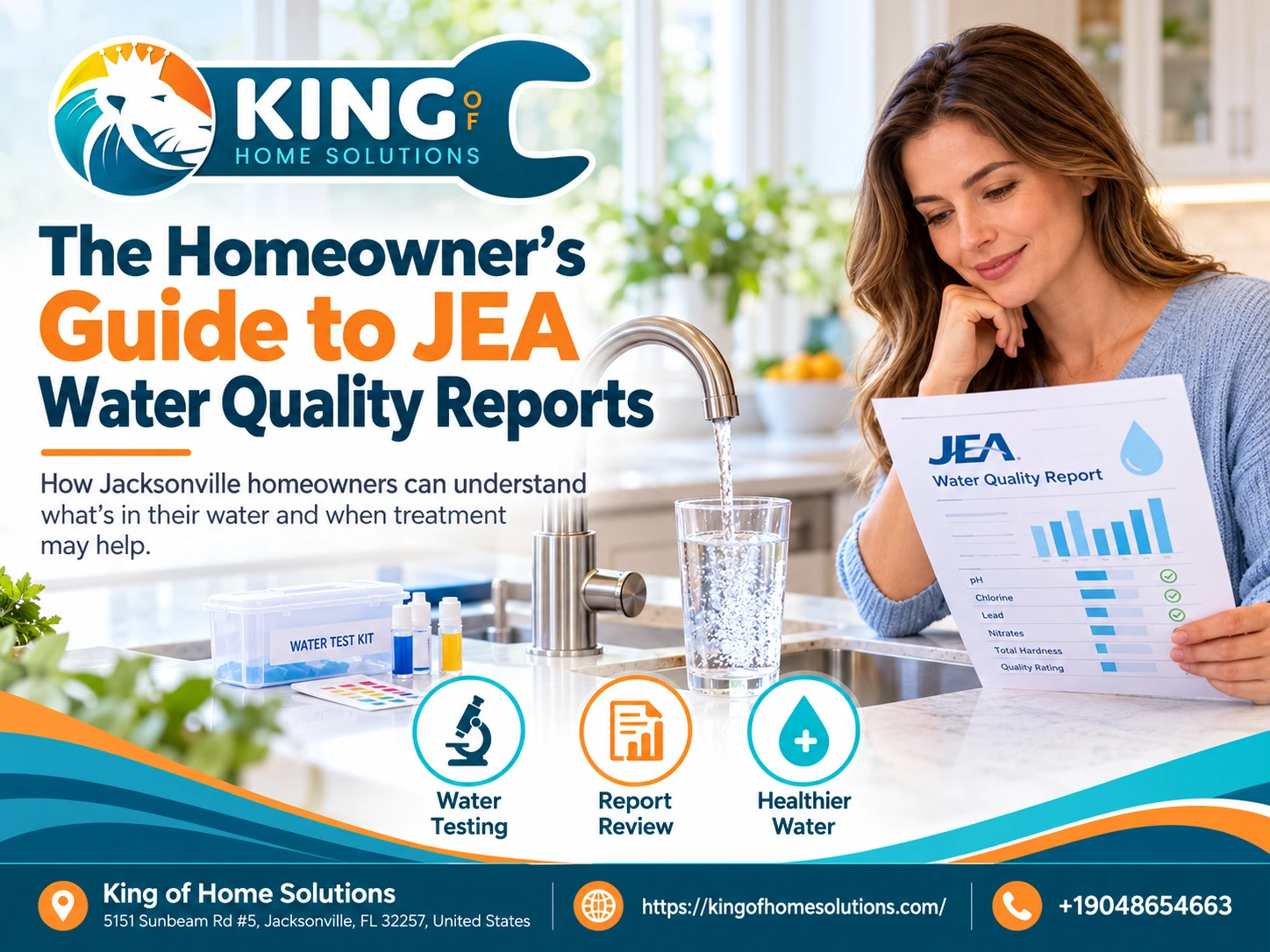
The Homeowner’s Guide to JEA Water Quality Reports
Your annual JEA Water Quality Report lands in your inbox.
You open it.
Then you see:
MCL. MCLG. MRDL. ppb. 90th percentile. TTHM. HAA5.
And five minutes later, you’re wondering whether you need a water softener, a reverse-osmosis system or a chemistry degree.
JEA’s annual report contains a huge amount of useful information. The problem is that regulatory water reports are written partly to satisfy federal reporting requirements, not simply to answer the questions most Jacksonville homeowners actually have:
Is my water safe?
Why does it leave white scale everywhere?
What’s that chlorine smell?
Should I buy a filter?
Does the report tell me what’s coming out of my particular kitchen faucet?
Here is how to read the JEA Water Quality Report without getting lost in the abbreviations.
First: What Exactly Is the JEA Water Quality Report?
The report is JEA’s version of what EPA calls a Consumer Confidence Report, or CCR.
Community water systems are required to provide customers with an annual drinking-water quality report. EPA says these reports identify the source of the water, regulated contaminants that were detected, how measured levels compare with regulatory limits, and information about any violations.
JEA publishes its reports annually, generally by July 1, with the report named for the year in which most of the testing occurred. So the 2025 JEA Water Quality Report, available in 2026, primarily covers monitoring conducted from January 1 through December 31, 2025, although some contaminants are tested less frequently and therefore show older sample dates.
That older date does not automatically mean JEA forgot to test something.
Different contaminants have different regulatory monitoring schedules.
Where Does Jacksonville’s Drinking Water Come From?
For most JEA customers, the answer is the Floridan Aquifer.
JEA says its wells draw groundwater from roughly 1,000 feet below the surface. At its treatment plants, the water is aerated to remove sulfur-related odor, disinfected with chlorine and then distributed through the water system. Two plants also use ozone for additional sulfide removal and taste-and-odor control.
JEA’s Major Grid serves most of Duval County and parts of northwest St. Johns County. JEA also operates or supplies several other areas, including Mayport, Yulee and portions of the coastal St. Johns County corridor.
That leads to Rule #1 when reading the report:
Make sure you’re looking at the section for the water system that actually serves your home.
Not every number in the report applies to every JEA customer.
The Most Important Column: “Violation”
If you only understand one part of the table, start here.
A row marked:
Violation: No
means the reported result did not constitute a violation of the applicable regulatory standard shown for that contaminant.
That does not mean the contaminant measured absolute zero.
It means the utility remained within the applicable regulatory requirement.
That’s why simply seeing a chemical name in the report should not immediately scare you.
EPA requires water reports to disclose regulated contaminants that are detected. The entire point of the table is to compare the measured amount with the relevant standard.
The number by itself means very little until you compare it with the limit.
What Does MCL Mean?
MCL = Maximum Contaminant Level.
EPA defines this as the highest level of a contaminant allowed in drinking water under the regulation. MCLs are set as close as feasible to health-based goals while accounting for available treatment technology.
Suppose the report says:
Your water: 20 ppb
MCL: 80 ppb
That does not mean the water is 25% unsafe.
It means the measured value is below the regulatory maximum.
The comparison is what matters.
What About MCLG?
This one confuses homeowners.
MCLG = Maximum Contaminant Level Goal.
It is a health-based goal rather than an enforceable treatment limit. EPA defines it as the level below which there is no known or expected health risk, with a margin of safety.
For some contaminants particularly lead the MCLG is zero.
That doesn’t mean a utility automatically violates federal regulations if one sample detects a microscopic amount.
Lead is regulated using an Action Level system rather than a conventional MCL at the consumer’s tap.
Which brings us to another abbreviation.
What Is an “Action Level”?
An Action Level, or AL, is a concentration that triggers specific treatment or other regulatory requirements if the system exceeds the applicable threshold under the rule.
This is commonly seen in the lead-and-copper section.
JEA’s 2025 report includes results from tap-water sampling because lead and copper can enter drinking water through corrosion of plumbing materials after the water has entered the distribution and household plumbing system.
That distinction is extremely important.
A treatment plant can send compliant water into the street while an individual older home has a plumbing issue that affects water at one faucet.
A citywide report can therefore tell you how the system is performing.
It cannot completely certify every pipe inside your house.
Why Does the Lead Table Say “90th Percentile”?
This sounds more mysterious than it is.
Lead and copper compliance is not reported simply by averaging every home together.
The report includes a 90th-percentile result from sampled homes.
Think of it as a way of focusing attention toward the higher end of the sampling results rather than allowing a large number of very low measurements to hide elevated samples.
The report also tells you how many sampled locations exceeded the applicable action level.
That is a much more useful way to read the table than looking only at the word “lead” and becoming alarmed.
If you are concerned about the plumbing in your particular older Jacksonville home, however, your own tap test gives you information the citywide sampling program cannot.
Chlorine: Why You Can Sometimes Smell It
JEA disinfects drinking water with chlorine before it enters the distribution system.
That residual disinfectant serves an important purpose: helping control microbial contamination as the water travels through miles of pipes.
The report therefore includes a chlorine measurement and an MRDL.
MRDL means Maximum Residual Disinfectant Level the highest disinfectant concentration allowed under the applicable drinking-water rule.
Some homeowners can taste or smell chlorine at concentrations well below the regulatory maximum.
That is an aesthetic complaint, not automatically evidence of unsafe water.
If your primary complaint is chlorine taste or odor, activated-carbon filtration is generally more relevant than a water softener.
A softener and carbon filter solve different problems.
TTHMs and HAA5: The Long Names Everyone Googles
You’ll also see:
TTHM — Total Trihalomethanes
and
HAA5 — Haloacetic Acids
These are groups of disinfection byproducts that can form when disinfectants interact with naturally occurring organic material in water.
EPA regulates them.
In JEA’s 2025 report, the applicable limits shown are 80 ppb for TTHMs and 60 ppb for HAA5. Reported values vary by JEA grid and sampling location, which is why you need to read the correct system section rather than taking one number and applying it to the entire Jacksonville region.
This is another area where homeowners should resist interpreting the highest individual-looking number without understanding how compliance is calculated.
The report itself tells you whether the system was in violation.
The Number Jacksonville Homeowners Usually Care About Most Isn’t a Safety Limit
It’s hardness.
And this is where the difference between “safe water” and “water I enjoy living with” becomes obvious.
JEA’s current hardness map shows much of its Jacksonville service territory in the very hard category.
Examples include:
32202: approximately 14 grains per gallon
32207: approximately 17 grains per gallon
32216: approximately 20 grains per gallon
32225: approximately 18 grains per gallon
32256: approximately 20 grains per gallon
32258: approximately 17 grains per gallon
JEA classifies water above 180 ppm as very hard and explains that the hardness comes primarily from naturally occurring calcium and magnesium.
Hardness is why you may see:
White crust around faucets.
Cloudy shower doors.
Scale inside coffee makers.
Mineral deposits on fixtures.
Soap that seems difficult to rinse.
It isn’t generally treated as a drinking-water health violation.
It is a home-maintenance and comfort issue.
If hardness is the problem you’re trying to solve, you want to investigate a water softener, not simply a carbon drinking-water filter.
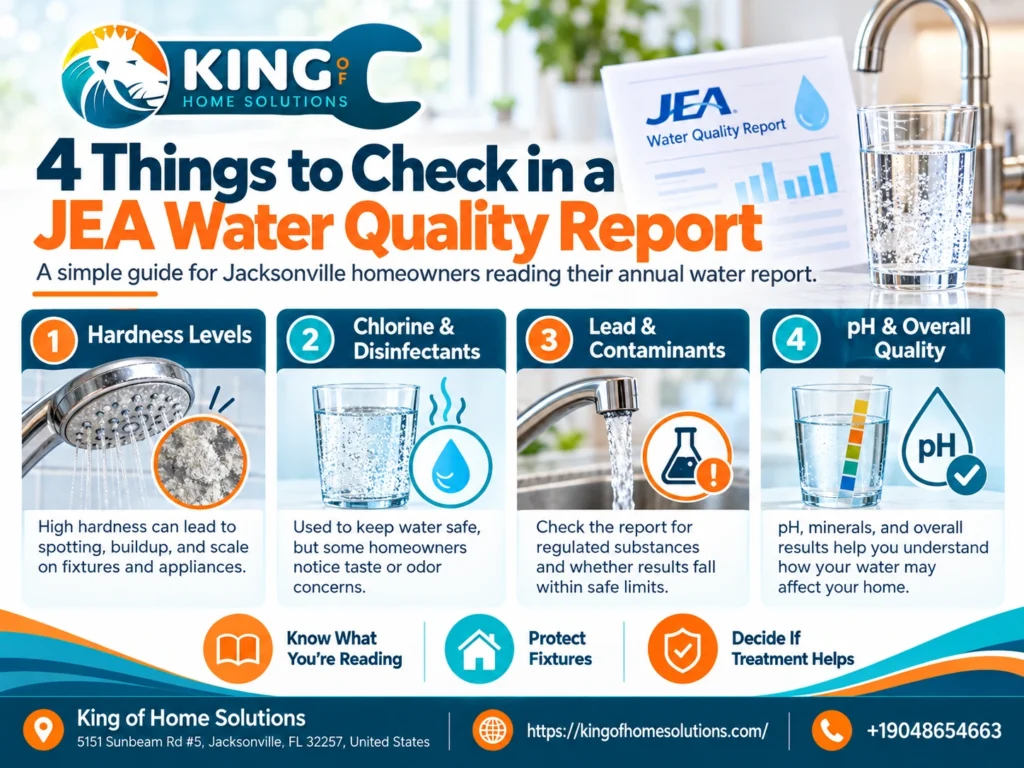
“Detected” Does Not Mean “Dangerous”
This is probably the single most important lesson in the whole report.
Modern laboratory equipment can measure substances at incredibly low concentrations.
A part per billion is tiny.
Seeing a chemical listed in a table does not by itself tell you whether it represents a significant risk.
Read across the row.
Look at:
Level detected
Range of results
MCL/MRDL or Action Level
Violation status
Likely source
Those columns together tell the story.
The chemical name alone doesn’t.
JEA says it tests for more than 100 bacteriological and chemical components and conducts roughly 45,000 water tests annually.
A report containing technical chemical names is therefore exactly what you would expect from a serious monitoring program.
Why Your Faucet Can Still Have a Problem When the JEA Report Looks Fine
The public water report describes the utility system.
Then the water reaches your property.
Now it may travel through:
- A service line
- Copper pipe
- Brass valves
- Galvanized plumbing
- Older solder
- A water heater
- A water softener
- Flexible supply connectors
Those components can alter water quality.
This matters particularly in older Jacksonville homes.
If you see blue-green staining, rusty water, metallic taste or unusual particles from only one fixture, the source may be inside the property rather than at the JEA plant.
The annual report cannot diagnose your bathroom sink.
So Do You Need a Water Treatment System?
Not simply because you read the JEA report.
Choose treatment based on the problem.
If your issue is white scale and mineral buildup, investigate softening.
If the complaint is chlorine taste or odor, activated carbon may make sense.
If you want additional contaminant reduction specifically for drinking and cooking water, an appropriately certified under-sink reverse-osmosis system may make sense.
If you have unexplained staining, corrosion or concerns about an older home’s plumbing, start with a proper water test before buying thousands of dollars of equipment.
Don’t let someone test your water hardness, show you some white residue and then imply that you’ve discovered a dangerous drinking-water contamination problem.
Those are two very different conversations.
The Bottom Line
The JEA Water Quality Report becomes much easier to read when you stop treating it like one giant pass-or-fail exam.
First, identify your JEA grid.
Then look at the violation column.
Compare detected levels with the applicable regulatory limits.
Understand that an MCL is different from an MCLG, and an Action Level is different again.
Pay particular attention to lead and copper if your home has older plumbing.
And treat hardness separately from drinking-water safety.
For most Jacksonville homeowners, the report should answer two different questions:
“Is JEA meeting regulated drinking-water standards?”
and
“Are there characteristics of my water that I still want to treat for comfort, taste or plumbing protection?”
Those questions can have different answers.
And that is the key to reading the report correctly.
A water-quality report tells you what is happening in the public water system. Your home’s pipes and your priorities determine what, if anything, you should do next.