Serving The Jacksonville Area


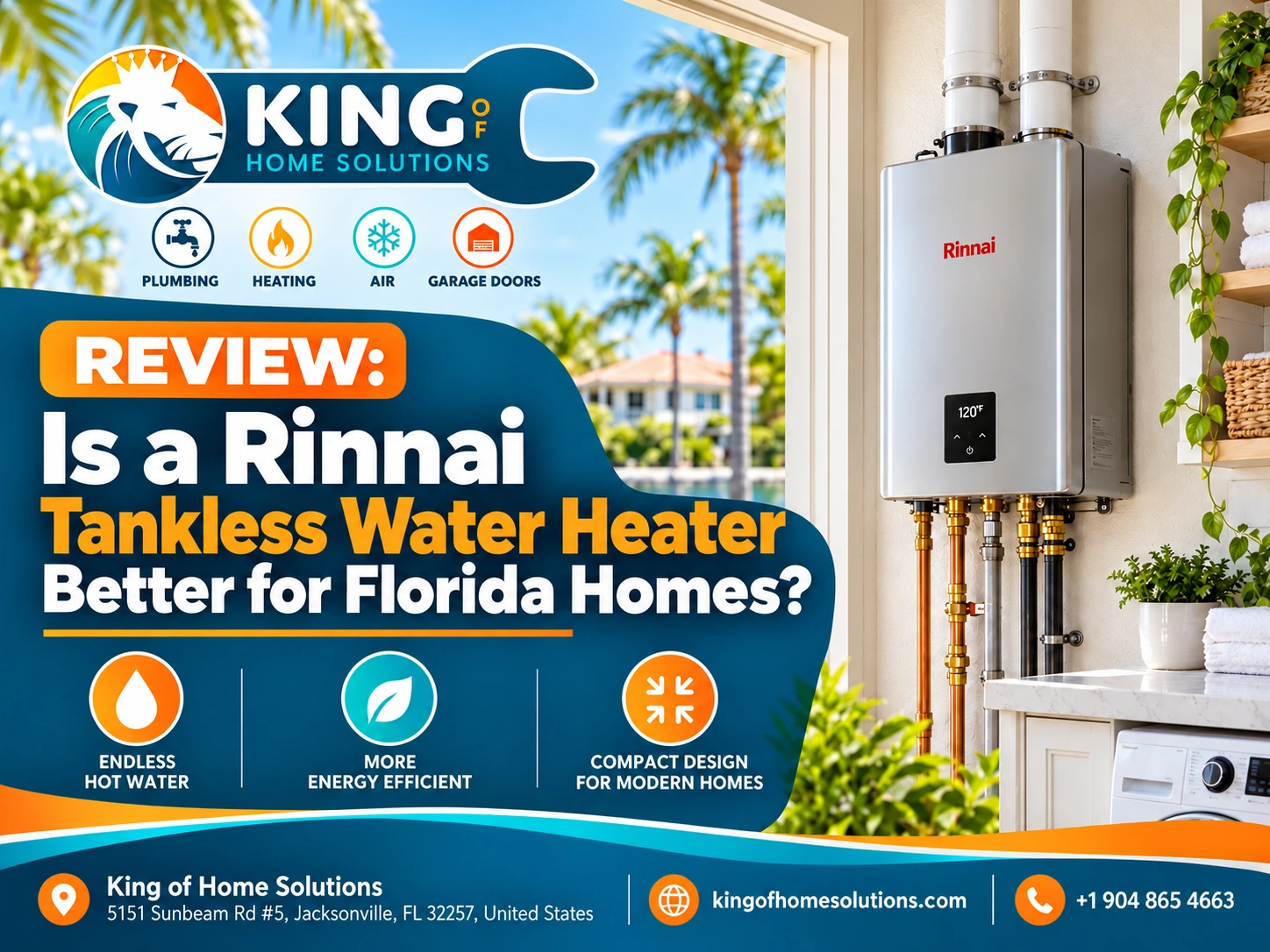
Review: Is a Rinnai Tankless Water Heater Better for Florida Homes?
Review: Is a Rinnai Tankless Water Heater Better for Florida Homes?
You’re replacing the water heater in your Florida home, and the plumber offers two very different choices.
Install another 50-gallon tank.
Or spend more upfront on a Rinnai tankless water heater and supposedly never run out of hot water again.
The tankless option sounds ideal.
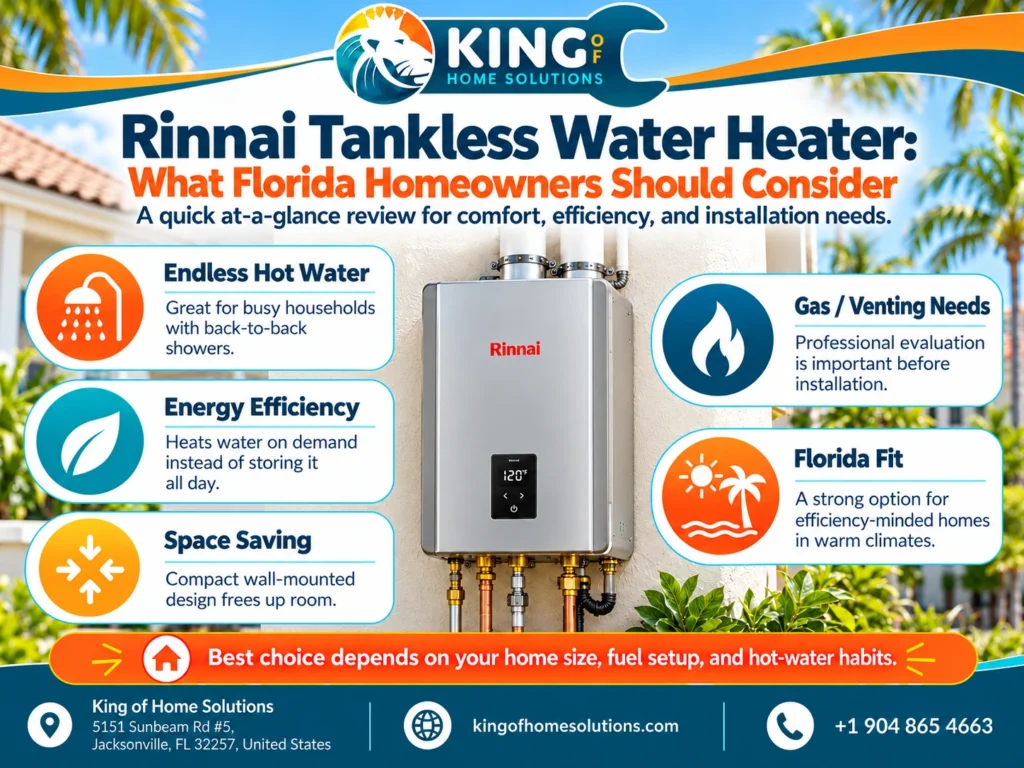
It takes up almost no floor space. It heats water only when you need it. Premium models can run multiple showers at once. Some even include hot-water recirculation.
But does Rinnai make more sense in Florida than it does elsewhere?
In many homes, yes.
Florida’s relatively warm incoming water can work in favor of a tankless heater because the equipment doesn’t need to create the enormous temperature rise required in colder northern climates. Rinnai’s high-end SENSEI RX199iN, for example, is rated up to 199,000 BTU, 11.1 GPM, and 0.98 UEF, although actual flow depends on incoming-water temperature and the required temperature rise.
But Florida also gives Rinnai one significant challenge:
hard water.
For Jacksonville homeowners in particular, that may be the factor that determines whether your expensive tankless unit performs beautifully for years or becomes a maintenance headache.
Why Florida’s Warm Water Gives Tankless an Advantage
Tankless water heaters don’t store 40 or 50 gallons of preheated water.
Cold water enters the heater when you open a faucet, and powerful burners raise that water to your selected temperature almost instantly.
How much hot water the unit can produce depends heavily on temperature rise.
Suppose incoming water is 45°F and you want 120°F water.
The heater must raise it to 75 degrees.
Now imagine the incoming water is considerably warmer.
The heater has less work to do.
That generally means a tankless system can provide more flow before reaching its maximum heating capacity.
Rinnai’s own technical specifications show that available flow changes with the required temperature rise.
That makes tankless technology particularly attractive in a warm climate.
A properly sized Rinnai in Florida may have an easier job supplying simultaneous showers than the same unit dealing with much colder incoming water farther north.
The Endless-Hot-Water Advantage Is Real
This is where Rinnai earns much of its appeal.
A conventional tank contains a limited amount of hot water.
Take two long showers.
Run the dishwasher.
Fill a large bathtub.
Eventually, you can exhaust the stored supply and have to wait for the tank to recover.
A properly sized tankless unit doesn’t work that way.
As long as the heater can meet the home’s simultaneous flow demand, it can continue producing hot water.
ENERGY STAR identifies continuous hot-water delivery as one of the major advantages of certified gas tankless systems.
For larger Florida families, vacation homes with frequent guests, or houses with big soaking tubs, this can be a noticeable upgrade.
But “endless” doesn’t mean unlimited capacity.
If your unit can provide enough heated water for two showers and someone suddenly starts a third shower, dishwasher, and washing machine simultaneously, demand can still exceed capacity.
Sizing matters.
Rinnai’s Condensing Models Are Impressively Efficient
Rinnai currently offers both condensing and non-condensing gas tankless heaters.
Its premium RX and RXP models carry a 0.98 Uniform Energy Factor, while current non-condensing RE-series models are closer to approximately 0.81 UEF.
That is a meaningful difference.
Condensing systems use an additional heat exchanger to extract more usable heat from the exhaust before venting it outside.
ENERGY STAR explains that certified condensing gas tankless heaters reduce standby losses and use more of the combustion energy than conventional gas tankless equipment.
If I were putting a Rinnai into a Florida house expected to keep the heater for many years, I would usually look seriously at the RX or RXP condensing series rather than choosing the cheapest available model.
Jacksonville Hard Water Is the Big Catch
Here is the issue that deserves far more attention during the sales conversation.
Jacksonville’s water is hard.
Very hard in many neighborhoods.
JEA currently reports water hardness by ZIP code, with many Jacksonville areas measuring roughly 11 to 20+ grains per gallon, and some portions of its service territory reaching approximately 22 grains per gallon. JEA classifies many of these readings as “very hard.”
Tankless heaters contain narrow heat-exchanger passages.
Heat plus mineral-rich water can create scale.
Over time, that mineral accumulation can reduce performance and efficiency.
Rinnai recommends flushing its tankless heaters at least once per year to remove mineral buildup.
For a Jacksonville Rinnai owner, I would not consider that an optional suggestion.
Annual descaling should be part of the ownership budget.
Depending on the specific water hardness and usage, a plumber may also recommend scale-control equipment or a water-softening strategy.
A tankless heater can last a long time.
But Jacksonville is not the place to install one and forget it exists for eight years.
Recirculation Can Fix the “Tankless Wait”
Another complaint homeowners sometimes have is:
“I bought tankless, but I still wait forever for hot water.”
That’s not necessarily a water-heater problem.
If the master bathroom is 70 feet of piping away from the heater, the cold water sitting inside that pipe still has to leave before newly heated water reaches the faucet.
Rinnai offers models with built-in recirculation pumps, including the RXP condensing series and REP non-condensing series. Its Smart-Circ technology can provide recirculation even in some homes without a traditional dedicated return line.
For larger Florida homes with long plumbing runs, I would strongly consider recirculation.
It may affect day-to-day satisfaction more than another small increase in efficiency rating.
Hurricane Season Exposes One Weakness
Here’s something Florida homeowners should know before replacing a tank.
Rinnai gas tankless heaters need electricity to operate.
They use electronic ignition, controls, sensors, and combustion equipment.
Rinnai confirms that during a power outage, its tankless water heaters will not operate unless backup power is available. The company supports battery-backup options for this reason.
That matters after hurricanes.
You might still have gas service but no hot water because the neighborhood has lost electricity.
A generator or compatible backup-power system can solve the problem.
But it needs to be part of the planning conversation.
What Does a Rinnai Tankless Installation Cost?
Tankless costs more upfront than simply swapping one storage tank for another.
Current 2026 national estimates put professional tankless installation around $1,400 to $3,900 in many situations.
Localized Jacksonville estimates are higher, roughly $2,500 to $5,350, with a typical estimate near $3,950 depending on installation complexity.
A conversion can become expensive if your house needs:
- A larger gas line
- New venting
- Condensate drainage
- Electrical receptacle work
- Plumbing relocation
- Recirculation modifications
- Old heater removal
- Permitting
A simple tank-to-tank replacement may cost considerably less.
So don’t buy tankless because someone promises that energy savings alone will immediately recover a $3,000 price difference.
ENERGY STAR estimates that a certified gas tankless heater can save a family of four about $95 per year compared with a standard gas storage heater.
The bigger reasons to choose Rinnai are often comfort, space, longevity, and hot-water capacity, not a lightning-fast financial payback.
What If Your Florida Home Is All-Electric?
This can completely change my recommendation.
Rinnai does not currently manufacture electric tankless water heaters; its residential tankless lineup uses natural gas or propane.
If your home has no natural gas service, installing propane simply to get a Rinnai may not be the smartest efficiency investment.
Florida’s warm climate is particularly favorable for heat-pump water heaters.
ENERGY STAR notes that heat-pump water heaters work especially well in warm climates and that garages can be excellent installation locations because the equipment can use warm surrounding air while providing some localized cooling and dehumidification.
For an all-electric Florida home, I would compare a high-efficiency heat-pump tank against converting to gas or propane before automatically choosing Rinnai.
So, Is Rinnai Better for Florida?
If you already have natural gas or propane: often, yes.
Florida’s warmer incoming water favors tankless performance.
Rinnai’s premium condensing models are highly efficient.
Large families can benefit from continuous hot water.
Outdoor-capable models can free up valuable garage or utility-room space.
And recirculation options can make large homes considerably more convenient.
But Jacksonville’s hard water creates a maintenance obligation.
And hurricane-related power outages mean backup electricity deserves consideration.
For an all-electric home, Rinnai becomes a less obvious winner because Florida is also an excellent climate for heat-pump water heaters.
The Bottom Line
My rating for a properly sized Rinnai condensing tankless heater in a Florida home with existing gas service:
Performance: 9/10
Efficiency: 9/10
Florida climate suitability: 9/10
Maintenance in Jacksonville hard water: 6/10
Upfront value: 7/10
Overall: 8.5/10
Would I install one?
Yes particularly a condensing RX or RXP model in a household with high hot-water demand.
But I would also install proper service valves, plan for annual flushing, verify the gas-line capacity, consider recirculation, and think about backup power before hurricane season.
Because the thing that makes Rinnai attractive in Florida isn’t simply the promise of “endless hot water.”
It’s that Florida gives a properly sized tankless heater favorable operating conditions as long as you don’t let Jacksonville’s mineral-heavy water quietly scale it from the inside.